Prices

February 19, 2019
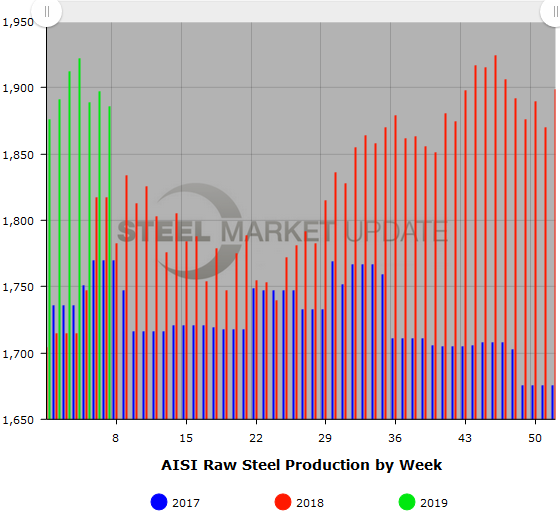
Mill Utilization Averaging Nearly 81 Percent in 2019
Written by Tim Triplett
The U.S. steel industry has produced 12,737,000 tons of steel so far in 2019, an 8.4 percent increase from the same period last year. Mill utilization has averaged 80.7 percent this year, up substantially from the 75.7 percent in 2018, reported the American Iron and Steel Institute.
For the week ending Feb. 16, the average capability utilization for U.S. steelmakers dipped slightly to 81.0 percent, with the mills producing 1,886,000 net tons of steel. Production decreased by 0.6 percent from the prior week but was up 3.8 percent from the same week the prior year.
Following is production by district for the Feb. 16 week: North East: 219,000 net tons; Great Lakes, 661,000 net tons; Midwest, 206,000 net tons; South, 726,000 net tons; and West, 74,000 net tons, for a total of 1,886,000 tons. Production for the week was up in the South and Midwest, but down in the North East, Great Lakes and West.
The raw steel production tonnage provided in this report is estimated. The figures are compiled from weekly production tonnage from 50 percent of the domestic producers combined with monthly production data for the remainder. Therefore, this report should be used primarily to assess production trends. The AISI monthly production report provides a more detailed summary of steel production based on data supplied by companies representing 75 percent of U.S. production capacity.
Note: Capability for first-quarter 2019 is approximately 30.5 million tons compared to 30.0 million tons for the same period last year and 30.8 million tons for fourth-quarter 2018.