Analysis

January 15, 2026
HR Futures: Front end moves up
Written by Gaby Ain
The opening weeks of 2026 are revealing a subtle but important change in the HRC futures market, as tightening physical conditions begin to exert greater influence over pricing dynamics.
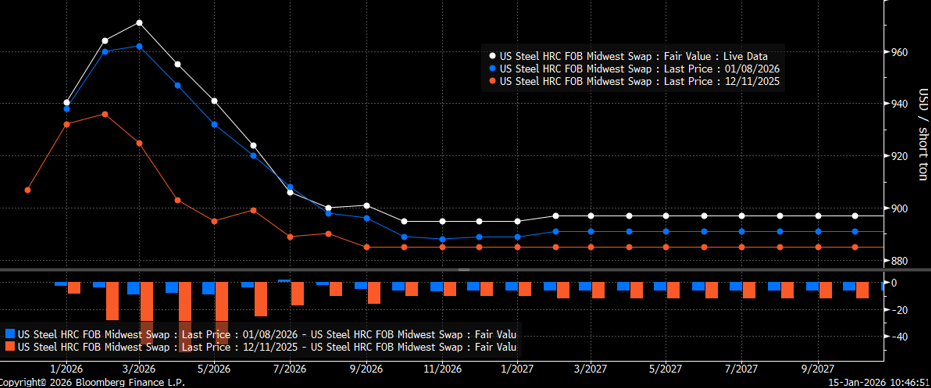
Since my last column on Dec. 11, there has been a more durable repricing of the existing curve structure. The front end has moved higher decisively, with March now standing as the peak of the strip. At the same time, values beyond mid-2026 have firmed, suggesting the market is reassessing the long-term equilibrium. The result is a market expressing both near-term tightness and a higher underlying baseline.
Looking at the forward curve’s progression, a month ago (orange), the curve reflected a market defining the lower boundary of the rally. By early January (a week ago, blue), the front of the curve had firmed. As of today (white), the curve’s posture has become more established. March now stands as the high point, signaling sustained stress across Q1 rather than a short-lived front-month squeeze. At the same time, the back half of the curve has become more firmly anchored, pointing toward an emerging baseline repricing. While demand remains uneven, tightening physical conditions are increasingly dominating the curve’s structure, a sign that the market is challenging the boundaries it was drawing in December.
CME Midwest HRC futures curve (1/15 in white, 1/8 in blue, 12/11 in orange)
That front-end strength is being validated by current physical conditions. Lead times have extended, mills have become markedly less negotiable, steel import arrivals have fallen to their weakest levels since 2009, and January scrap settlements moved higher, all pointing to tightening near-term availability and a firmer cost structure beneath both spot and forward prices. At the same time, this evolving physical landscape, such as muted import participation enduring, appears to be giving way to the higher band now forming from late-2026 through 2027, suggesting a reassessment of baseline pricing rather than a temporary spike. This is even as unresolved uncertainties remain ahead, including the Supreme Court’s pending ruling on IEEPA, upcoming USMCA negotiations in July, and incremental supply expected in 2026 (for example, U.S. Steel’s planned restart of Furnace B at Granite City near St. Louis in early Q2).
CME HRC money manager positioning
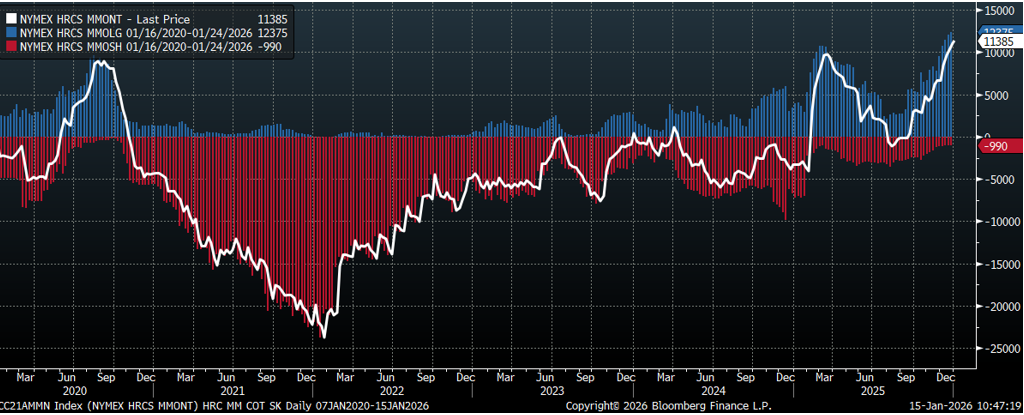
Positioning data adds another layer to the story and provides important context for the recent move in the curve. Money managers have expanded net long exposure into early January, reaching one of the higher levels observed in recent years. This increase has developed alongside tightening physical conditions and that alignment suggests the front-end repricing reflects broader market agreement on near-term constraints, while also increasing the market’s sensitivity to any shift in positioning, meaning elevated length leaves the market more exposed to position-driven volatility.
Taken together, these elements point to a market that is recalibrating its risk profile. The dominant uncertainty a month ago centered on whether higher prices could be sustained. Today, the more relevant question is how fully the curve has incorporated the evolving physical landscape. Price behavior is increasingly being shaped by structural features of supply. The market appears calm, sturdy on the surface, but the underlying structure continues to adjust. There are still unknowns, which could mean volatility is not far behind.
Disclaimer
The content of this article is for informational purposes only. The views in this article do not represent financial services or advice. Any opinion expressed by Flack Global Metals or Flack Capital Markets should not be treated as a specific inducement to make a particular investment or follow a particular strategy, but only as an expression of his opinion. Views and forecasts expressed are as of date indicated, are subject to change without notice, may not come to be and do not represent a recommendation or offer of any particular security, strategy or investment. Strategies mentioned may not be suitable for you. You must make an independent decision regarding investments or strategies mentioned in this article. It is recommended you consider your own particular circumstances and seek the advice from a financial professional before taking action in financial markets.