Market Segment
February 5, 2026
Nippon Steel confirms 100-day outage for Gary No. 14 reline as it swings to a loss
Written by Michael Cowden
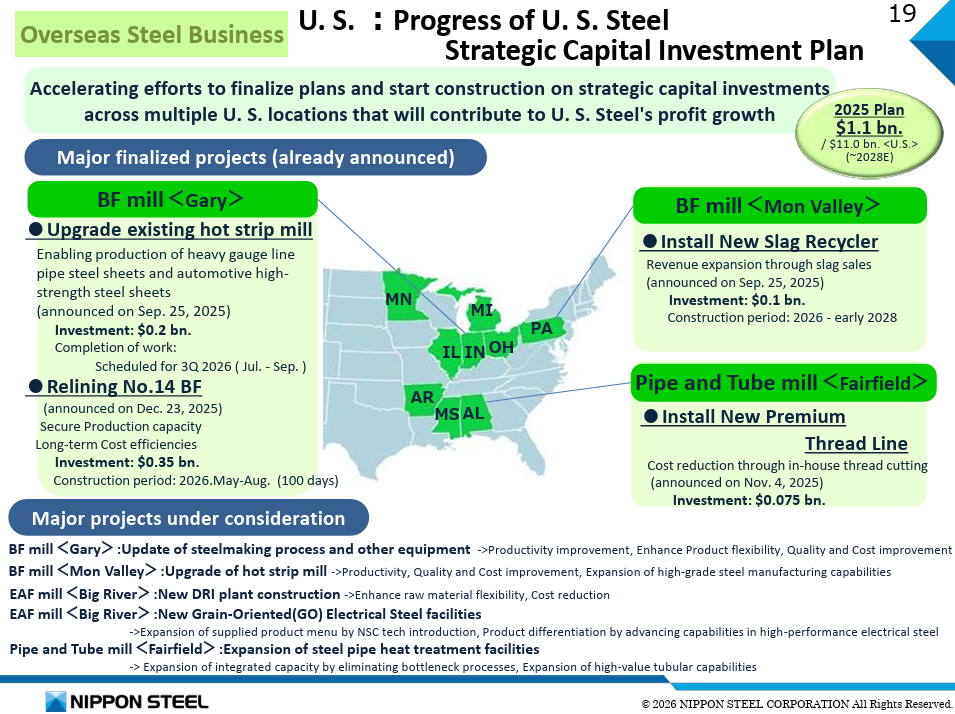
U.S. Steel plans to idle the No. 14 blast furnace at its Gary Works near Chicago for a reline for ~100 days from May to August.
The board of the Pittsburgh-based steelmaker approved a $350-million reline for No. 14 in December. But the company had not confirmed a timeline until now.
The No. 14 blast furnace is U.S. Steel’s largest, according to SMU’s blast furnace status table.
U.S. Steel, in addition, plans to undertake a $200-million upgrade of the hot-strip mill at Gary Works. The company expects the project, announced in September 2025, to be completed in the third quarter.
The improvements to the Gary hot-strip mill will allow it to make heavy-gauge sheet for the line pipe market as well as high-strength steel for the automotive market.
Granite City and BR2
The news about Gary Work No. 14 and other operational updates were included in Nippon Steel’s fiscal third-quarter earnings results, which were released on Thursday. The Tokyo-based steelmaker’s fiscal year ends on March 31.
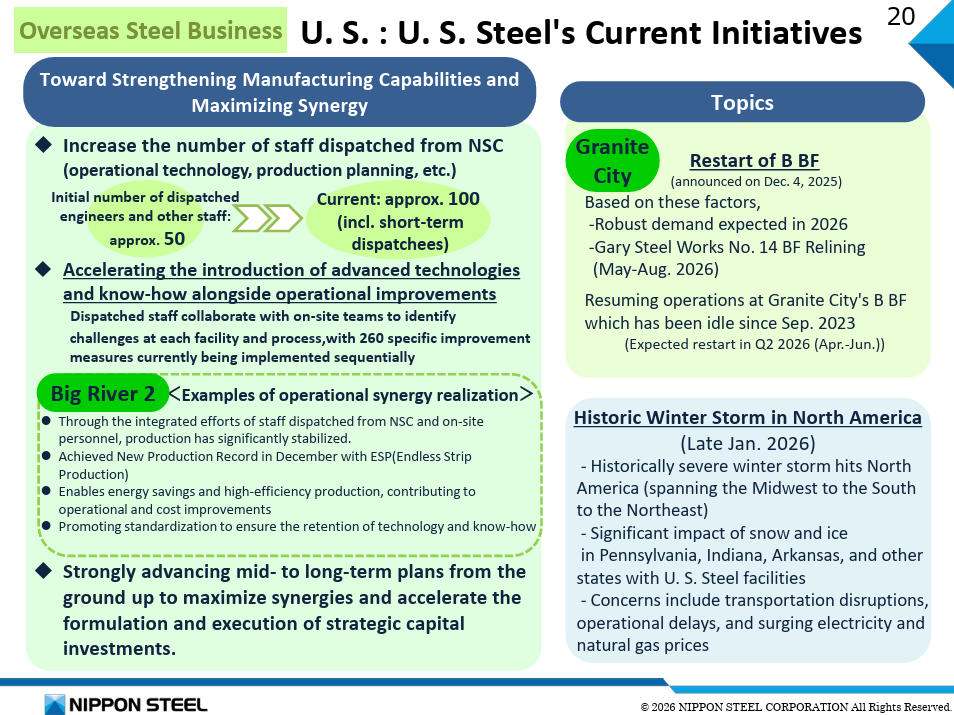
U.S. Steel also plans to restart the ‘B’ blast furnace at its Granite City works near St. Louis in the second quarter. That update comes after the company began the process of firing up the ‘B’ furnace in December.
Granite City has two furnaces, ‘A’ and ‘B’. Both have been idled since September 2023. SMU is not aware of any plans to restart that ‘A’ furnace.
Recall U.S. Steel had planned to halt steelmaking operations at Granite City before the Trump administration intervened with its “golden share” negotiated as part of Nippon Steel’s nearly $15-billion acquisition of the company.
Nippon Steel did not mention the golden share. It said the ‘B’ furnace at Granite City was restarting not only because of the extended outage at Gary Works No. 14 but also because of the “robust demand” the company expects in 2026.
Also on the operations front, Big River 2 (BR2) set a new production record in December thanks to its endless-strip production technology, Nippon said.
Recall BR2 is a new mill built next to the original Big River Steel mill in Osceola, Ark. BR2 will roughly double capacity in Osceola to approximately 6 million short tons per year. It will also add new capabilities, such as a non-grain-oriented (NGO) electrical steel line.
You can find more on BRS and other expansion projects in SMU’s new capacity table. More details on developments at Gary, Granite City, and BR2 – as well as other U.S. Steel operations – are in the Nippon Steel slides below. You can click on the images to expand them.
Market conditions
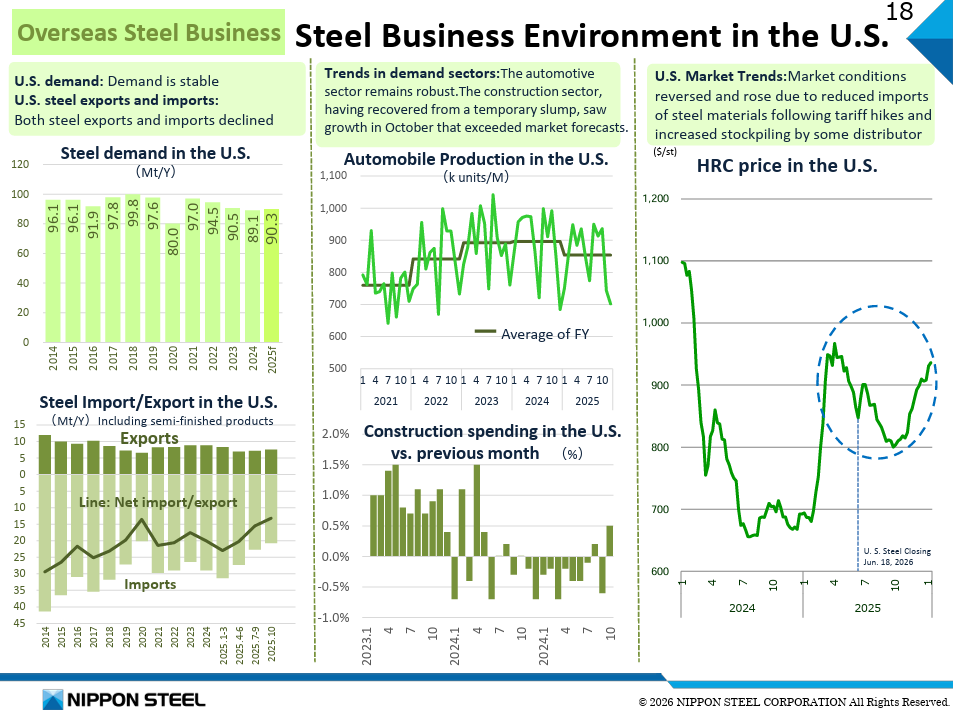
Nippon Steel said US demand has been “stable” thanks to “robust” automotive activity and improvement in the construction sector. The company also noted US prices have risen thanks to lower import volumes, higher tariffs, and restocking among distributors.
Case in point: SMU’s hot-rolled coil price stands at $965 per short ton (st) on average, up 23% after bottoming out at $785/st in mid-September.
But an “historic winter storm” stretching from the Midwest to the South has impacted states where U.S. Steel has operations. The “significant impact of snow and ice have resulted in transportation disruptions, operations delays, and surging electricity and natural gas prices,” the company said.
Nippon Steel also hedged its bets on the outlook for the US. “Although market conditions in the US have been improving, near-term uncertainties remain, partly due to the recent severe winter storms,” the company said in commentary released with earnings figures.
More details on Nippon’s outlook for the US steel market are in the slide below.
Nippon swings to a loss
All told, Nippon Steel recorded revenue of $46.3 billion ($6.5 trillion yen) in the nine months ended Dec. 31, up nearly 11% from $41.8 billion in the same period last year. Despite increased revenue, the Japanese steelmaker swung to a $132.7 million loss in the first three quarters of its 2025 fiscal year compared to a profit of $2.46 billion a year earlier.
The company blamed the loss on various factors – including an unplanned outage at a blast furnace in Japan and excess production capacity in China, which it said has led to a glut of low-priced exports into Japan and Southeast Asia, two of its key markets.
The overcapacity situation has been made worse by other countries moving to block imports. (Section 232 in the US and CBAM in Europe, for example.) “The examination and implementation of trade countermeasures in Japan need to be advanced strongly,” Nippon Steel said.