Analysis

February 23, 2026
SMU Steel Demand Index dips, remains in expansion
Written by David Schollaert
SMU’s Steel Demand Index slipped from earlier in the month, but remains above expansion territory, according to late-February indicators.
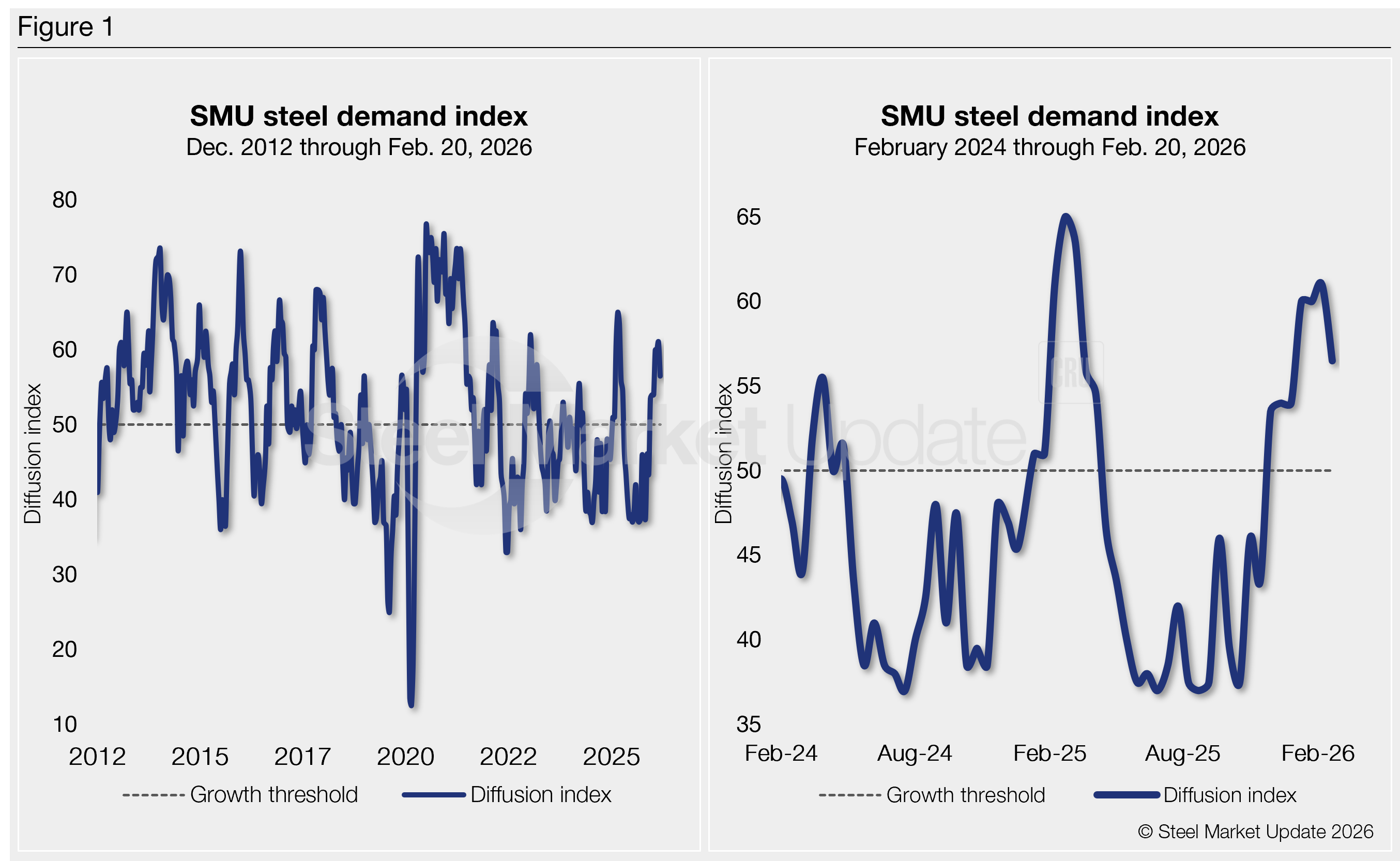
The Steel Demand Index, compiled from our survey data, now stands at 56.5, down from a reading of 61.0 in early February but not far off from a four-year high of 65.0 one year ago.
Though the pace of growth slowed, the index has shown a bit of growth as we’ve seen buying reportedly pick up from early Q4. But despite the positive movement, gains have paled in comparison to the early buying flurry ignited by the onset of undiluted Section 232 tariffs last March.
Still, following steady declines since the back half of last March, the index has recovered slightly in response to some Q4 buying backed by mill price hikes and tighter spot supplies. The trend has helped the index find a bit of footing, remaining in expansion territory for the better part of the past three months.
Methodology
Derived from the market surveys SMU conducts every two weeks, the index compares lead times and demand to create a diffusion index. This index has historically preceded lead times. This is notable given that lead times are often seen as a leading indicator of steel price moves. An index score above 50 indicates rising demand, and a score below 50 suggests declining demand.
Figure 1 shows the nearly 13-year history of the index on the left and provides a closer look at the Steel Demand Index readings of the past two years on the right.
Rearview mirror analysis
Last year, demand had a bit of the see-saw buying pattern. Though improved from 2024, it was heavily impacted by a shift in the tariff regime, which resulted in a slightly higher pricing floor despite uneven demand.
Similarly, sentiment was irregular, with most in the market indicating that contract tons took precedence, and spot demand was seen in pockets. The dynamic kept prices largely on an upward trajectory, though market confidence was uncertain.
A tale of shifting dynamics
Early optimism shifted slightly, as debate occurred on whether pricing gains have been driven primarily by demand or by limited supplies. The trend is supported by widening lead times, a sharp cut in imports, and upcoming spring outages.
But most continue to suggest that flat-rolled steel prices are moving higher as mixed demand appears to indeed be offset by limited supplies – for the time being.
Others continue to suggest that tariff uncertainty has added its share of doubt to the market, somewhat curbing buying, and forcing many to work leaner than in years past.
Ultimately, indicators appear to highlight an overall steady market.
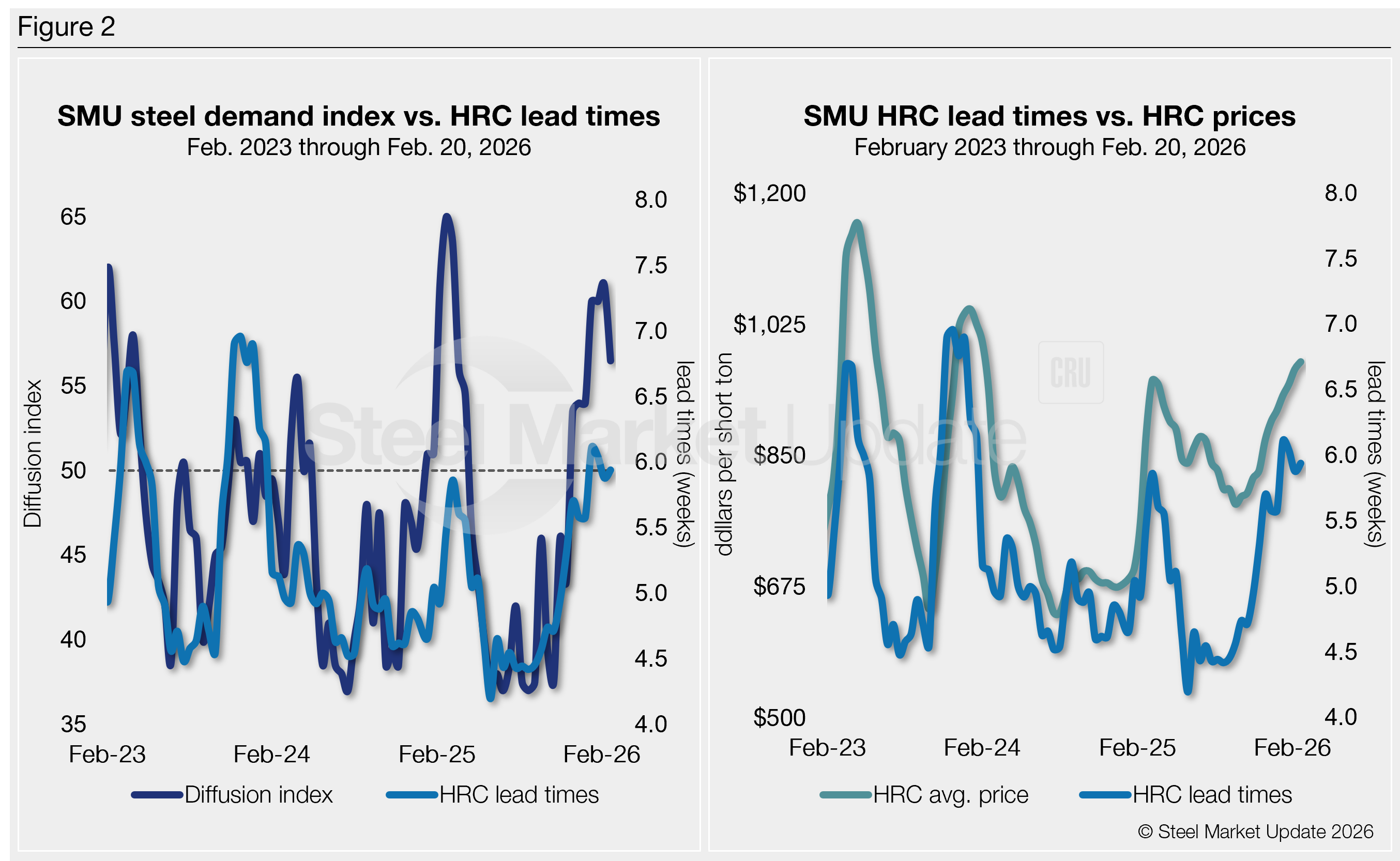
HR coil prices have followed a similar trend, reaching an average of $975 per short ton (st) in mid-February. The are now stable but still pointing higher, according to SMU’s latest market check on Tuesday, Feb. 17.
Lead times have moved up as well, but are showing some steadiness right around six weeks on average since early January. Presently at 5.9 weeks, they are up marginally from 5.8 weeks in early February.
For nearly a decade, SMU’s steel demand diffusion index has preceded moves in mill lead times (Figure 2, left side), and SMU’s lead times have also been a leading indicator of flat-rolled steel prices, particularly for HRC (Figure 2, right side).
In their own words
Here are a few quotes from our latest survey about how flat-rolled steel buyers see demand:
“Demand is steady but flat compared to last year.”
“Demand is up – clients are seeking tariff advice.”
“Bookings are up over the last two weeks.”
“Stable to a lower forecast for 2026.”
“Flat, but possibly some slight increase. Price checking?”
“Demand forecasts start dropping in April.”
“We have yet to see the purse strings loosen. Outside of data center-related business, no one is truly spending money.”
“Demand hasn’t moved much in the last few months.”
“No real change since the last survey, but at a good level.”
Signals ahead
Demand is steady, but buying remains largely tied to contracts—in many cases, buyers are taking max volumes but buying sparingly on spot. Inventories remain closely monitored.
This has been the trend for much of the past six-plus months.
But lead times and prices are moving up. In fact, HR coil prices are in the middle of one of their most sustained rallies in nearly a year. And while few, if any, expect demand to rally at a significant rate, tariffs have cut import competition, providing a stronger base for domestic products and thus prices.
Add that to lean inventories and firm raw material costs, and you have the current pricing support in play. And pair that with many reporting troubles finding available tons, and pricing gains might remain on the horizon for the time being.
Does it last if it’s not fundamentally demand-driven?
Maybe a while? I don’t know. We don’t forecast at SMU. We leave that to our colleagues at CRU, but ultimately, time will tell.
In the interim, we’ll continue to report on indicators, looking for smoother sailing ahead.
Editor’s note
Demand, lead times, and prices are based on the average data from manufacturers and steel service centers participating in SMU’s market trends analysis surveys. Our demand and lead times do not predict prices but are leading indicators of overall market dynamics and potential pricing dynamics. Look to your mill rep for actual lead times and prices.