Analysis

March 13, 2026
CRU: Steel export prices rise on the back of higher energy costs
Written by Anton Perevezentsev & Linda Lin & Puneet Paliwal
This item was first published by CRU. To learn about CRU’s global commodities research and analysis services, visit www.crugroup.com.
Chinese steel export prices and Turkish longs export prices increased this week due to higher energy and raw material costs. In India, HR coil exports remained paused amid the Middle East crisis.
Chinese steel export prices up amid Middle East conflict
Chinese steel export prices broadly increased this week on the back of a rebound of the yuan and inflated global energy costs due to the ongoing conflict in the Middle East. In addition, elevated oil prices had a knock-on effect on coal and metallurgical coal prices, while recovering demand after the Chinese New Year holidays also supported scrap and steel prices.
Ocean freight rates also increased sharply due to the conflict, further pushing up purchasing costs for buyers and prompting some of them to adopt a wait-and-see approach. Market contacts suggest that freight rates increased by 30-100%, depending on the route.
Billet/slab buyers in Southeast Asia were eager to secure material this week as the conflict in the Middle East cut off Iranian semi-finished products supply. Bidding prices from regional billet buyers increased to $460-470 per metric ton, CFR Southeast Asia, compared with indications of around $450/mt at the end of February.
Meanwhile, the availability of tax-evading cargoes remained low, which was reflected by a notable reduction in China’s latest export data. According to China’s Customs, China exported 15.6 million mt of finished steel over the January-February period, down by 8.1% year-on-year. January export volumes declined sharply by 31.4% from December, given the reintroduction of the export license management system.
In the Chinese domestic market, demand continued to improve this week. According to CRU’s weekly survey, 75% of the respondents observed an increase in domestic sales this week, compared with a previous reading of 33%.
Indian HR coil exports remain paused amid Middle East crisis
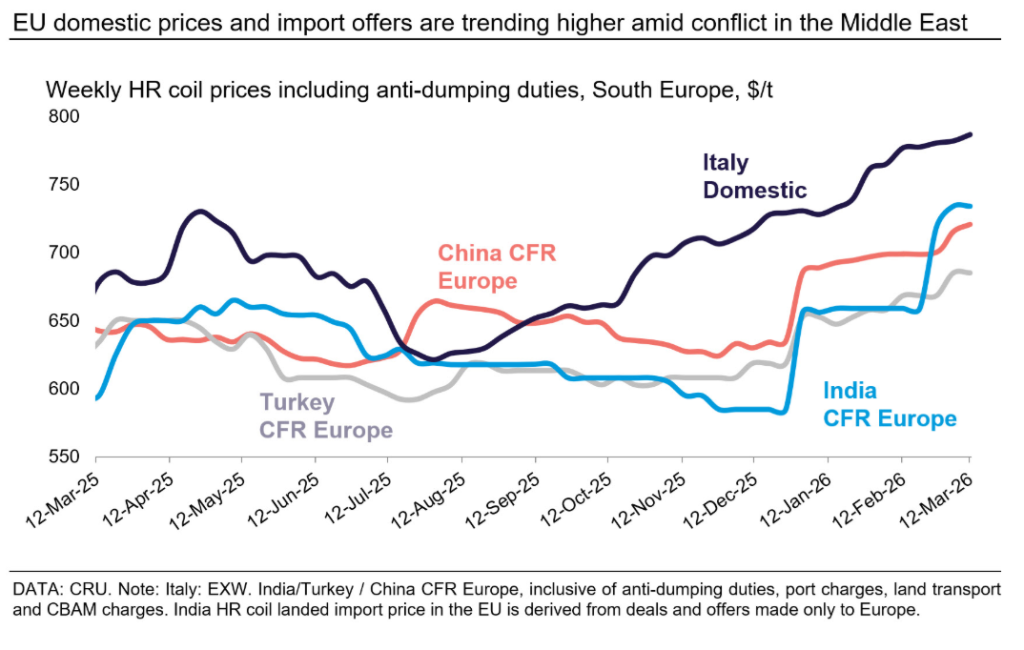
Indian HR coil export prices remained unchanged w/w at $530/mt FOB Indian Port as no new export deals were reported in the past week. Offer prices were in the range of $480–580/mt, with offers to the Middle East and Vietnam at the low end and offers to Europe at the high end of the range.
Buyers across Europe and the Middle East have adopted a wait-and-see approach towards booking import cargoes, as the ongoing Middle East conflict has disrupted shipping operations and sent freight rates spiraling. Market contacts suggest that India-EU freight rate has jumped by at least $15/mt (or by ~30%) since the conflict started.
Middle East crisis supports Turkish longs export prices
Turkish rebar export prices increased by $15/mt w/w to $57/mt FOB Turkish port. Despite overall weakness in export and local markets, challenges posed by the ongoing conflict in the Middle East raised costs of input materials and freight. This forced producers to increase export prices.
Turkish HR coil export prices remained stable w/w at $570/mt FOB Turkish port. Some sales were made to the European market. However, buying demand in the Middle East has subsided due to the outbreak of the conflict, preventing any price rise.