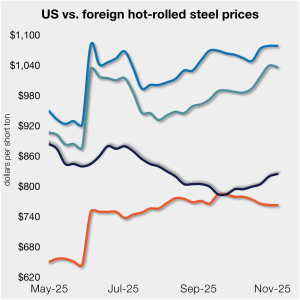

Doubled S232 tariff holds US HR prices below EU
David Schollaert presents this week's analysis of hot-rolled coil prices, foreign vs. domestic.
Steel buyers this week are lamenting weak demand, cautious buying, and So. Much. Uncertainty. I'm no doctor, but I suggest a dual diagnosis of extreme tariff fatigue and early-onset summer doldrums.
Ferrous scrap export activity has picked up steam.
CDC Atlantic already houses 13 die-casting machines (ranging from 900 to 1,600 tons), three on-site furnaces, and shot blasting capabilities.
Sheet and plate prices were little changed in the shortened week ahead of Independence Day, according to SMU’s latest check of the market.
Canada has implemented tariff-rate quotas (TRQs) on steel imports to help stabilize its domestic market.
The owner of Liberty Steel and his family were among the six victims of a plane crash in Ohio on Sunday, according to local media reports.
Will more DRI investment come to the US?
The Chicago Purchasing Managers Index (PMI) slipped 0.1 points to 40.4 points, in June.
A roundup of trade news, what's up with Brazilian pig iron, SMU's latest survey results and more to keep you up to date.
Oil and gas drilling activity declined for the ninth-consecutive week in the US, while Canadian counts rose for the fourth straight week, according to Baker Hughes.
Stainless prices in the US market will rise, following price increases by major US producers. Our base case scenario incorporates higher US prices in the near term, despite the initial negative reaction by the market. US stainless prices will go up in 2025 H2 and will stay elevated in 2026 as tariffs on stainless […]
Both of SMU’s Steel Buyers’ Sentiment Indices edged higher this week. Current Sentiment rebounded from a near five-year low, while Future Sentiment rose to a two-month high
The Canadian steel industry is bracing for thousands of job losses because of US tariffs, the Canadian Steel Producers Association says.
Maybe some of this uncertainty will get ironed out ahead of Liberation Day tariffs resetting higher rates on July 9. But if I had to place a wager, it would be on more drama and last-minute brinksmanship - whether it comes to the Liberation Day tariffs or the various Section 232s that are in the works.
After a hot start to June, the CME ferrous derivatives complex has cooled down.
Following the uptick seen two weeks ago, lead times eased this week for all four sheet products tracked by SMU, while plate lead times held steady, according to this week’s market survey.
“Contractors say that they're still busy, but their order books have gotten a lot softer or a lot more uncertain,” said Ken Simonson, chief economist for The Associated General Contractors of America.
Steel market participants contend that buyers will remain in “wait-and-see" mode until some market stability is restored.
The majority of steel buyers responding to our latest market survey say domestic mills are more willing to talk price on sheet and plate products than they were earlier this month. Sheet negotiation rates rebounded across the board compared to early June, while our plate negotiation rate hit a full 100%.
Could the US and Mexico end up with a tariff-rate quota system?
Worthington Steel earnings rose while sales fell in its fiscal fourth quarter.
Prices for steel sheet slipped this week despite Section 232 tariffs remaining at 50% and a US strike on nuclear facilities in Iran over the weekend.
Subsidized Chinese steel imports and cheap steel products from Association of Southeast Asian Nations (ASEAN) entering Latin American (LATAM) are threatening the region's steel market.
CMC entered the back half of its fiscal year with improving steel margins, steady rebar demand, and confidence in long-term construction fundamentals
The resistance Brazilian pig iron sellers had shown to accepting lower prices has proved short-lived, sources told SMU.
Not many people in the North American steel market had direct US involvement in another Middle East conflict on their bingo card. Prices weren't expected to shoot higher unless something unexpected happened. That unexpected something has now happened. And there is talk of oil at $100 per barrel. What does that mean for steel?
US cold-rolled (CR) coil prices continued to tick higher this week, while offshore markets were mixed.
The document makes clear that Nippon Steel, through Nippon Steel America, will have “100% ownership of [the] common stock.” So if you want to own an interest in U.S. Steel’s future success, you will need to buy shares in Nippon Steel on the Nikkei stock exchange. It certainly will not be in your domestic S&P 500 ETF.
Your highlights on the week in trade developments, price increases, scrap news, and more.