
SMU survey: Steel Buyers' Sentiment slips to 16-month low
SMU’s Current Steel Buyers’ Sentiment Index fell further week, now at the lowest reading recorded since October 2022


SMU’s Current Steel Buyers’ Sentiment Index fell further week, now at the lowest reading recorded since October 2022
Steel companies in Mexico have lined up capex plans totaling $5.7 billion in the next three years. The focus is on replacing imports with domestic production, said David Gutierrez, outgoing president of sector association Canacero. “The investments are aimed at reducing imports, strengthening national production, and ensuring that the benefits stay in the country,” he was quoted as saying at Canacero’s annual congress by regional news service Business News Americas.

Oil and gas drilling activity in North America slowed this week, according to the latest figures from Baker Hughes.
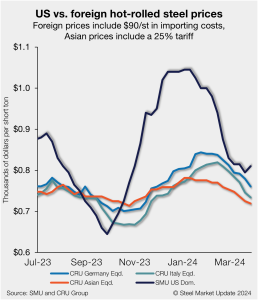
US hot-rolled coil and offshore hot band moved further away from parity this week as stateside prices have begun to move higher in response to mill increases.
Numerous mid-sized export yards in California and in Baja Mexico had little to no inventory on the ground last week because most had sold forward in the falling March market. Looking to secure their margins, they dropped prices across the scale. That resulted in lower-than-normal flows. “I’m sold out through mid-April and even longer if the flow doesn’t pick up” one yard owner said. That turned out to be the position of numerous West Coast suppliers.
I can’t really define “Bidenomics” because it is so filled with contradictions. It seems to aim to increase manufacturing output in the United States. But not all increases are created equal.
SMU’s sheet prices firmed up modestly this week, even as CME hot rolled futures declined. What gives? My channel checks suggest that demand remains stable and that buyers have returned to the market following new HR base prices announced by mills earlier this month. I’m looking forward to seeing whether lead times, which have stabilized, will start extending. SMU will have more to share on that front when we release updated lead time figures on Thursday. As for HR futures, what a reversal! As David Feldstein wrote last Thursday, bulls expected mill price increase announcements. And we briefly saw the May contract climb as high as ~$1,000 per short ton (st).
There’s that concept from Adam Smith we all learn about in our Econ 101 classes: The Invisible Hand. A simple Google search will provide a refresh, but if memory serves I would classify it as something akin to “the market is magic” or “the market’s gonna market.” Today, obviously, we live in a mixed environment. There are a lot of hands out there, and they’re not too difficult to see. In this election year of 2024, one of the most visible hands out there probably belongs to the federal government.
North American rig count activity declined this week, according to the latest data from Baker Hughes. The number of active rigs in the US eased from last week’s 6-month high, while Canadian activity continued to wind down.
Worthington Steel is taking a pause on M&A activity as it focuses on progressing its electrical steel expansions in Mexico and Canada.

Prices for pig iron in Brazil have increased despite efforts by US-based buyers to lower them.
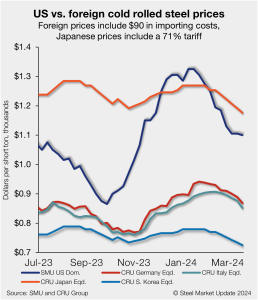
Foreign cold-rolled (CR) coil remains notably less expensive than domestic product even with repeated tag declines across all regions, according to SMU’s latest check of the market.

2024 started with a $200 per short ton (st), one-week demon drop in the CME Midwest hot-rolled (HR) coil futures. Then, HR futures consolidated in the low $800s/st with the April future trading to as low as $770/st as the curve shifted into contango or upward sloping. A big move was expected, and a big […]
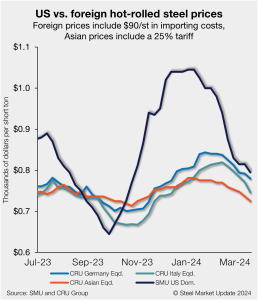
US hot-rolled coil (HRC) remains more expensive than offshore hot band but continues to move closer to parity as prices decline further. The premium domestic product had over imports for roughly five months now remains near parity as tags abroad and stateside inch down.
SMU caught up with Barry Zekelman, executive chairman and CEO of Zekelman Industries, on Wednesday’s Community Chat. As one of the largest independent steel pipe and tube manufacturers in North America, his company is also one of the largest steel buyers in the region. This year alone, the Chicago-based company will buy roughly 2.8 million tons of steel. As such, Zekelman provides a great perspective on the steel industry and the markets it serves.
North American auto assemblies edged down in February vs. the prior month, according to LMC Automotive data. While assemblies did fall month on month (m/m), they are up nearly 3% year on year (y/y).

Varsteel, a Canadian steel and pipe service center, has announced the acquisition of Pacific Steel in Laval, Quebec.
The Architecture Billings Index (ABI) indicated architecture firm billings continue to decline through February, according to the American Institute of Architects (AIA) and Deltek. While the latest reading does not indicate improving business conditions, it is one of the higher measures seen in recent months, suggesting the recent slowdown may be diminishing.
Earlier this week SMU polled steel buyers on an array of topics, ranging from market prices, demand, and inventories to imports and evolving market chatter.
US light-vehicle (LV) sales rose to an unadjusted 1.25 million units in February, up 9.6% vs. year-ago levels, the US Bureau of Economic Analysis (BEA) reported. The year-on-year (y/y) growth in domestic LV sales was boosted by a 6% month on month (m/m) gain.
SMU’s price for hot-rolled (HR) inched lower this week. I wouldn’t be surprised, however, if we start to see prices and lead times move higher in the weeks ahead. The modest declines in HR this week are probably the result of lingering deals cut at “old” prices, as sometimes happens after mill price increases. But those deals will probably be out of the market soon if they aren’t already. So why do I float the idea of higher prices? Some big buys have been placed. It reminds me a little of what we saw last fall, when people restocked in anticipation of higher prices once the UAW strike was resolved.
Sheet and plate prices mostly moved lower this week after little change was noted the week prior. Despite edging down, sentiment is mixed, and many suggest a bottom may be near.
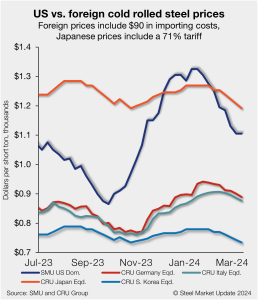
Foreign cold-rolled coil (CR) remains significantly less expensive than domestic product even as US tags continue to decline in a hurry, according to SMU’s latest check of the market.

Rig counts in the US and Canada were mixed this week, according to the latest data from Baker Hughes.
In this Premium analysis we cover North American oil and natural gas prices, drilling rig activity, and crude oil stock levels.
SMU’s Current Steel Buyers’ Sentiment Index edged down while the Future Sentiment Index ticked up, according to our most recent survey data
New York state manufacturing activity slipped deeper into negative territory this month, according to the latest Empire State Manufacturing Survey from the Federal Reserve Bank of New York.

Steel buyers found mills more willing to negotiate spot pricing on the products SMU tracks with the exception of hot rolled, according to our most recent survey data.
Steel mill lead times were flat to slightly up, according to our market survey this week.
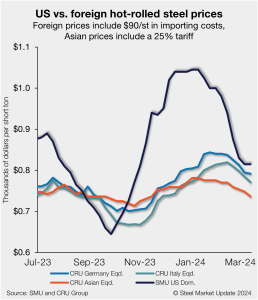
US hot-rolled coil (HRC) remains more expensive than offshore hot band, even as domestic prices remain under pressure. The premium domestic product had over imports for roughly five months now remains near parity as tags abroad and stateside inch down.