Market Segment
January 15, 2026
Steel Caucus hears unified call for tougher trade enforcement
Written by Laura Miller
Members of the Congressional Steel Caucus met in Washington on Wednesday to assess the state of the domestic steel industry. Industry leaders joined lawmakers to discuss the importance of Section 232 tariffs, strong trade enforcement, and continued investment in American steelmaking.
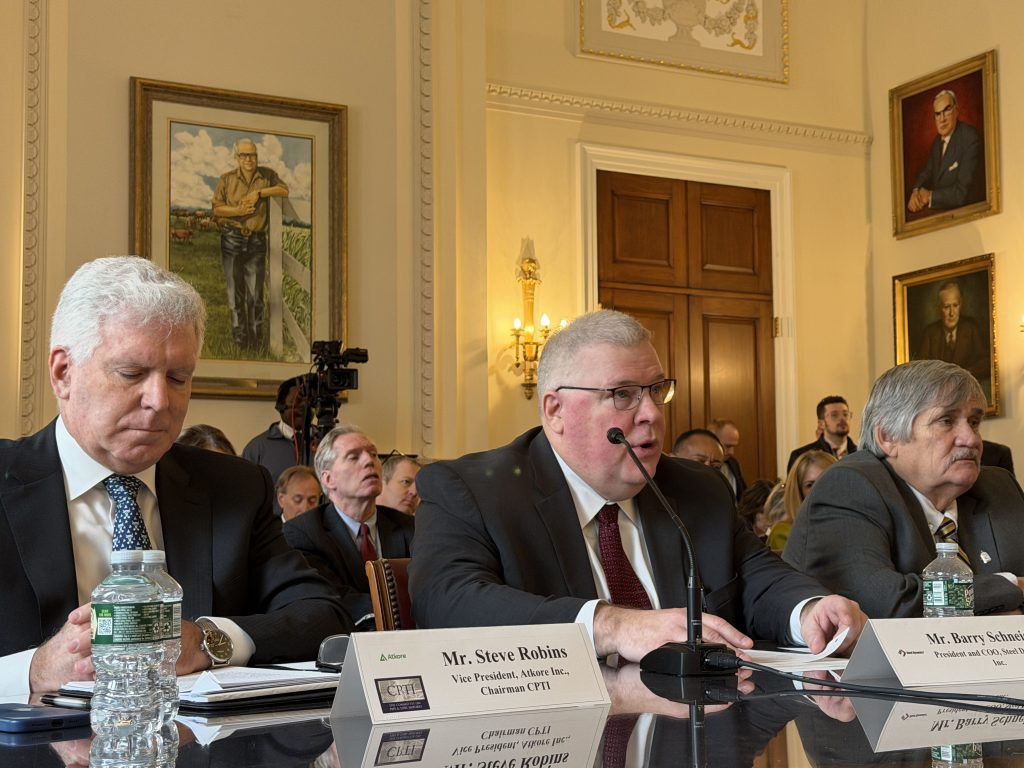
Caucus calls out global overcapacity
Leaders of the Caucus highlighted the steel sector’s economic footprint and the need to maintain bipartisan support for policies that protect domestic production. They recognized that global overcapacity, particularly from China and its proxies, continues to distort markets and threaten US jobs.
Witnesses from major American steel producers and the United Steelworkers (USW) union detailed recent investments, workforce needs, and the impacts of strengthened trade actions under the current presidential administration.
U.S. Steel highlights investment momentum
David Burritt, president and CEO of U.S. Steel, told the Caucus the steelmaker is experiencing renewed momentum across its footprint. He cited upgrades in Pennsylvania, Arkansas, Indiana, Illinois, and Alabama. He noted U.S. Steel is advancing major projects, including Big River 2, a new hot strip mill in the Mon Valley, and a blast furnace reline at Gary Works.
He also commented on tariffs that are benefiting US steelmakers. “Tariffs work,” he testified. “They protect jobs, preserve domestic capacity, and support the investments we’re making.”
“Strong nations make things,” Burritt told lawmakers. “And when a nation stops making things, it starts depending upon others to decide its future. Steel is where independence begins at U.S. Steel.”
He continued, “Everyone in this room understands the stakes. If you care about national security, economic security, and energy security, you must care about American steel.”
The USS chief executive highlighted the company’s upcoming 125th anniversary next month. “A company that helped build the modern United States is now helping build its future,” he stated. “We’re investing, we’re hiring, we’re building. U.S. Steel is back, and with your leadership,” he told the Caucus, “American steel will stay strong for generations.”
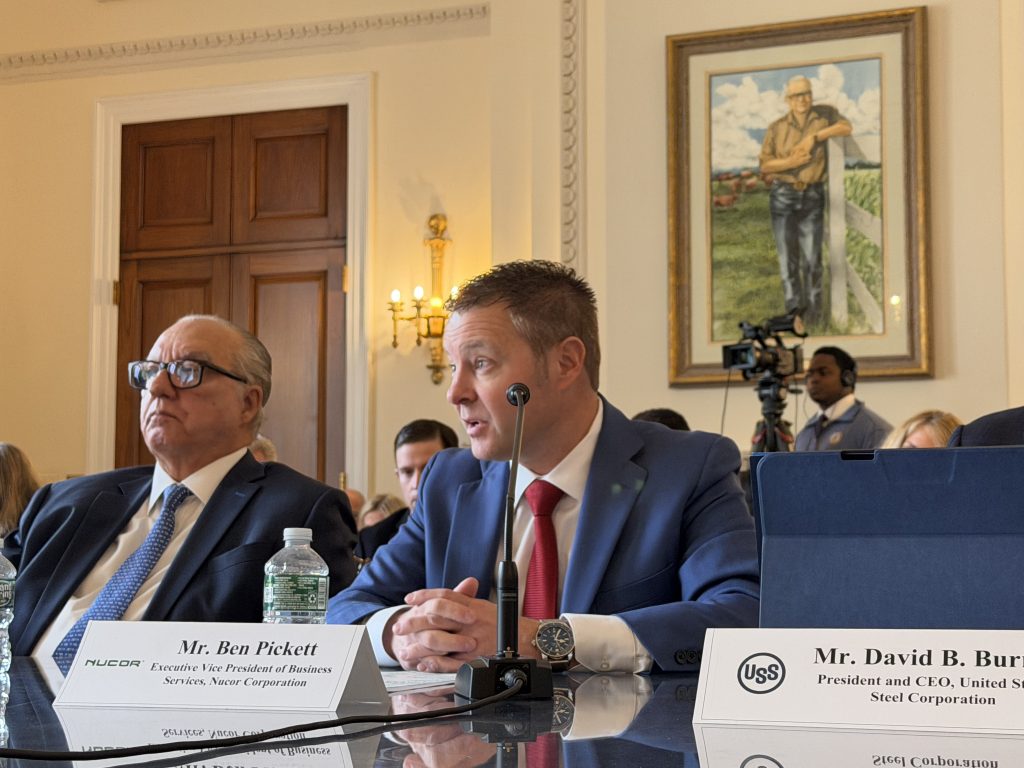
Nucor urges Congress to stay aggressive on trade
Nucor Executive Vice President and Vice Chairman of the Steel Manufacturers Association (SMA) Ben Pickett emphasized how Section 232 tariffs and AD/CVD laws have enabled more than $20 billion in domestic investment since 2017. He warned global overcapacity is rising again and urged Congress to maintain strong, comprehensive trade measures.
“This is no time for complacency,” Pickett stated in his testimony before the Caucus. “If we let our guard down, these volumes will flood our market, undermine our investments, and harm our teammates and communities throughout America.”
Cliffs pushes for zero exemptions, stricter melt-and-pour rules
Lourenco Goncalves, chairman, president, and CEO of Cleveland-Cliffs and chairman of the American Iron and Steel Institute (AISI), credited the revamped Section 232 tariffs with reducing import penetration and restoring market stability. He urged Congress to resist tariff exclusions, which he said “plant the seed of destruction” and create more and more exemption requests.
Highlighting the increasing risk of sourcing foreign steel amid a volatile global geopolitical environment, Goncalves also stressed the importance of reshoring manufacturing and securing domestic supply chains. He encouraged lawmakers to maintain a strict melt-and-pour standard in the USMCA and across trade agreements.
Goncalves also called out steel consumers for their complacency. He said they’ve been “slow to modify their supply chains and continue to seek exemptions” so they can use steel that isn’t melted and poured in the US. “It’s now up to steel consumers and end-users to ensure that a resurgency of US manufacturing takes hold,” he admonished.
USW calls for investment, stronger trade laws
Michael Millsap, USW District 7 director, called attention to the union’s growing membership and the importance of long-term investment in facilities to ensure job security.
He, too, pointed to rising global excess capacity – projected to reach 720 million metric tons by 2027 – as a major threat to US production.
Millsap urged Congress to strengthen trade laws, expand melt-and-pour requirements in the USMCA, and support shipbuilding initiatives that would increase demand for American steel.
EAF producers cite progress, warn against complacency
Steel Dynamics Inc. President and CEO Barry Schneider, testifying on behalf of the Steel Manufacturers Association (SMA), said EAF producers have invested heavily since the introduction of Section 232 tariffs.
“Our industry is in a good place today, but we cannot become complacent,” Schneider declared.
He called for additional improvements to permitting, workforce development, and trade enforcement.
Schneider also urged the Caucus to support robust Build America, Buy America requirements. “It’s a simple idea,” he stated. “If we’re rebuilding America, we should do it with American steel and American workers.”
P&T sector flags market share losses
Representing the pipe and tube sector, Atkore Vice President and Chairman of the Committee on Pipe & Tube Imports (CPTI) Steve Robbins warned that imports continue to capture more than one-third of the US market.
He, too, urged Congress to strengthen “Buy America” requirements for federally funded projects.
Robbins also joined Goncalves and Schneider in pushing for Congress to advance the Leveling the Playing Field 2.0 Act. As Goncalves said, the legislation is “not protectionism. It’s self-defense. It’s national security.”
USMCA review center stage
The upcoming 2026 joint review of the US-Mexico-Canada Agreement loomed large in the discussion.
Both lawmakers and industry leaders warned that loopholes in the agreement continue to enable the transshipment of foreign steel – particularly Chinese material – through Canada and Mexico.
Witnesses urged Congress to push for stronger melt-and-pour requirements across all steel-intensive products. They argued the current agreement undermines domestic steel production and weakens the effectiveness of Section 232 measures.
Several executives said the review presents a critical opportunity to close gaps that have allowed foreign producers to exploit the North American market. At the same time, union leaders called for a “Fortress America” approach to ensure that trade partners cannot serve as conduits for dumped or subsidized steel.
Lawmakers pledge bipartisan support
Throughout the hearing, lawmakers underscored the importance of maintaining a strong domestic steel industry for national security, manufacturing competitiveness, and economic stability. They pledged continued bipartisan support for trade enforcement, workforce protections, and policies that expand demand for American-made steel.
Various lawmakers appeared at the hearing, including Steel Caucus Chairman Rep. Rick Crawford (R-Ark.) and Vice Chairman Rep. Frank Mrvan (D-Ind.).