Analysis
February 17, 2026
Tampa Steel Conference: Inside Barry Zekelman’s bluntest talk yet
Written by Laura Miller
Barry Zekelman used his Tampa Steel Conference fireside chat to deliver one of the bluntest assessments yet of the forces shaping North American steel. He warned that a flawed tariff structure and an impending power crunch threaten the industry more than most realize.
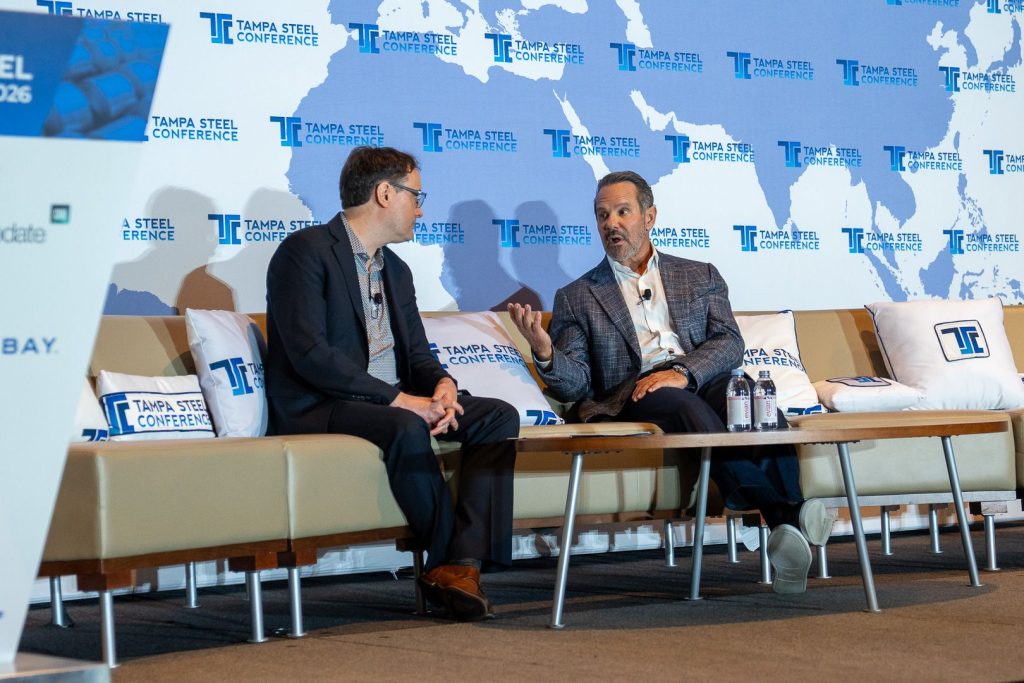
Across a wide-ranging discussion with SMU Editor-in-Chief Michael Cowden, the Zekelman Industries executive chairman and CEO returned repeatedly to two themes. One, the urgent need to fix derivative tariffs that are flooding the US with pipe and tube imports. And two, the transformative potential of small-scale nuclear power as data centers strain the grid.
Derivative tariffs: ‘A huge problem.’
Zekelman didn’t mince words when describing how a policy oversight in the previous administration created a loophole that slashed duties on pipe and tube. And that opened the floodgates for imports.
He explained that when steel pipe and tube products in Chapter 73 of the HTS code were moved into the “derivative” category, the duty calculation changed from the value of the finished product to the value of the steel content alone.
The result was disastrous. “They actually lowered the duties on pipe and tube… And it’s a huge problem,” Zekelman said. He gave the example of a $1,200 pipe import, which used to have a $600 duty; as a derivative, the tariff would only be $200-250.
However, he said a fix was “imminent,” and the stakes are enormous. Pipe and tube imports across major categories hit 6 million metric tons in 2025. He estimated that correcting the tariff structure could bring back 30-40% of that volume to domestic producers.
“I don’t think too many people are aware of that,” he noted, emphasizing the issue is widely misunderstood.
Zekelman’s comment about an “imminent” fix may have referred to the next day, when President Trump announced upcoming changes to Section 232 derivative tariffs.
Derivative tariffs are ‘way more complicated than I ever thought.’
The chief executive also highlighted the broader challenge of enforcing tariffs on derivative products. The category is far more complex than most policymakers appreciate.
He offered a striking example: “There’s stainless steel wire in tea bags… It’s way deeper and way tougher to do.”
Customs and Border Protection (CBP), he said, is overwhelmed. “They’re looking at tens of thousands of products, and they don’t have the manpower,” he explained.
The core problem: The US wants to enforce fair trade without hammering consumers or disrupting supply chains. But the derivative category is so broad – and so easily manipulated – that enforcement becomes a maze.
The solution, he argued, is long-term policy consistency – something the US has historically struggled to maintain.
Nuclear micro-reactors: ‘game-changers.’
If derivative tariffs were the policy problem keeping Zekelman up at night, the power grid was the economic one.
He described a recent conversation with the Deputy Secretary of Energy, who told data center operators they must overbuild capacity. “If you need 100 gigawatts, you’ve got to put in 120 or 140… They know the demand is going to be there,” he said.
Wind and solar, he noted, are treated by utilities as only 20% on-time resources. This makes them expensive and unreliable for baseload power.
That’s why Zekelman believes the next decade will be defined by small-scale nuclear.
He recounted conversations with developers of micro-reactors: “We can get enough power in the size of a shipping container… and it’s about $3 million. And it’ll last 10 years.”
His reaction was immediate: “These are game-changer things. Game-changer.”
He predicted rapid deployment, first in commercial shipping, then across industries. “It’s coming… and fast,” he noted.
Trade, power, and the future of North American steel
Zekelman tied both themes – tariffs and energy – to a broader warning about North America’s industrial competitiveness.
On “Fortress North America,” he was blunt: “I see that slipping.” He foresees bilateral trade agreements between the US and Canada and the US and Mexico. But he doesn’t believe there will be a trilateral trade deal.
And on the need for long-term policy stability, he commented, “Trade is evolving… It evolves because the economy evolves.” He gave an old TV antenna as an analogy. You’ve got to tune it just right, or business investment freezes.
In the end, Zekelman’s message was clear. Fix the tariff system that’s distorting the market, embrace the nuclear technologies that can actually power the next wave of industry, and stop pretending North America can stay competitive without bold, long-term decisions. The stakes, he warned, are rising fast, and the steel sector can’t afford to be on the wrong side of obvious.