
US OCTG producers petition for duties on Austria, Taiwan, UAE
The petitions allege that foreign producers are selling seamless and welded OCTG at unfairly low prices and, in Austria’s case, benefitting from countervailable subsidies.


The petitions allege that foreign producers are selling seamless and welded OCTG at unfairly low prices and, in Austria’s case, benefitting from countervailable subsidies.
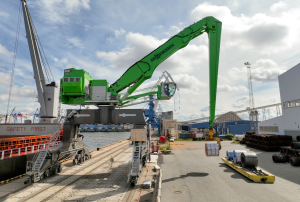
The price gap between US hot-rolled coil (HR) and landed offshore product tightened this week.
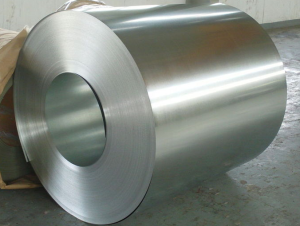
The Commerce Department has launched another duty circumvention inquiry targeting coated steel imports at the request of two US mills.

What impact could the war in Iran have on the steel raw materials supply chain and prices?

Could we see prices continue to inch higher, plateau, and then start to slide back? A lot hinges on whether and how long it takes mills to catch up on orders.

Prices for iron ore, aluminum, pig iron, and shredded scrap have all risen in the last 30 days. Busheling scrap held steady, while zinc and coking coal declined.
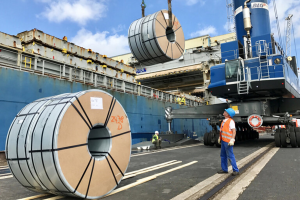
CR imports from Germany, Italy, and Japan on a landed basis remain much more expensive than domestic product. But South Korean imports remain competitive, in theory, even with the 50% Section 232 tariff.

APAC steel prices are expected to rise due to high energy and freight costs stemming from the Middle East conflict. Imports will remain subdued in the EU due to rising freight rates but are expected to pick up marginally in the USA.

Worthington Steel reported steady progress on its planned acquisition of Kloeckner & Co., calling the deal a major strategic step as steel markets show early signs of tightening in the US and remain under pressure in Europe.

The US Department of Commerce has launched two trade investigations to determine if certain corrosion-resistant (CORE) steel imports are being transshipped through Indonesia to avoid paying anti-dumping and countervailing duties (AD/CVDs).
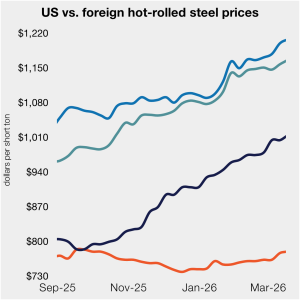
The price gap between US hot-rolled coil (HR) and landed offshore product remained within a tight band this week. The dynamic continues as both stateside and offshore prices have trended higher.
Worthington Steel reporter lower FY Q3 earnings on what its CEO described as "challenging" macroeconomic conditions.
Sheet prices continue to inch higher. And people who once thought hot-rolled coil (HR) prices couldn’t go above $1,000 are now saying $1,100 doesn’t seem out of the question.

The bulk scrap export market into Turkey is starting to form after several weeks of inactivity.

Mexico’s Ministry of Economy issued a preliminary ruling in its anti-dumping case on hot-rolled steel from China and Vietnam. The government found evidence of price discrimination and imposed provisional duties on a wide range of hot-rolled flat products, including coils, sheet, strip, and plate.

When nations eye their trade policy these days, are they only seeing tariffs? It might seem that way, especially after reading a presidential executive order or five over the last year. But is the condition spreading?
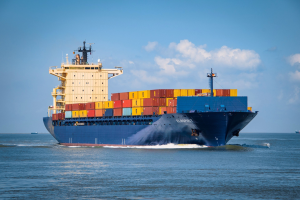
The UK will reduce steel import quotas and raise outside caps to 50%.
Chinese steel export prices and Turkish longs export prices increased this week due to higher energy and raw material costs. In India, HR coil exports remained paused amid the Middle East crisis.

With the Iran war approaching its third week, the future course and scope of the conflict remain uncertain. Even so, while the human costs are the most immediate and tragic, the global economic implications have already proven to be significant.
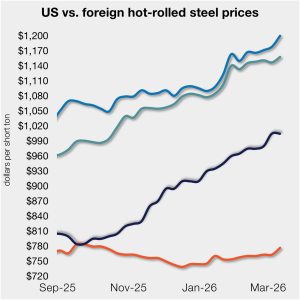
The price gap between US hot-rolled coil (HR) and landed offshore product widened this week, as stateside tags were little changed.

The Global Steel Climate Council (GSCC) has certified its first Asian steel company.
This CRU insight demonstrates how the conflict in Middle East supports metallurgical coal prices and iron ore will be impacted by a potential decline in demand from China and rising costs, while the pellet market will be severely disrupted.
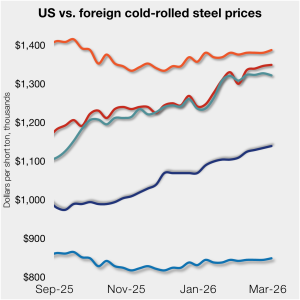
Cold-rolled (CR) coil prices ticked up in the US this week, matching a similar trend seen in most offshore markets as well.
The main impact on the ferrous value chain from the Middle East conflict will be the higher energy costs in a prolonged scenario.
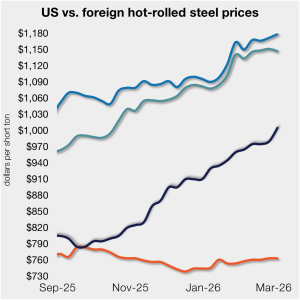
The price gap between US hot-rolled coil (HR) and landed offshore product tightened this week, as stateside tags continue to rise.
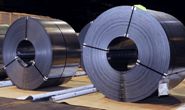
CVDs and anti-dumping duties matter when importing steel. Korea often offers very competitive import rates. The importer of record is responsible for paying any ADs, CVDs, or tariffs.

The US surpassed Japan in annual steel production in 2025 for the first time in 26 years, according to the World Steel Association (worldsteel).
Crude-oil and natural-gas prices spiked, metals opened higher and some fertilizer benchmarks climbed after the US and Israel launched a “pre-emptive” strike on Iran, killing the supreme leader and plunging the region into chaos.

Tariff-related litigation in the US and around the world reflects the willingness of the president to act without consulting Congress or our trading partners. We're seeing the impulse to act without congressional approval in international relations too.
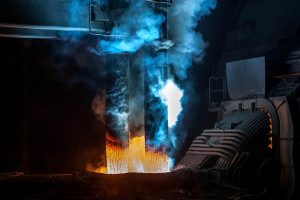
Graphite electrodes are critical to electric-arc furnace steelmaking and the production of other non-ferrous metals.