
Nucor’s $875/ton HR spot price spills into week six
Nucor is keeping hot-rolled (HR) coil prices unchanged again this week, according to its latest consumer spot price (CSP) notice issued on Monday, Sept. 29.
Most steelmaking raw material prices held steady or ticked higher over the past month
Market chatter from steel buyers this week: prices steady to slightly higher, demand weak, inventories slow, and tariffs clouding the outlook.
SMU’s average price for domestic hot-rolled (HR) coil held at $785 per short ton (st) this week, unchanged week on week (w/w). A similar dynamic was seen in offshore markets last week as well.
Nucor kept hot-rolled (HR) coil prices unchanged this week, according to its latest consumer spot price (CSP) notice on Monday, Sept. 22.
We’ve been talking about a potential inflection point for the past couple of weeks. And the market does appear to be nearing one.
Participants in the US carbon and steel plate market are frustrated by the lack of activity following the Labor Day holiday weekend.
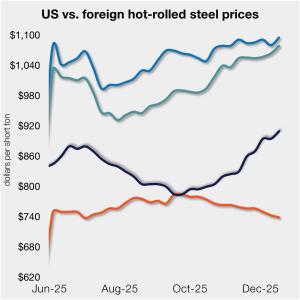
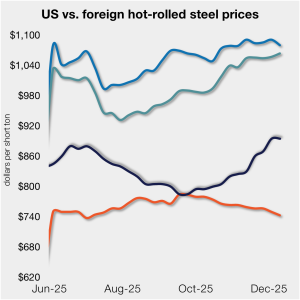
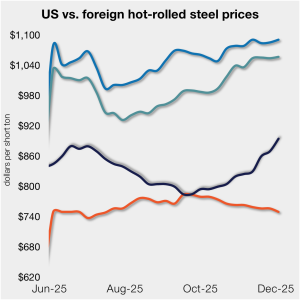
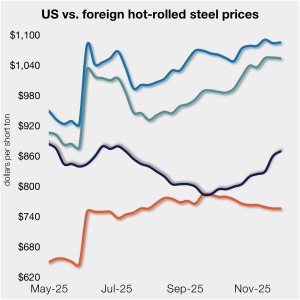
With only a modest decline in US prices, HR imports, on a landed basis, remain much more expensive than domestic hot band.
Sheet and plate buyers say mills remain open to negotiating spot prices this week, though less so than in recent weeks, according to SMU’s latest market survey.
The premium galvanized coil carries over hot-rolled coil (HRC) coil has marginally widened in recent months. As of Sept. 16, the spread between these two products reached a three-month high of $175 per short ton (st), though it is still low by historical standards.
SMU’s price ranges were mixed again this week as the market continues to seek a floor amid industry hopes for a Q4 rebound.
In this Premium analysis we examine North American oil and natural gas prices, drill rig activity, and crude oil stock levels through September. Trends in energy prices and rig counts serve as leading indicators for oil country tubular goods (OCTG) and line pipe demand.
Nucor held its hot-rolled coil list price flat again this week, according to its Monday, Sept. 15 consumer spot price (CSP) notice.
U.S. Steel has revised its Galvalume coating extras higher effective Nov. 2, 2025. The steelmaker released new extras to customers on Friday, Sept. 12.
Participants in the hot-rolled steel sheet market expect the market to remain subdued through the end of the year.
Market sources say demand for domestic plate refuses to budge despite stagnating prices.
Nucor aims to keep plate prices flat for a seventh straight month with the opening of its October order book.
Sheet prices were mixed this week as some mills continued to offer significant discounts to larger buyers while others have shifted toward being more disciplined, market participants said.
Nucor kept hot-rolled (HR) coil prices unchanged this week, according to its latest consumer spot price (CSP) notice on Sept. 8.
Cold-rolled (CR) coil prices ticked lower in the US this week, while prices in offshore markets diverged and ticked higher.
I’ve been getting some calls lately from some of you who want to kick around ideas on where prices might bottom and when.
The majority of steel buyers responding to this week’s market survey continue to report that mills are open to negotiating spot prices on sheet and plate products.
SMU’s hot-rolled (HR) coil price held steady this week while prices for other sheet and plate products declined.
Nucor kept its weekly list price for hot-rolled (HR) coil unchanged this week, following a price bump of $10 per short ton (st) last week.
The Chicago Business Barometer, a leading indicator for the broader US economy, remains in contraction, slipping 5.6 points to 41.5 in August.
Another record-breaking SMU Steel Summit is in the books. Thanks to all of you – attendees, speakers, sponsors, and exhibitors – for making it possible it in what has been an uncertain year for steel.
Domestic hot-rolled (HR) coil prices were flat this week, while offshore prices varied week over week (w/w). The price margin between stateside and foreign product was little changed as a result.
Steel prices, end-use demand, inventory levels, tariffs, imports, and evolving market events... what is the steel industry talking about this week?
Steel prices remained largely unchanged this week, staying at or near lows last seen in February. All five sheet and plate products tracked by SMU moved by no more than $5 per short ton (st) from the previous week.
Carbon steel plate market participants suspect that this week’s modestly softer prices are the result of quietly negotiated prices between plate purchasers and mills.