Prices
June 5, 2025
Tariff announcement upends futures market
Written by Mark Novakovich
What had been a sleepy and sideways CME ferrous futures market for most of May, was upended on the back of President Trump’s May 30 announcement that he was doubling existing US steel and aluminum tariffs, which were in place since March.
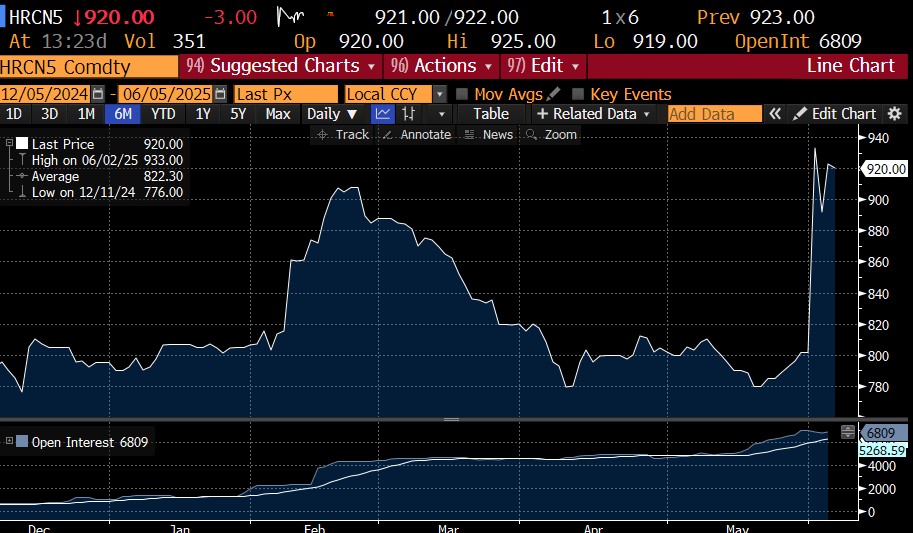
A fierce flat price rally started this week that saw the nearby months rally by over $120/ short tons (st), exceeding the contract highs seen in February ahead of the first batch of tariffs. On May 30, the CME July 25 HRC futures contract was trading just shy of $800/st, but closed Thursday at $924/st.
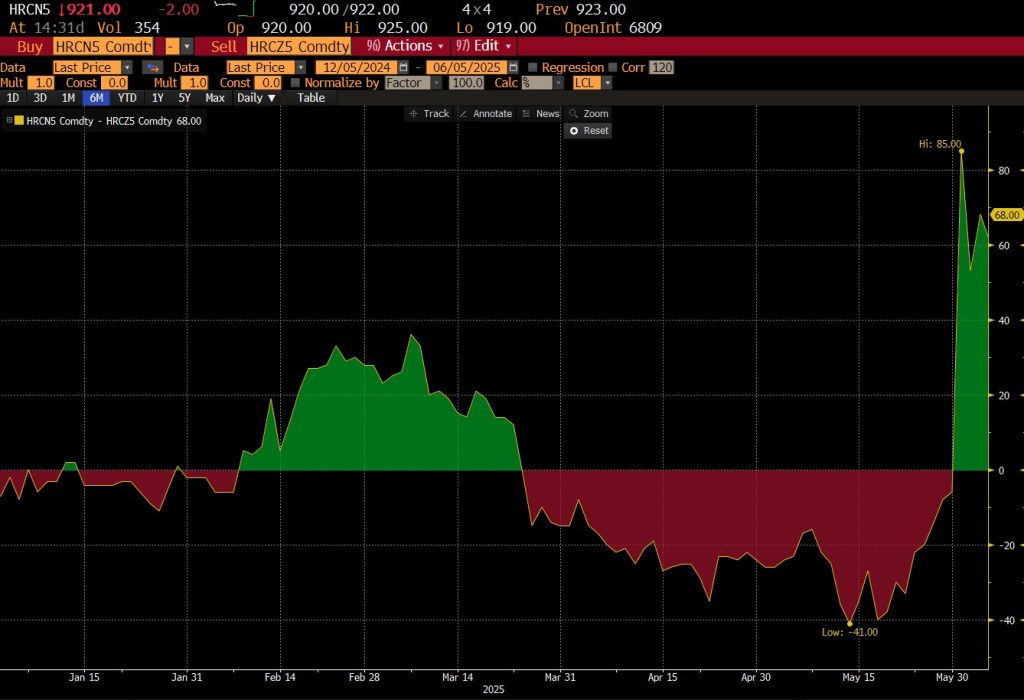
The strength of the bidding on the front of the curve has kept the balance of the 2025 futures curve in a steep backwardation structure, with the July 25 – Dec 25 CME HRC spread settling at a $64/st inverse, as of Thursday’s close.
This futures shape of the HRC curve reflects concerns about the tariffs’ effects on prices are largely near-term focused. Amid ongoing uncertainty about the broader impact to real physical demand, along with uncertainty about the administration’s commitment to maintaining the increased levies, the forward part of the curve has languished relative to the nearbys.
Trade interest and activity in 4Q’25 or Cal26 months has been minimal since the announcement. It’s also interesting to note that with the expiration of the May 2025 HRC futures contract, nearly 140,000 st of open interest has fallen from the total HRC futures complex, which now stands at about 640,000 st.
Despite some of the heaviest traded volume days in the HRC contract in recent memory – Monday’s volume alone totaled nearly 140,000 st – the contract has only managed to add 20,000 st of total fresh interest since May 25’s expiration. This suggests that minimal new positions have entered the market place so far this week, and indicates that trade activity was dominated by shorts covering and longs exiting.
Opinions on the sustainability of the recent move are mixed. Feedback from commercial participants skews somewhat bearish as the overall demand picture for real tons is concerned. Some traders say sales are sluggish and clients say inventories are still sufficient for now, so there’s some debate as to whether the rally has further room to run. Others have said the quick turnaround from the announcement to the implementation of the tariff increase, as well as the looming Nippon-U.S. Steel merger, show a firm and longer-term policy commitment to the increased tariffs.
The CME’s Chicago No.1 busheling contract (BCH) did however catch some fresh interest on the back of the announcement. Monday saw contact high volume of 13,000 gross tons (gt) traded. Open interest now stands at over 50,000 gt across all futures months, and while not exactly deep, it is a notable 25% increase in OI from last week. CME BCH prices followed the lead of the HRC rally, and some commercial participants took an opportunity to sell some length across the 2025 curve.