Market Data

March 29, 2026
Steelmaking raw material prices increase through March
Written by Brett Linton
Editor’s note: Steel Market Update is pleased to share this Premium content with Executive members. For information on how to upgrade to a Premium-level subscription, contact Luis Corona at luis.corona@crugroup.com.
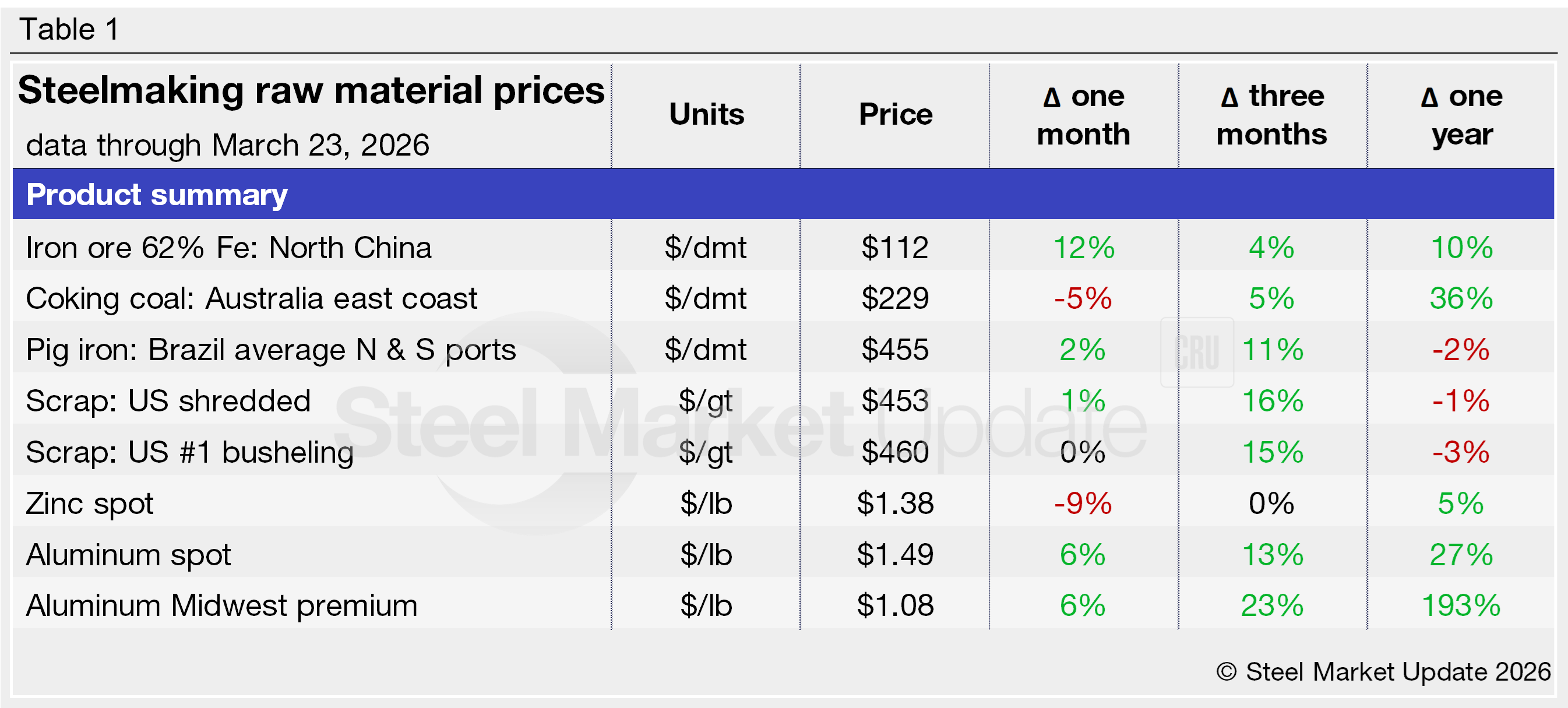
Many of the steelmaking raw materials we track increased in price over the last month. Prices for iron ore, aluminum, pig iron, and shredded scrap have all risen in the last 30 days. Busheling scrap has held steady, and zinc and coking coal have declined. Collectively, prices rose 2% month over month (m/m). Seven of the eight products we track are more expensive than they were three months ago. That said, pig iron and ferrous scrap remain slightly less expensive than they were a year ago.
Table 1 shows the latest prices for each product and their changes from recent months.
Iron ore
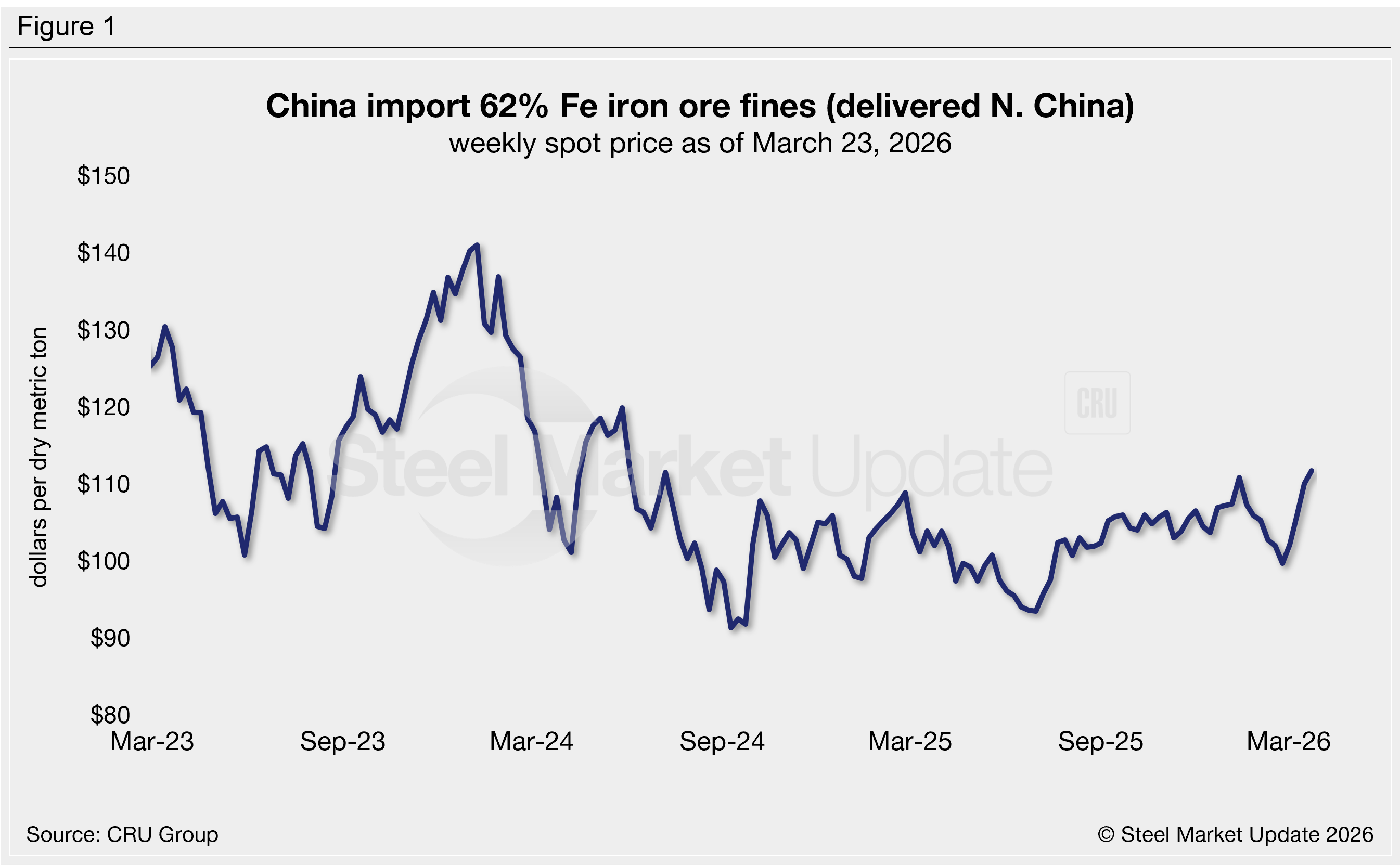
Chinese iron ore fines (62% Fe, delivered North China) have mostly remained between $100-110 per dry metric ton (dmt) since July 2025. Through the week of March 23, prices have ticked up 12% m/m to a year and a half of high $112/dmt (Figure 1). Iron ore is up 4% compared to prices of three months ago and 10% higher than it was this time last year.
Coking coal
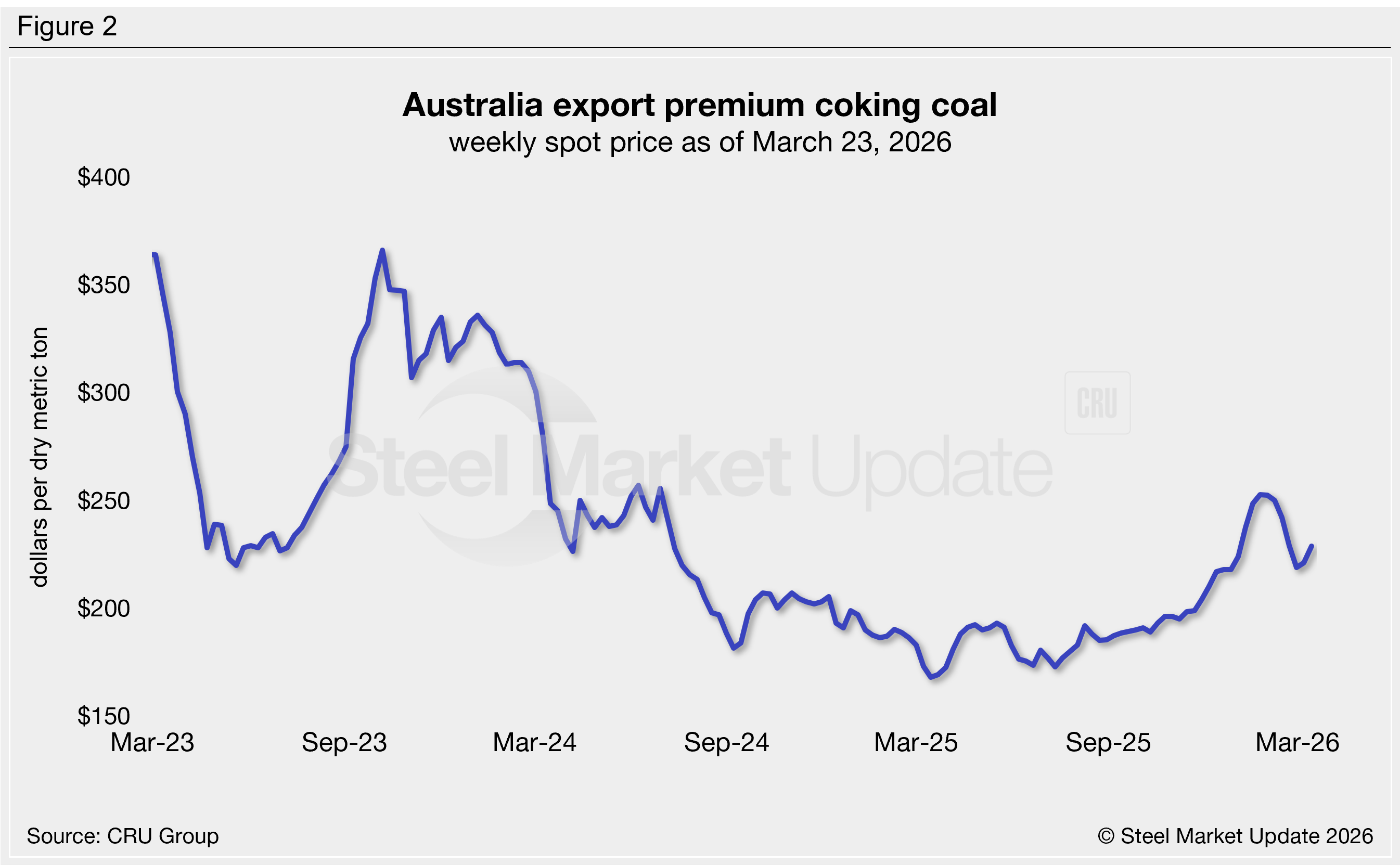
Premium hard coking coal prices have slipped since our previous update but remain at one of the higher rates recorded in the past year and a half. The market had trended upwards from last August through mid-February, when prices rose to a one-and-a-half-year high of $253/dmt. Prices have since fallen 5% m/m to $229/dmt last week (Figure 2). Coking coal prices are 5% higher than they were three months ago and up 36% from year-ago levels.
Pig iron
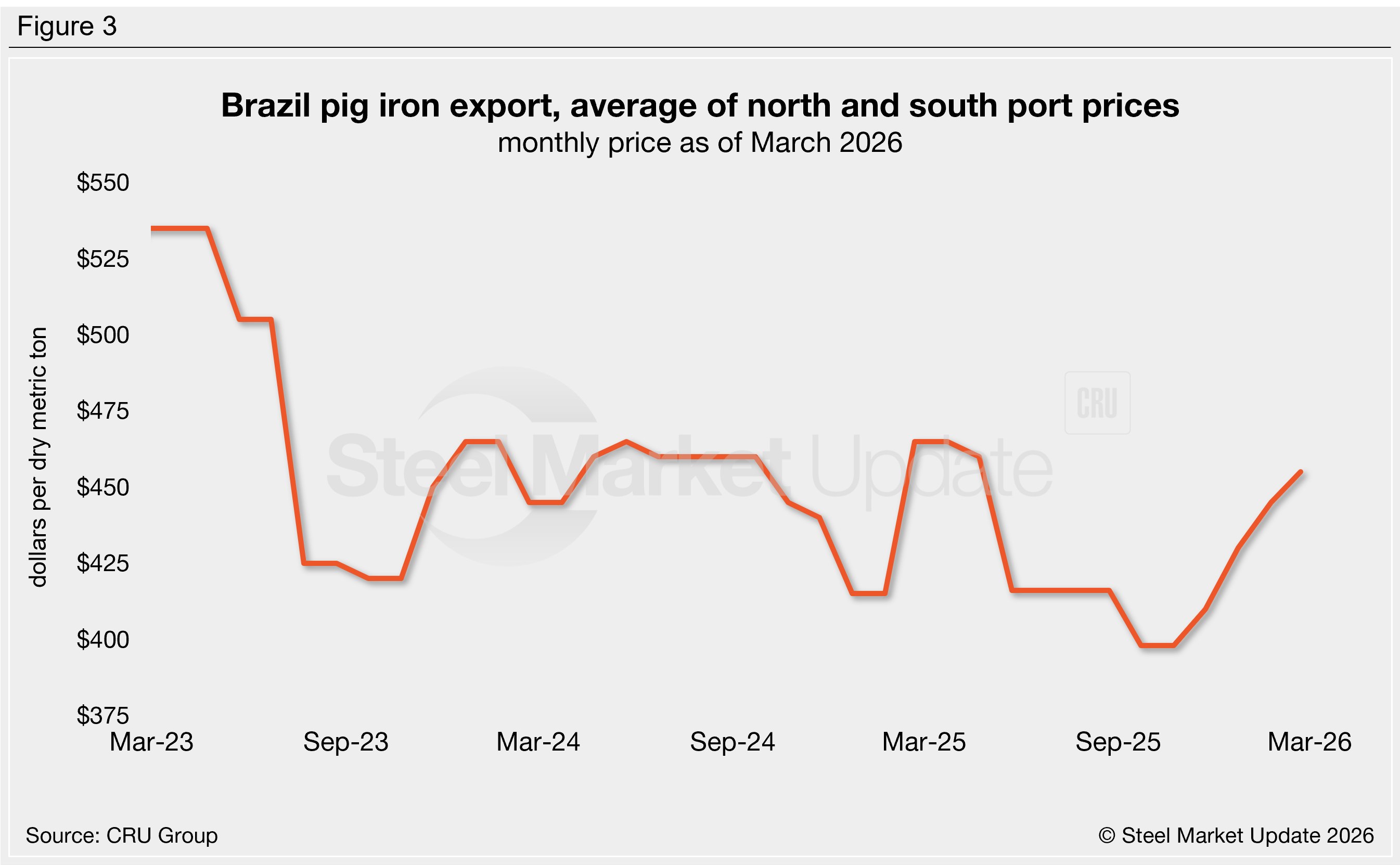
Brazilian pig iron prices have increased each of the last four months after bottoming out last November at $398/dmt. Prices increased 2% m/m in March to a ten-month high of $455/dmt (Figure 3). Pig iron has risen 11% in the past three months but is 2% less expensive than it was one year ago. A recent article by Stephen Miller explains the current state of the Brazilian pig iron market and how some expect prices to increase soon.
Note that this report uses Brazilian pig iron prices because Brazil is now the main source of pig iron for the US. We average prices from the country’s northern and southern ports. (Editor’s note: Russia and Ukraine had been important suppliers to the US market before Russia’s full-scale invasion of Ukraine in 2022. Since then, Russia has been out of the US market, and Ukraine has a reduced presence.)
Scrap
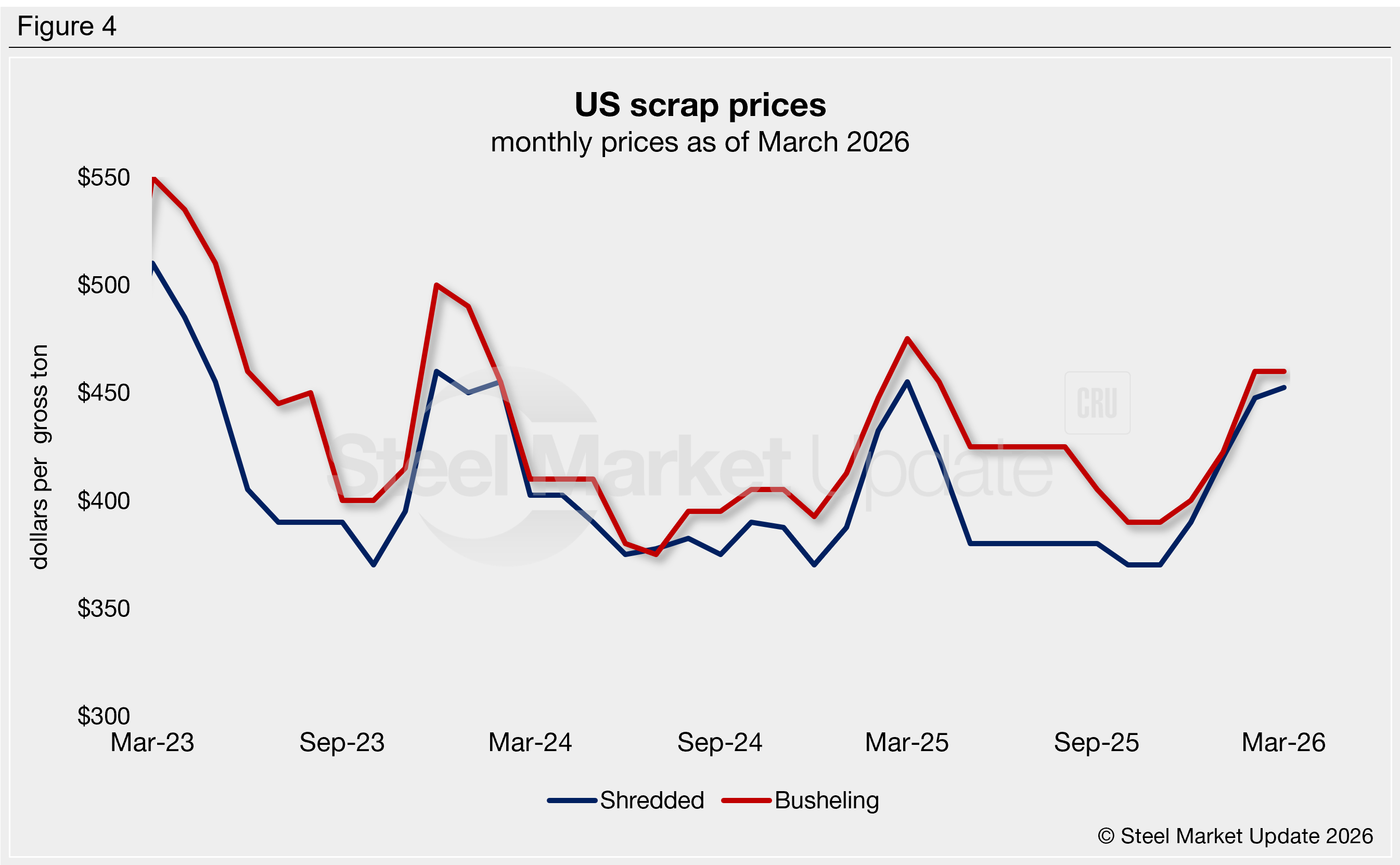
Steel scrap prices were relatively stable from February to March, both within earshot of a two-year high. SMU’s shredded scrap index inched up to $452.50 per gross ton (gt) and our busheling index remained at $423/gt. Scrap prices have increased 15-16% in the past three months but are 1-3% lower than they were this time last year (Figure 4). A mid-March update found that many buyers expect the market to be sideways again in April. Market participants cited continued winter weather impacts and ongoing shipment disruptions.
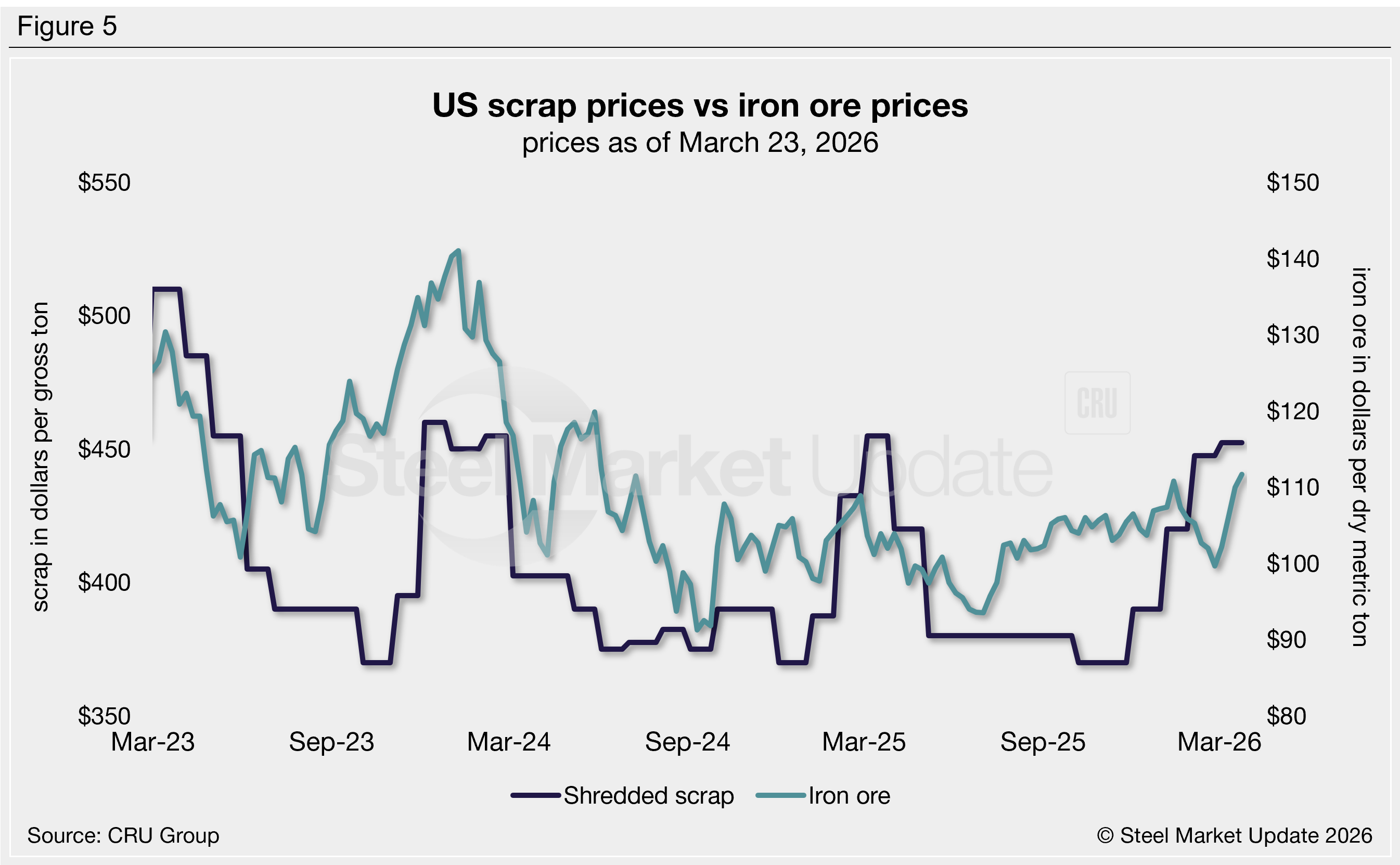
Fluctuations in scrap and iron ore prices provide insight into the competitiveness of integrated (blast furnace) mills, whose primary feedstock is iron ore, versus mini-mills (electric arc furnace), whose primary feedstock is scrap. Figure 5 displays a three-year history for these two products.
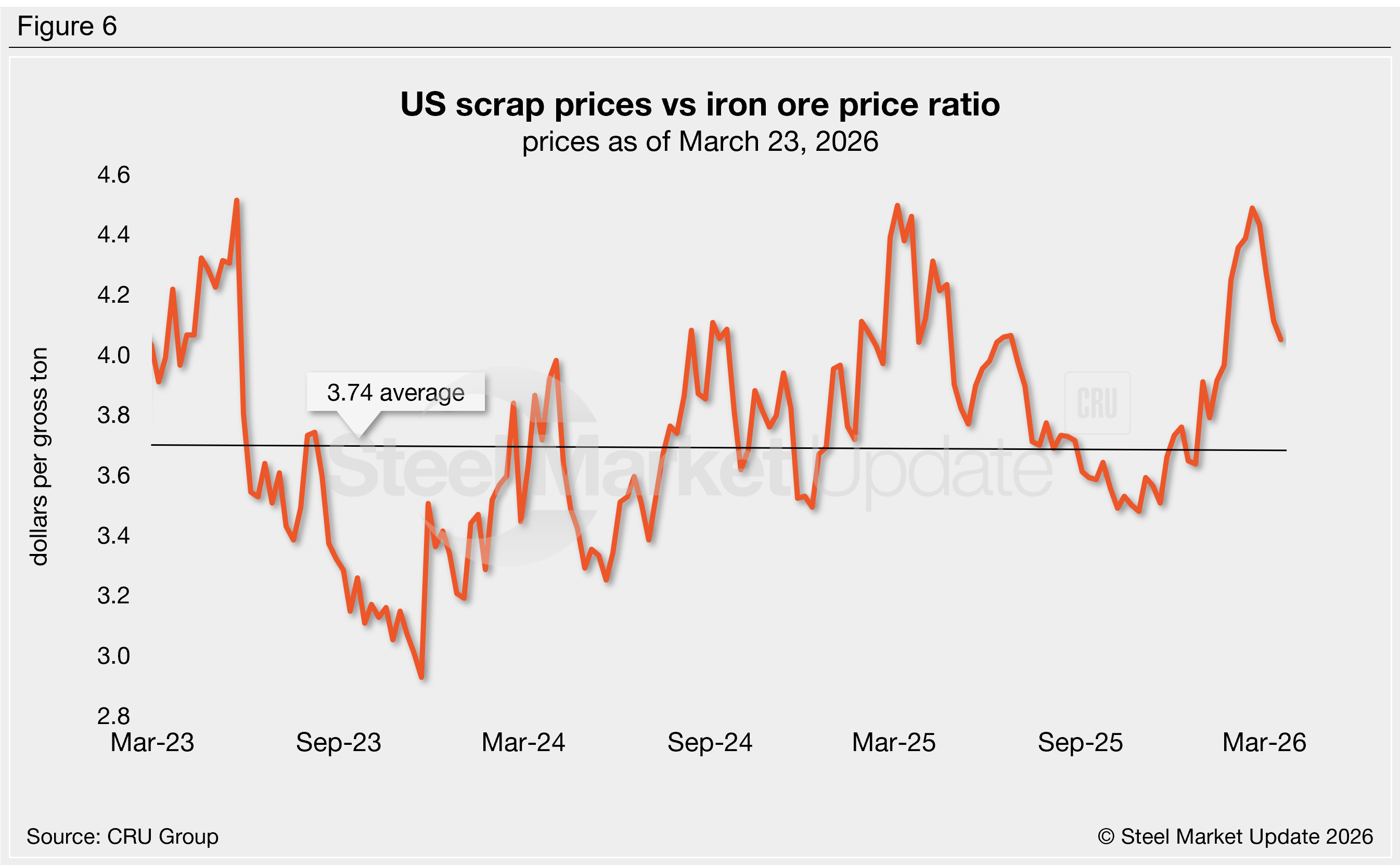
To analyse the cost advantage of these two mill materials, SMU divides the shredded scrap price by the iron ore price to calculate a ratio. A higher ratio favors integrated mills, a lower ratio favors mini-mill producers (Figure 6). This time last year, integrated producers held the cost advantage, but it gradually shifted toward mini-mill producers across the remainder of the year. At the start of this year, we saw the advantage shifting back towards integrated mills. The ratio spiked through late February to a one-year high of 4.49. As of last week, it stands at 4.05, which still strongly favoring integrated producers.
Zinc and aluminum
Zinc and aluminum are used in some coated steel products. Fluctuations in spot prices can prompt steel mills to adjust their galvanized and Galvalume coating extras.
Zinc prices had generally trended upwards for most of the last year, reaching a three-year high of $1.53/lb in late January. Prices have declined 9% in the last month. They were down to a three-month low of $1.38 through last week. This time last year, prices were 5% lower (Figure 7).
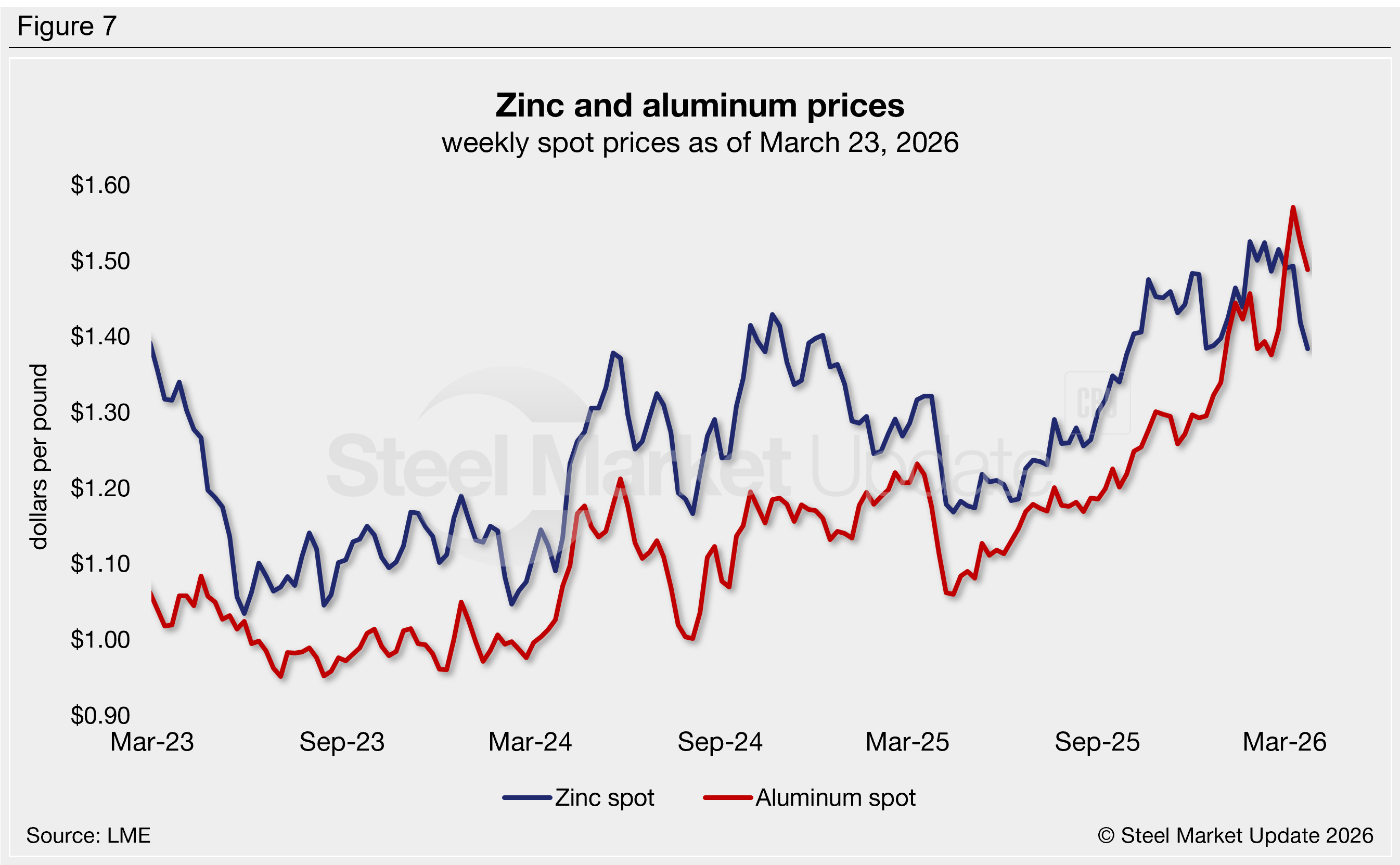
Aluminum spot price movements typically mirror those of zinc. But we saw these prices diverge earlier this year when aluminum prices spiked because of the Iran war. The latest weekly LME cash price is $1.49/lb, just $0.08 below the four-year high seen two weeks prior (Figure 7). Prices have increased 13% in the last three months and 27% over the past year.
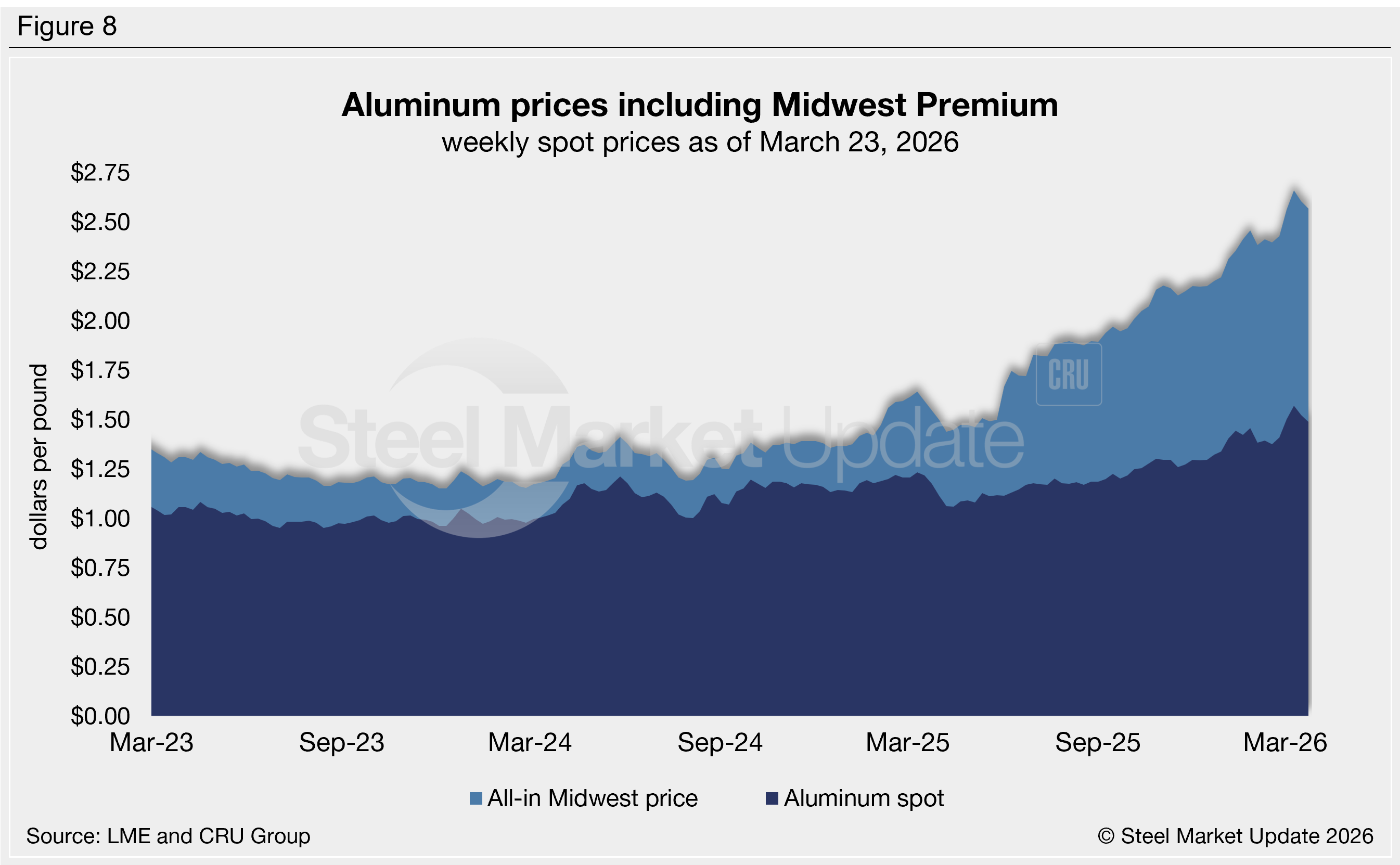
The weekly average aluminum MWP reached $1.08/lb this week, one penny beneath the record high set in early March (the highest rate in our limited six-year data history). The MWP has increased 23% in the last three months and is up 193% from year ago levels. The huge gains in MWP stem in large part from 50% Section 232 tariffs on Canada, where the US gets most of its imported aluminum from. The all-in Midwest aluminum price now totals $2.57/lb (Figure 8). It recently peaked at $2.66 in early March.