American mills urge Trump to maintain no exceptions on steel tariffs
"We urge you to resist any requests for exceptions or exclusions and to continue standing strong on behalf of American steel," the companies wrote.


"We urge you to resist any requests for exceptions or exclusions and to continue standing strong on behalf of American steel," the companies wrote.
US rig counts remain slightly above multi-year lows, while Canadian activity is experiencing a seasonal decline from a recent seven-year high.
The Trump 1.0 tariffs appeared to have little positive effect on the US manufacturing, partly because they hurt export competitiveness.

SMU’s Buyers’ Sentiment Indices both declined this week but remain strong. This indicates buyers are still optimistic about their companies' ability for success.

An inventory valuation of the assets of Altos Hornos de Mexico SA (AHMSA) has been completed. Local reports suggest an auction for the assets of the bankrupt steel company could come as soon as the end of this month.

Wonder what the fallout from all the Trump tariffs might be? A manufacturing renaissance? A post-WWII order in ashes? Or something a little more down the middle? Then register for our next Community Chat on Thursday, March 13 at 11 am ET. Yes, you read that correctly, SMU is shattering precedent by holding a Community Chat on a day that is not Wednesday. Our featured speaker will be Alan Price, a leading trade attorney at Wiley and someone whose columns you read regularly in SMU.

Before we get whipsawed by the current moment, it’s important to reflect on optimism. Whatever happens, consumers are going to need steel.

Headline risk has returned to the ferrous complex, with both hot-rolled coil (HRC) and busheling ferrous scrap (BCH) markets surging in response to fresh trade restrictions.
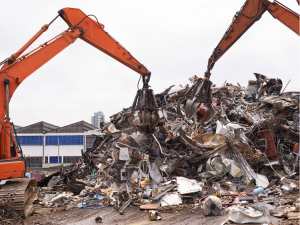
The situation on ferrous scrap has cleared up with the pause of the implementation of Canadian and Mexican blanket tariffs.
Buyers responding to our latest market survey reported longer lead times this week on all of the sheet and plate products SMU tracks.
Facing an uncertain tariff trade war, Algoma Steel took action this week, halting steel shipments to the US, laying off employees, and prepping for an unknown future, according to local media reports.
Manufacturing activity exhibited slight to modest increases across a majority of districts. However, manufacturers expressed concerns over the potential impact of looming trade policy changes between late January and February.
The majority of the steel buyers responding to our latest market survey reported that domestic mills are not open to negotiating prices on new orders this week.
The latest on the trade war

Mexico has launched an anti-dumping investigation into imports of hot-rolled steel from China and Vietnam.

On 4 March, new 25% blanket tariffs across all products exported to the USA from Canada and Mexico are now in effect. The only exception is Canadian energy products, which will be assessed a 10% tariff.

April 2 is when reciprocal tariffs are expected to kick in.

Remember infrastructure week in Trump 1.0? It became a running joke. Because it was almost always derailed by whatever the scandal of the day was. In Trump 2.0, we've got tariff week. And unlike infrastructure week, tariff week is no joke.
Steel prices climbed across the board this week, with every steel product tracked by SMU rising to multi-month highs.
Don't forget that Trump's reinstatement of the Section 232 tariffs on steel and aluminum imports is slated for Wednesday, March 12.
“It is completely shocking for the United States to treat a long-time and fair trading partner in this manner,” the Canadian Steel Producers Association said.
The Association of Equipment Manufacturers slammed the use of "broad and indiscriminate" penalties.
Construction spending edged down slightly in January, slipping for the first time in four months. The US Census Bureau estimated spending at a seasonally adjusted annual rate of $2,196 billion in January, down 0.2% from December’s downward revised rate. The January figure is 3.3% higher than a year ago. January’s result, despite the slight erosion, […]
Steel Manufacturers Association (SMA) President Philip K. Bell stressed a mood of "cautious optimism" for steel on what turned out to be Tariff Eve.
We really don’t know yet what and how severe the impact will be. But we do know ferrous scrap will become more expensive in the US. And it will be less expensive for Canadian mills. The larger consequences will be felt on the Canadian front. Even so, in the Southwest, the tariffs on Mexico will lower prices for Mexican scrap and might limit normal flows across the border.
SMU’s Monthly Review provides a summary of key SMU steel market metrics for the previous month, with the latest data updated through February 28th.
These tariffs would significantly increase costs for American manufacturers that rely on Canadian metals. They would also disrupt supply chains and weaken economic ties that have benefited both nations for decades.

President Trump reaffirmed Monday afternoon that his 25% universal tariff on all imports from Canada and Mexico would take effect on Tuesday. “Tomorrow – tariffs 25% on Canada and 25% on Mexico. And that’ll start,” Trump told reporters Monday, according to an Associated Press report. “They’re going to have to have a tariff.”
The Manufacturing PMI registered 50.3% in February. That’s 0.6 percentage points lower compared to the 50.9% recorded in January.
The main impact of tariffs on scrap prices would be felt in Northern states - and especially among those along the Canadian border. Many steelmakers in this area receive a substantial portion of their monthly scrap charge from Canadian processors. Much of it is prime scrap used by hot-rolled (HR) coil producers.