Nucor increases HR spot price by $5/ton
Nucor increased its weekly hot-rolled coil spot list price by $5 per short ton on Monday, Nov. 10.


Nucor increased its weekly hot-rolled coil spot list price by $5 per short ton on Monday, Nov. 10.
North America continues to anchor Klöckner & Co.’s performance in 2025. The Kloeckner Metals Americas segment delivered robust earnings in the third quarter despite softer steel prices.

The Dodge Momentum Index (DMI) fell more than 7% in October, sliding for the first time in six months. Still, the index is up 35% year-to-date, according to the latest data released by Dodge Construction Network.
Nippon Steel is positioning U.S. Steel as a cornerstone of its global growth strategy, highlighting the US as the most developed and demand-rich market, especially for premium steel products used in the automotive, energy, and infrastructure sectors.

AMU's latest survey of aluminum market participants shows widening gaps in lead times, with extrusions lengthening dramatically.
Nippon Steel is making good on the big capex promises it made to secure its purchase of United States Steel Corp. This week, the Japanese company and American steelmaker together unveiled various capital investments they plan to make across U.S. Steel’s footprint.

Earlier this week, SMU polled steel buyers on an array of topics, ranging from market prices, demand, and inventories to tariffs, imports, and evolving market events.
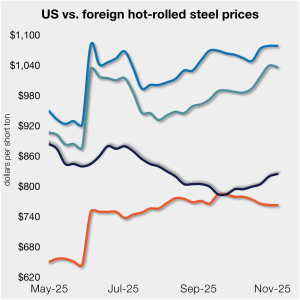
The gap between US hot band prices and imports narrowed slightly. But with the 50% Section 232 tariffs, most imports remain more expensive than domestic material.
U.S. Steel has unveiled more details of a multi-year growth plan in partnership with Nippon Steel.
Shipments from US steel mills were strong in September, according to the latest figures provided by the American Iron and Steel Institute (AISI).

Most sheet prices inched up again this week following mill efforts to set a floor under tags and to increase them from there.
The United Steelworkers (USW) union has voted down a tentative agreement with Metallus. The parties will continue the existing labor contract for 90 days, until Jan. 29, 2026, as they continue negotiating.
SunCoke Energy’s earnings declined in the third quarter as weaker domestic coke sales and contract economics weighed on results.
The volume of raw steel produced by US mills eased last week, according to AISI's latest figures. Prior to this month, output had remained historically strong since June.
Nucor increases HR spot price by $5/ton
With infrastructure demand shifting toward digital capacity, Nucor Corp. is positioning itself as the go-to steel supplier for the data center boom.
The latest Baker Hughes rig count report showed oil and gas drilling slowing in both the US and Canada last week.

SMU’s Steel Buyers’ Sentiment Indices both rose this week, with Current Sentiment rebounding 14 points.

Most steel buyers responding to our market survey this week reported that domestic mills are considerably less willing to talk price on sheet and plate products than they were in recent weeks.
Ternium closed the third quarter with steady shipments and improving margins. But trade policy uncertainty and subdued demand in Mexico weighed on the Latin American steelmaker’s results.

Steel mill lead times marginally extended for both sheet and plate products this week, according to responses from SMU’s latest market survey.

Executives framed the all-stock deal as a path to scale, efficiency, and long-term growth despite ongoing weakness in the metals market.
Sheet steel indices increased across the board this week, while plate prices held steady. All five of SMU’s price indices are higher than they were two weeks ago, and all but one are above levels recorded four weeks ago.
Nucor entered the fourth quarter with clear forward momentum: stronger-than-expected results, solid sheet and plate demand, and construction progress on a major new mill that should add capacity next year.
Nucor has pulled the plug on a planned rebar micro mill in the Pacific Northwest.
Domestic mill production inched higher last week, according to the latest figures released by the American Iron and Steel Institute (AISI). Prior to the start of this month, raw output had remained historically strong since June.

As another month goes by and another futures columnist starts by saying “not much to see here,” I understand that a reader might flip their brain to skim mode.
Demand for plate on the spot market remains soft by comparison to years past. However, this week regional demand variations grew more pronounced.

Our average HR coil price increased $5/short ton from last week, marking a second consecutive week of modest gains. Market participants generally attributed the increase to...

Medium- and heavy-duty trucks (MHDV) and buses imported to the US will start being charged Section 232 tariffs beginning Nov. 1.