
Final Thoughts
I think it’s fair to say that the last few weeks – and last week especially – have been among the most intense for any of us covering steel (or aluminum).


I think it’s fair to say that the last few weeks – and last week especially – have been among the most intense for any of us covering steel (or aluminum).

A look at how SMU survey respondents are reacting to President Trump's recent actions on tariffs.
A lot of the changes basically entail rolling back what I’ll call, for fun, Section 232 Lite. S232 Lite resulted from watering down what I’ll call OG S232 – the one first imposed in March 2018 - with exemptions and exclusions over the years. Now, OG Section 232, is back with its across-the-board 25% tariffs against everyone.
An exciting first look at the results from SMU's first scrap survey.
As Wolfe Research’s Timna Tanners put it in her opening talk at Tampa on Monday afternoon, we’re living in a world of “Trumplications” now. That probably means – at least in the short term – higher scrap costs, lower imports from countries hit with or threated tariffs, and higher steel prices. SMU data reflects that. Scrap went up in January. More than 75% of the respondents to our more recent survey expect scrap to go up again February, maybe by a lot. Lead times, meanwhile, have been ticking upward this month. It started with hot-rolled coil and plate earlier this month. Now we’re seeing coated lead times extending too.

We joked in our last Final Thoughts that Wiley trade attorney Tim Brightbill – one of the nation’s leading experts on trade law and policy – would probably be revising his presentation on Trump, trade policy, and tariffs for the Tampa Steel Conference. He did. And even after those last-minute revisions, he actually got trumped […]
The whole SMU team is packing up our laptops and our SMU polos/cardigans, loading up the PowerPoint slides, and preparing to make the trek down to Florida for the Tampa Steel Conference. There will be plenty to talk about!
From one group of folks, I’ve heard that Trump might not wait until Feb. 1 – the date he threatened on to place tariffs on China, Canada, and Mexico. They say he could act as soon as Friday. And then there are those who don’t think anything will happen before April 1. That’s the deadline for Commerce, Treasury, and USTR to submit key reports on “America First Trade Policy” to President Trump.
Trump made a clarification in a speech on Monday. Previously, he had declared the word “tariff” the most beautiful word in the dictionary. No longer.
President Donald Trump on Sunday hammered Colombia with 25% tariffs and threatened to increase them to 50%. Trump in a post on Truth Social said he took the action not because of a trade dispute but because the South American nation had refused to accept planes carrying deported immigrants. The president also cited "national security" concerns, just as he did to justify 25% Section 232 tariffs on steel in his first term. Even the 50% threat echoes his first term. Turkish steel, like that of most nations, was assessed a 25% tariff in March 2018. Trump doubled Turkey's tariff to 50% via a tweet in August of that year over a matter unrelated to steel.
We surveyed many of you this week and asked what you wanted to see from the new Trump administration. Responses were varied but fell largely into three groups: tariffs and trade policy, the Nippon-U.S. Steel deal, and those who are concerned about too much government sway in steel. Some also expressed hope that President Trump would continue the infrastructure spending that began under former President Biden.
Sometimes new presidential administrations hit the ground running. No time for change like the present. And sometimes new administrations blast off on a SpaceX rocket bound for Mars. There’s a big universe, and we’ve got a lot of flags to plant. Such seems to be the case with the new Trump administration.

Next Monday marks the start of the second Trump administration. The limbo we’ve been living in since Election Day in early November will finally come to an end. What better way to take a look at what’s coming up in Washington, D.C., than a conversation with Steel Manufacturers Association (SMA) President Philip K. Bell. He […]
It’s another week of big headlines and ho-hum pricing moves – which is to say the start of 2025 is looking a lot like the end of 2024. Scrap has settled up $20 per gross ton (gt). Steel prices, however, were a soft sideways this week. Chalk it up to uneven demand and abundant supply. And while we’re not aware of any major outages, some of you tell us that you’ve lost some shipping days here and there because of the recent cold snap.
SMU lets readers respond on their thoughts about President Joe Biden blocking Nippon's deal for U.S. Steel.
Some world-changing events happen in an instant. Others take many twists and turns. The outcome remains unknowable at every phase. That is, until you finally arrive at the end of the roller coaster, the safety bar lifts up, and you stagger off the ride. It appears such is the case with Japan’s Nippon’s Steel Corp.’s (NSC’s) proposed $14.9-billion buy of Pittsburgh-based U.S. Steel. And the ride ain't over yet.
We never eat chicken on New Year’s Day. My Irish-Catholic grandmother thought it was bad luck – because chickens scratch backward. And one should start the year looking forward. But it’s hard to avoid the fact that we’re carrying a lot 2024 issues (and even 2023 ones) forward into 2025. That’s not all bad. We’re starting 2025 with SMU’s hot-rolled coil price at $675/per short ton (st). That’s $370/st lower than $1045/st at the outset of 2023, according to our interactive pricing tool. I think we can safely say that a decline of that magnitude won’t happen in 2025.

And just like that, we’re wrapping up the last SMU newsletter of 2024. We’re closing out our 19th year and looking with wide-eyed anticipation to what 2025 will bring.
SMU looks back at stories from Decembers past, one, five, 10, and 100 years ago.
It's that time of year again. You know, that time when people wonder if those things are drones in New Jersey or if the aliens are ready to come onto the stage just in time for Inauguration Day. What will that do for steel price volatility? In any case, the SMU team finds itself in Pittsburgh this week.
The Community Chat last Wednesday with ITR economist Taylor St. Germain is worth listening to if you couldn’t tune in live. You can find the replay and Taylor’s slide deck here. You can also find SMU reporter Stephanie Ritenbaugh’s writeup of the webinar here. Taylor is Alan Beaulieu’s protégé at ITR. Many of you know Alan from his talks at SMU Steel Summit. I found Taylor’s analysis just as insightful as Alan’s.
It’s been another week of torrid speculation when it comes Trump and tariffs. And another week of mostly flat price movement when it comes to steel sheet and plate. As far as Trump and tariffs go, I think I might have lost track. We've potentially got 10% blanket tariffs on imports from China, 25% tariffs on imports from Canada and Mexico, 100% tariffs on the BRICs, and 200% on Caterpillar. Canada might be the 51st state. Mexico could be the 52nd state. But all can be resolved if you stop by Mar-a-Lago and kiss the ring?
As my colleague Ethan Bernard noted in our most recent Final Thoughts, I don’t think many of us thought uncertainty would be mounting four weeks out from 2025. If anything, the general theme post-Steel Summit and into Q4 was that election night would be the turning point. And whatever had been keeping the steel market from building would finally get the jump-start it needed.
Never have I been more certain in declaring that those in the steel industry are less certain now than they thought they’d be at this point before the election.
“Trump took to Twitter.” That was a familiar story lead in Trump 1.0. Now it’s “Trump took to Truth Social (or X)." The latest example: President-elect Donald Trump on Monday evening said he was “totally against” U.S. Steel being acquired by Nippon Steel in a post on Truth Social.
And so it begins (again). Not to be outdone by Thanksgiving, President-elect Donald Trump has threatened to impose tariffs of 25% on all imports from Canada and Mexico. He also threatened to hit all imports from China with tariffs of 10% - an amount that would come on top of a boatload of pre-existing duties and tariffs.
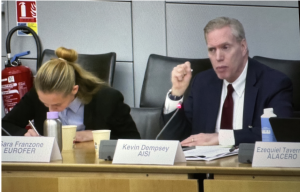
“We’ll always have Paris,” as the famous line in Casablanca goes. And this month, the global steel industry did as well. The Organization for Economic Co-operation and Development (OECD) Steel Committee met in the City of Lights earlier this month. There was also a meeting of the Global Forum addressing excess steel capacity.
It’s once again A Tale of Two Cities in the steel market. Some are almost euphoric about Trump’s victory. Others, some rather bearish, are more focused on the day-to-day market between now and Inauguration Day on Jan. 20.
t this point in the game I think what we can say about Nippon Steel’s proposed buy of Pittsburgh-based U.S. Steel is that it will go through, it won’t go through, or the outcome will be something new and completely unexpected. Then again, I’m probably still missing a few options.
President-elect Donald Trump continues to send shockwaves through the political establishment (again). And steel markets and ferrous scrap markets continue to be, well, anything but shocking. As the French writer Jean-Baptiste Alphonse Karr wrote in 1849, "The more things change, the more they stay the same." (I thought the quote might have been Yankees catcher Yogi Berra in 1949. Google taught me something new today.)