
• Skip to main content

    Overseas

    Chinese Steel Export Tax Rebate Rumors Re-Surface

    Written by John Packard


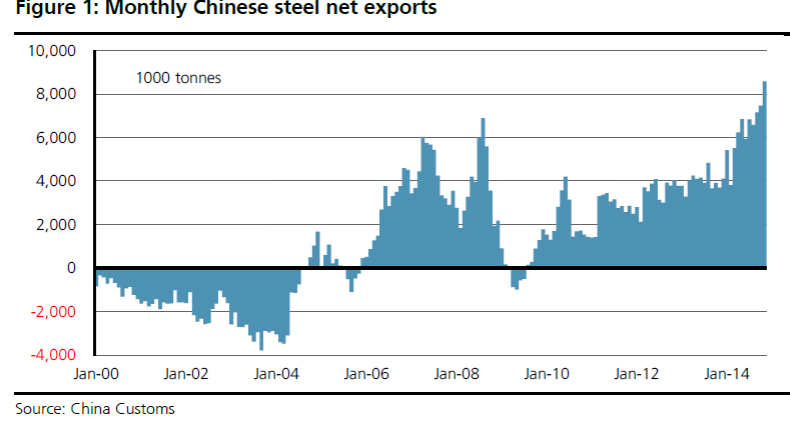
    The subject of how China is going to deal with their surging steel exports continues in earnest after the release of the most recent Chinese export data. As the graphic shows below, the Chinese steel mills have spent this calendar year flooding the world markets with their steel excesses. In November the Chinese steel mills exported 9,720,000 metric tons (10,714,000 net tons) of steel products around the world. This is an increase of 12.1 percent over October’s 8,550,000 metric tons of steel exports.

    Latest in Overseas

    Commerce amends duties on pipe and tube imports

    The US Department of Commerce recently made adjustments to the anti-dumping duties (AD) on certain steel pipe and tube imports after annual administrative reviews, according to notices in the Federal Register. Commerce reviewed the AD order on imports of oil country tubular goods (OCTG) from Mexico and lowered the dumping rate for one company. Tubos de Acero de Mexico received a 1.87% dumping rate for the year ended Oct. 31, 2024. The rate is down notably from 26.1% in the previous year. The all-others cash deposit rate remains set at 44.93%.

    US tweaks import duties on Korean plate

    After an annual administrative review, the US Department of Commerce is adjusting the countervailing duties (CVDs) on imports of cut-to-length carbon-quality steel plate from South Korea. For the 2024 calendar year, Commerce set CVDs of 1.89% for Dongkuk Steel Mill and 1.39% for Hyundai Steel, according to a Federal Register announcement. The rates have changed slightly from the prior year review: Dongkuk's is down from 2.21% and Hyundai's is up from 1.31%. The cash deposit rate for all other companies remains 3.26%.

    Price on Trade: Steel’s zero-sum game

    During the first three quarters of 2026, finished steel imports from South Korea increased 50.8% compared with the same period in 2025. Imports from Vietnam increased 23.4%, imports from Turkey increased 49.5%, and imports from India increased 29.5%. Those are not marginal increases. They are substantial import surges, especially in a US market where apparent domestic consumption has bounced around but has not grown since 2017. More importantly, these import surges are arriving at lower average unit values (AUVs).