Analysis

April 2, 2026
Final Thoughts: the Iran War, tariffs, and the dark side of The Moon
Written by Michael Cowden
I was writing this column on the one-year anniversary of “Liberation Day,” when President Trump’s “reciprocal tariffs” sent markets into turmoil and put an abrupt end to a Q1 steel-price recovery.
You could make the case there are parallels between last year and our current moment. We certainly had some tariff news today. More on that in a moment.
But the parallel that seems most apt this time is the Iran War: Trump in a speech on the evening of April 1 said he would hit Iran “extremely hard over the next two or three weeks” after saying earlier in the week that the Iran War might be over “within maybe two weeks.”
Brent crude, the oil benchmark used by most of the world, hit its highest point since 2008. Equities fell (although they later narrowed their loses). Meanwhile, steel prices, like lead times, continue to hold steady or inch higher. So, this isn’t a mirror of last year. There has been no immediate steel market impact from the Iran War as there was from “Liberation Day”.
That said, I mentioned in my last Final Thoughts that we would introduce a question about the Iran War this week. We have, and we appreciate all of you who not only ticked a box but also offered some comments.
If I had to sum it up, I’d say “pain at the pump” is back. AAA says gasoline now averages more than $4 per gallon nationally ($4.08 to be precise) for the first time in four years. Meanwhile, diesel prices average $5.40 per gallon, according to the US Energy Information Administration. That’s up $1.81 per gallon from a year ago.
(Editor’s note: We’ve released our steel market survey results a day earlier than usual because our offices will be closed tomorrow in observance of Good Friday. The page numbers in the images, which you can click on to expand, refer to where in the survey deck you can find them. The full deck is available to our premium subscribers here.)
Iran War impact on steel
As you can see, 65% of survey respondents said the Iran War was impacting their business, 25% said they weren’t sure, and only 10% said it was having no impact.
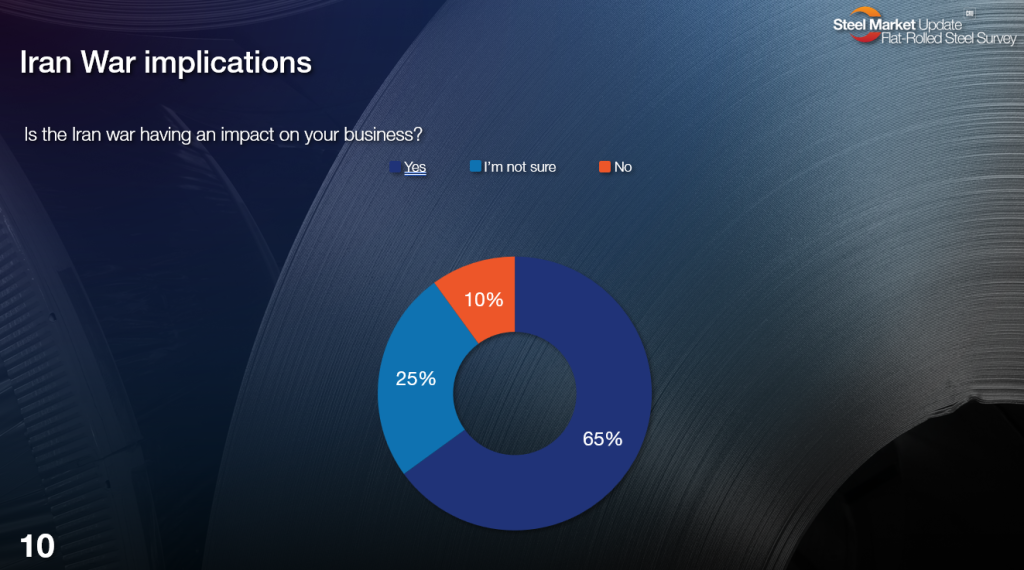
Below is what some respondents had to say.
Yes, it is having an impact:
“I think we’ve passed the point where there would be no impact. If you haven’t been impacted, your domino just hasn’t fallen yet.”
“It is. Because gas is skyrocketing, and everyone is starting to sit on cash again. No bueno!”
“Freight costs are moving higher. This always has an impact on steel.”
“Diesel prices! Freight prices have to be monitored closely”
“Prices are up due to energy costs.”
“Higher freight costs, uncertain trade flows, and higher overall costs as it related to oil and gas products.”
“Fuel prices have a significant impact on our operating costs.”
“Freight costs are rising rapidly.”
“Increased oil pricing, related to freight. Aluminum availability.”
“Concerns over steel deliveries.”
“Higher fuel prices affect all shippers of freight. But it’s a temporary spike. We have seen these fuel surcharge levels before, navigated, and kept pushing forward.”
“More uncertainty keeping buyers cautious; energy inflation costs.”
“Higher transport costs.”
“Negative sentiment.”
I don’t know whether it is having an impact
“Consequences still to be seen.”
“Other than prices rising, the business pace is improving.”
“I think it is throttling demand for construction on the West Coast. High construction costs and stubborn interest rates are probably holding back projects.”
In short, the “yes” camp had a lot to say. The “I don’t know” camp had less to say. And literally no one who ticked “no” explained why the Iran War wasn’t having an impact. So, hey, “no” folks, next time let us know what you’re thinking!
Tariffs remain unpopular among buyers
As for tariffs, we’ve had news on Thursday on Trump’s tariffs on downstream steel- and aluminum-containing products.
You might recall those tariffs stood at 50%. But there had been complaints that determining the value of steel or aluminum in a part made of multiple materials was complicated and difficult for Customs and Border Protection (CBP) officials to administer. What’s changed? Trump in a proclamation reduced the tariff to 25% but applied it to the entire good rather than just the steel and aluminum it contains.
This probably shouldn’t come as a complete surprise. Zekelman Industries Executive Chairman and CEO Barry Zekelman advocated for such an approach when he spoke at the Tampa Steel Conference in February.
Our latest polling doesn’t reflect the impact of potential changes to downstream tariffs. But it does capture a period in which the reciprocal tariffs – aka International Emergency Economic Powers Act (IEEPA) – were struck down by the Supreme Court. It also captures a period in which Trump has put in place 10% Section 122 tariffs as a stopgap measure. (They went into effect on Feb. 25 and last for 150 days, which takes us to late July.) Meanwhile, the administration has signaled it will then replace the 122 tariffs with other measures, which Wiley trade attorney Alan Price details here.
Have any of those developments changed what steel buyers think of tariffs? Not really. Opinions remain fixed, as you can see in the chart below:
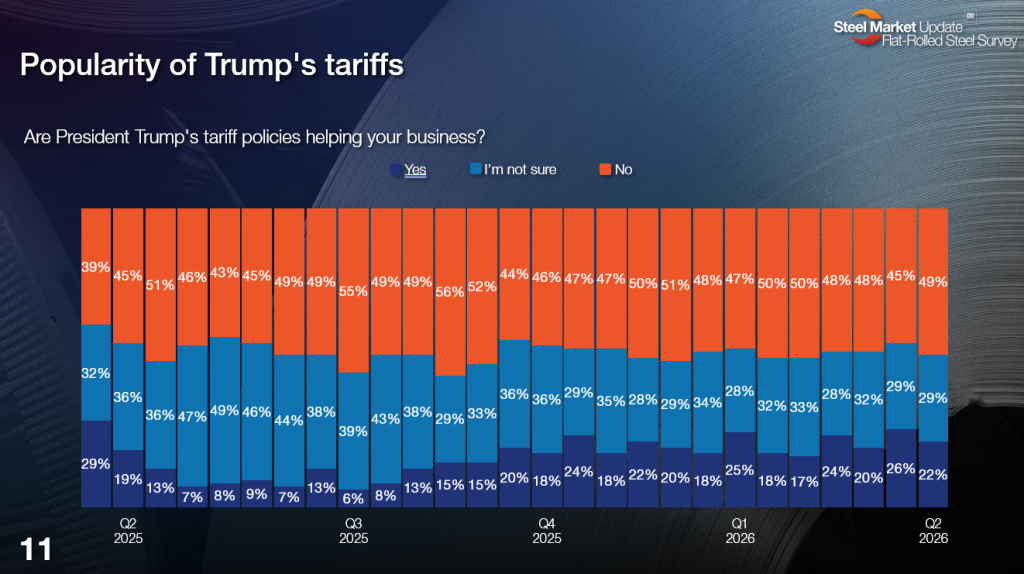
When we ask steel market participants what they think of tariffs, most continue to say the tariffs are not helping their business (49%) or they’re not sure of the impact (29%). Only a minority (22%) tell us tariffs are helping their companies.
Here is what some survey respondents had to say, in their own words.
No, tariffs are not helping my business
“Prices of metal just keep going up!”
“They are inflating prices and causing companies to make slow decisions.”
“I’m pretty exhausted at this stage.”
“They are hurting our business by restricting trade and making business difficult in general.”
“Raising costs and restricting supply.”
“Creating additional cost impacts.
Yes, tariffs are helping my business
“Creating a domestic price floor. Seems like everyone has forgotten 2024 and most of 2025.”
“Higher pricing lifts all boats. At this point, the tariff economy is here to stay for another two years – so time to accept it and adapt.”
“Onshoring; also border fence demand.”
“Still seeing signs of quotes for items being reshored.”
“The higher price of steel creates a larger spread between secondary and prime.”
“Inventory values remain stable, and imports declining should continue to help that.”
Despite being unpopular among many steel buyers, as far as we can tell, the Trump administration has given no signals that it plans to back off its strict tariff regime. Or, as one respondent noted, “the tariff economy is here to stay” (at least as long as Trump remains in office).
As I’ve noted before, the “yes” camp to the tariff question – despite being a minority – is very vocal in the comments. It’s the “I don’t know” folks who have kept quiet. If you’re on the fence on tariffs, please let us know your thoughts next time. We promise not to bite.
Evidence of reshoring. Maybe?
Finally, are we finally seeing evidence of reshoring?
While there has been a lot of news about both tariffs and the fragility of global supply chains lately, most people continue to tell us they have seen no evidence of reshoring (39%) or that it’s too early to say (30%). But a solid minority (31%) say they do see manufacturing moving back to the US.
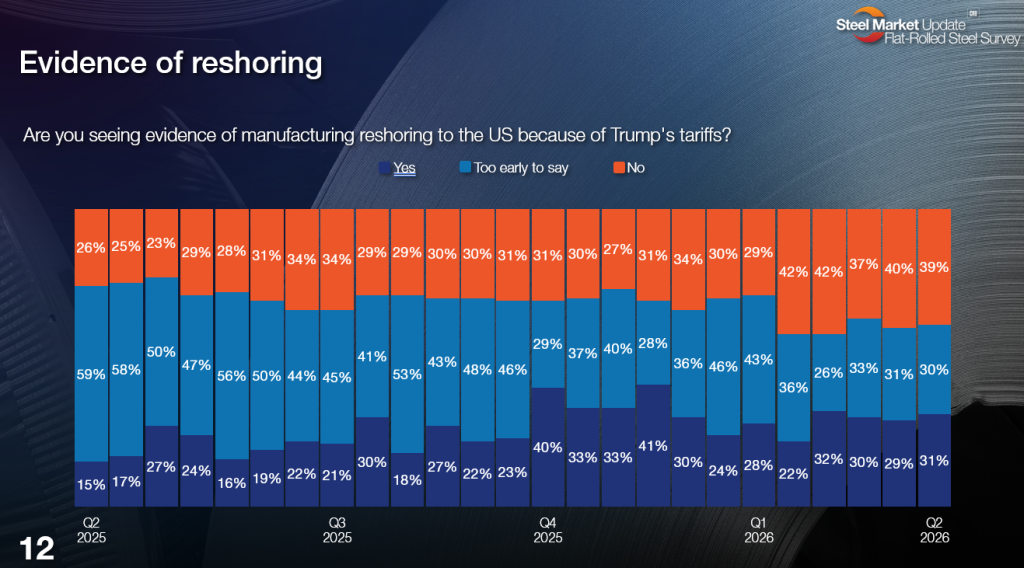
Here is what some of them have to say:
No, I’m not seeing evidence of reshoring
“Waaaayyyy too much ‘noise’ out there to determine what is actually real.”
“Mostly talk in my estimation.”
“Outside of normal investment in the US, no.”
It’s too early to see evidence of reshoring
“Tons of announcements, very little actual production moved back at this point.”
Yes, I’m seeing evidence of reshoring
“Some, but not much.”
“Numerous end-user segments.”
“Folks are considering moving roll forming lines to the US from Mexico.”
“Tariffs have pushed some purchasing back to domestic mills.”
“Hearing investments almost monthly. I guess people assume as soon as a deal is made production starts the next day?”
See you on the dark side of the moon (aka Monday)
What’s something we can all agree on? I hope everyone found the Artemis II launch on April 1 as inspiring as I did. My youngest daughter learned all about it in science class and couldn’t wait to watch it on TV. I watched with more trepidation. I’m from a generation that learned all about the Challenger space shuttle at school – and then watched it explode on live TV.
Yesterday, fortunately, was not a repeat of yesteryear. And maybe one day there will be a burgeoning new market for steel on the dark side of the moon! One can dream.
By the way, you might have seen our holiday notice. Our offices will be closed on Friday. And we won’t be putting out an issue on Sunday. We wish all of you a restful long weekend, whether you’re observing Easter, Passover, or just taking a little time off for spring break.
We’ll be back on Monday, just as the crew of Artemis II flies around the dark side of the moon. And we’ll put out our next issue, including updated pricing, on Tuesday.