
Final Thoughts
Another record-breaking SMU Steel Summit is in the books. Thanks to all of you – attendees, speakers, sponsors, and exhibitors – for making it possible it in what has been an uncertain year for steel.


Another record-breaking SMU Steel Summit is in the books. Thanks to all of you – attendees, speakers, sponsors, and exhibitors – for making it possible it in what has been an uncertain year for steel.
Steel Dynamics Inc. (SDI) President and Chief Operating Officer, Barry Schneider, remains bullish about the Fort Wayne, Ind.-based steelmaker’s position in the current market.
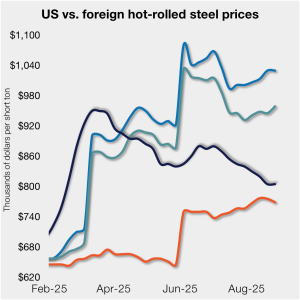
Domestic hot-rolled (HR) coil prices were flat this week, while offshore prices varied week over week (w/w). The price margin between stateside and foreign product was little changed as a result.
Most steelmaking raw material prices we track saw little change across the month of August. Iron ore, pig iron, shredded scrap, busheling scrap, zinc, and aluminum prices all held relatively steady,
Barry Zekelman has a unique vantage point from which to view today’s trade landscape. A Canadian national who owns operations in both the US and Canada, he has also had dialogue with both Canadian and American administrations.
Karla Lewis, president and CEO of Reliance Inc., told attendees of SMU’s Steel Summit 2025 that North America’s largest service center company is eyeing strategic opportunities in Mexico.
Steel prices, end-use demand, inventory levels, tariffs, imports, and evolving market events... what is the steel industry talking about this week?
Tariff policy dominated the discussion of the SMU Steel Summit trade panel on Tuesday afternoon. The message was clear: uncertainty is rattling the steel supply chain.

Steel prices remained largely unchanged this week, staying at or near lows last seen in February. All five sheet and plate products tracked by SMU moved by no more than $5 per short ton (st) from the previous week.

The Commerce Department announced the final anti-dumping and countervailing duty (CVD) margins in the sprawling trade case investigating corrosion-resistant steel imports.
World crude steel output declined for a second straight month in July, falling 2% from June to an estimated 150.1 million metric tons (mt), according to recent data published by the World Steel Association (worldsteel).
Canada has agreed to drop some retaliatory tariffs on US products, effective Sept. 1.
The big show is here again. SMU Steel Summit begins on Monday. This year, like last year, more than 1,500 people will be joining us. And I couldn’t be more excited to have everyone here in Atlanta.
Oil and gas drilling activity slowed in the US and Canada this past week. An unfamiliar trend after both regions saw repeated gains of late.

On Thursday, the U.S. and EU agreed to more concrete terms to their handshake deal of last month.

Domestic sheet prices in the US remained under pressure, limiting interest in imports, while domestic prices for longs products continued to rise.
SMU’s Steel Buyers’ Sentiment Indices moved in opposing directions this week. Our Current Steel Buyers’ Sentiment Index dropped to one of the lowest levels recorded in over five years, while Future Buyers’ Sentiment inched higher.
Carbon steel plate market participants suspect that this week’s modestly softer prices are the result of quietly negotiated prices between plate purchasers and mills.
With SMU Steel Summit starting in just a few days, I decided to go back and do a quick check on where things stand now compared to the week before Summit last year.
Steel buyers report steady lead times for sheet and plate products, a soft-sideways trend we've seen since May.
The Canadian Steel Producers Association expressed dismay upon the news that the Trump administration had added over 400 products to the list of derivative products covered by the 50% Section 232 tariffs on steel and aluminum.
The majority of steel buyers responding to our market survey this week continue to say that mills are negotiable on new spot order prices. Negotiation rates have remained high since May.
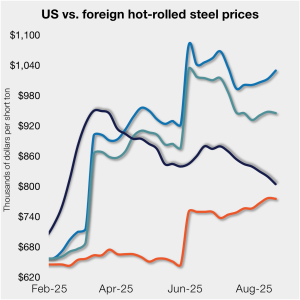
HRC prices in the US eroded further last week, while offshore prices varied week over week (w/w), widening the price margin between stateside and foreign product.
ArcelorMittal reported a "strong" explosion at the direct reduction part of its massive Lazaro Cardenas mill in Mexico.
US housing starts rose in July both month-on-month and year-on-year, according to figures from the US Census Bureau.
China has requested dispute consultations with Canada at the WTO about Canadian measures on Chinese steel and aluminum imports.

Is a pattern finally emerging in the post-Liberation Day tariff landscape?

Sheet and plate prices were flat or lower again this week on continued concerns about demand and higher production rates among US mills.
Steel Dynamics Inc. (SDI) announced that it has agreed to acquire the remaining 55% equity interest in New Process Steel.
Prices remain subdued in US pig iron market, sources said.