Market Data

June 17, 2025
SMU Price Ranges: Sheet and plate prices tick higher again
Written by Brett Linton
Steel prices inched higher again this week across most of the sheet and plate products tracked by SMU.
According to market participants, prices aren’t rising as much as announced increases might suggest, with several buyers saying they aren’t fully sticking. While import volumes have dipped, the market is still grappling with weak demand, ample supply, and rising domestic output.
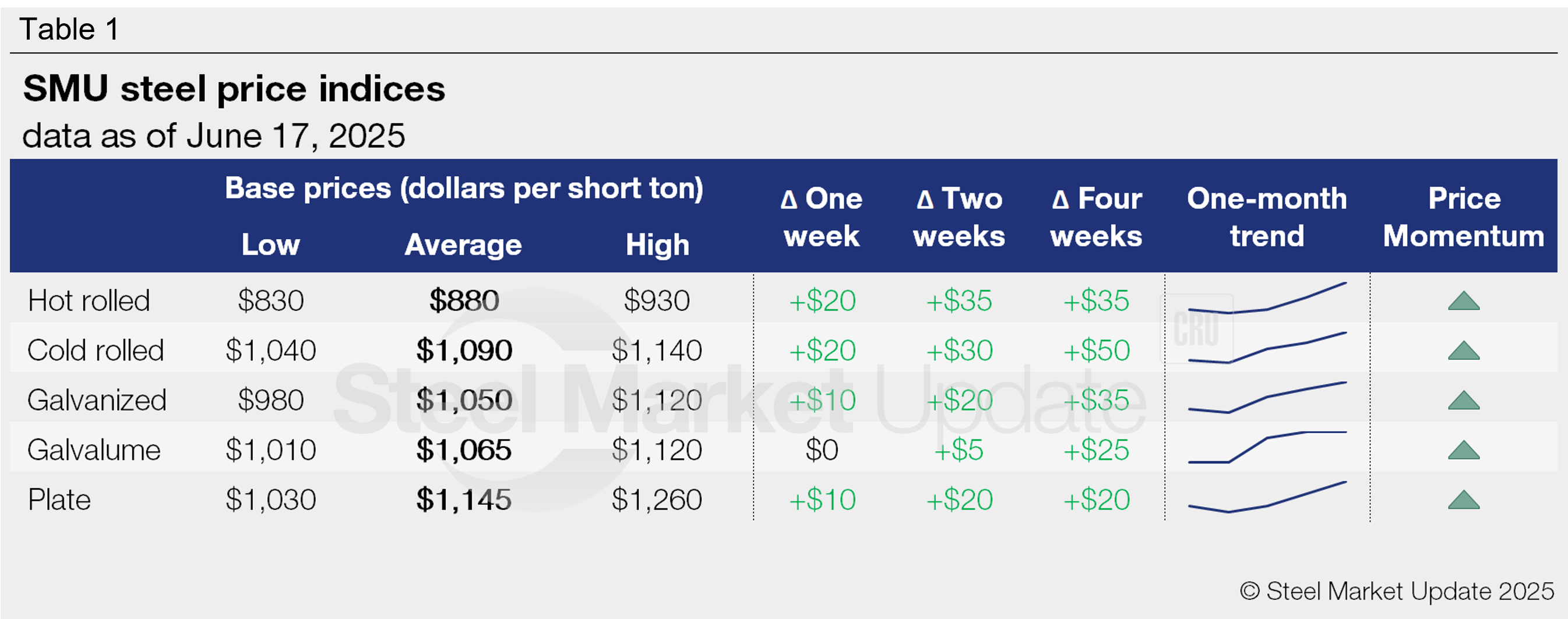
Hot-rolled and cold-rolled coil prices increased the most this week, both rising $20 per short ton (st) to $880/st and $1,090/st, respectively. Coated prices were mixed; galvanized base rose $10/st week over week (w/w) to $1,050/st, while Galvalume held steady at $1,065/st. Plate edged up $10/st from the week prior to $1,145/st.
Following last week’s adjustment, SMU’s price momentum indicator remains at higher for all sheet and plate products, signaling that we expect prices to increase from here.
Refer to Table 1 (click to enlarge) for our latest price indices and trends.
Hot-rolled coil
The SMU price range is $830-930/st, averaging $880/st FOB mill, east of the Rockies. The lower end of our range is up $30/st w/w, while the top end is up $10/st. Our overall average is up $20/st w/w. Our price momentum indicator for hot-rolled steel remains at higher, meaning we expect prices to increase over the next 30 days.
Hot rolled lead times range from 3-6 weeks, averaging 4.7 weeks as of our June 12 market survey.
Cold-rolled coil
The SMU price range is $1,040–1,140/st, averaging $1,090/st FOB mill, east of the Rockies. Our entire range shifted $20/st higher w/w. Our price momentum indicator for cold-rolled steel remains at higher, meaning we expect prices to increase over the next 30 days.
Cold rolled lead times range from 5-9 weeks, averaging 6.8 weeks through our latest survey.
Galvanized coil
The SMU price range is $980–1,120/st, averaging $1,050/st FOB mill, east of the Rockies. The lower end of our range is up $20/st w/w, while the top end is unchanged. Our overall average is up $10/st w/w. Our price momentum indicator for galvanized steel remains at higher, meaning we expect prices to increase over the next 30 days.
Galvanized .060” G90 benchmark: SMU price range is $1,058–1,198/st, averaging $1,128/st FOB mill, east of the Rockies.
Galvanized lead times range from 4-8 weeks, averaging 6.3 weeks through our latest survey.
Galvalume coil
The SMU price range is $1,010–1,120/st, averaging $1,065/st FOB mill, east of the Rockies. Our range was unadjusted w/w. Our price momentum indicator for Galvalume steel remains at higher, meaning we expect prices to increase over the next 30 days.
Galvalume .0142” AZ50, grade 80 benchmark: SMU price range is $1,278–1,388/st, averaging $1,333/st FOB mill, east of the Rockies.
Galvalume lead times range from 5-7 weeks, averaging 6.3 weeks through our latest survey.
Plate
The SMU price range is $1,030–1,260/st, averaging $1,145/st FOB mill. The lower end of our range is up $20/st w/w, while the top end is unchanged. Our overall average is up $10/st w/w. Our price momentum indicator for plate remains at higher, meaning we expect prices to increase over the next 30 days.
Plate lead times range from 4-8 weeks, averaging 5.6 weeks through our latest survey.
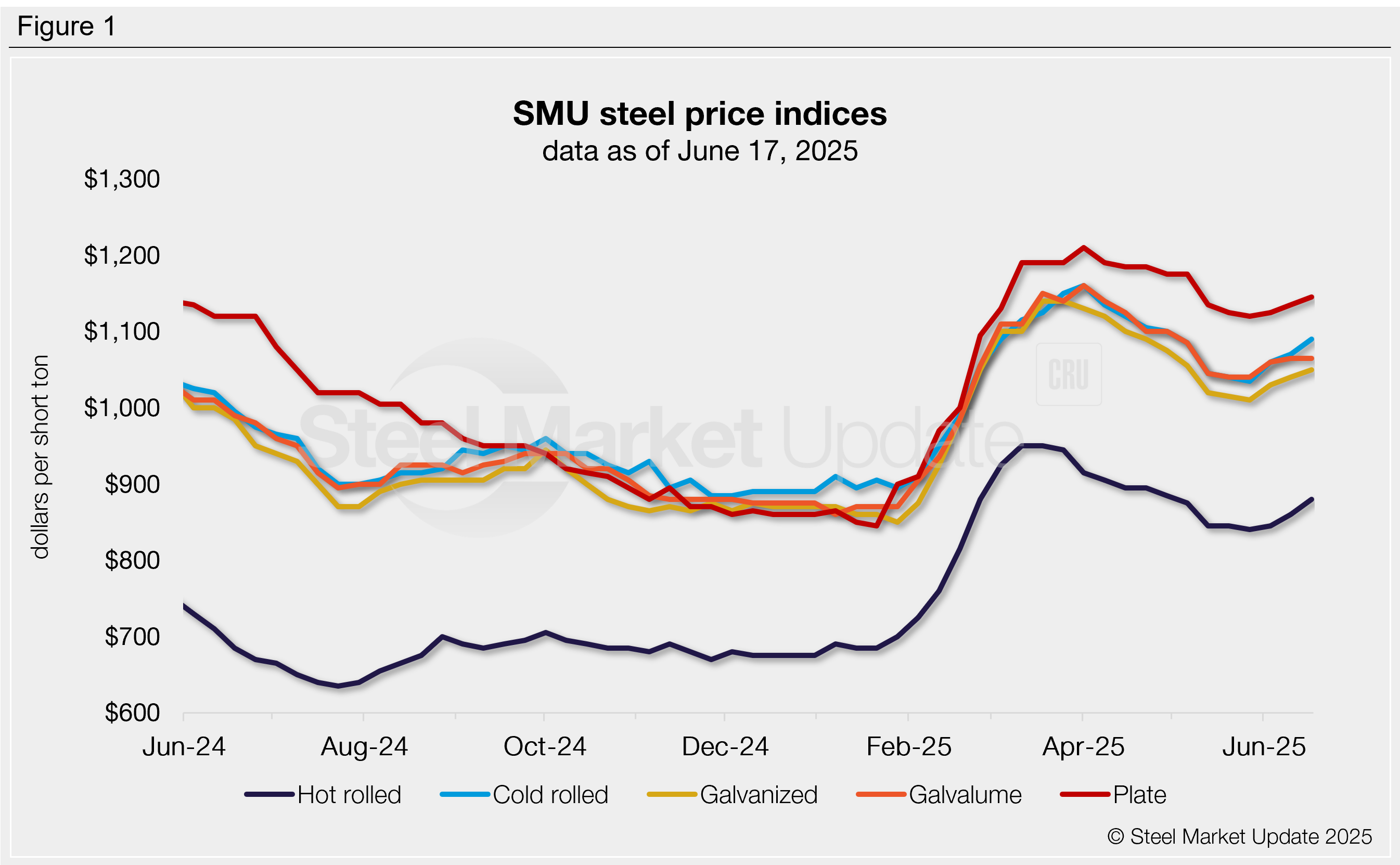
SMU note: Above is a graphic showing our hot rolled, cold rolled, galvanized, Galvalume, and plate price history. This data is also available on our website with our interactive pricing tool. If you need help navigating the website or need to know your login information, contact us at info@steelmarketupdate.com.