
Oil and gas drilling slows in Canada, ticks higher in US
Oil and gas drilling continued to slow in Canada but remained steady in the US this past week.


Oil and gas drilling continued to slow in Canada but remained steady in the US this past week.
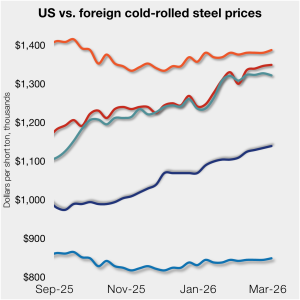
Cold-rolled (CR) coil prices ticked up in the US this week, matching a similar trend seen in most offshore markets as well.
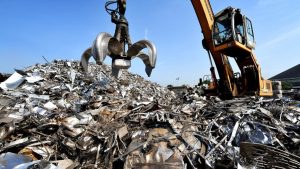
Market participant comments from this month's SMU Ferrous Scrap Survey.

Mexico’s Secretary of Economy is conducting ‘Operation Clean-Up,” inspecting suspicious steel companies to verify compliance with rules of origin.

Steel buyers remain optimistic for their current and future business prospects, though not as strong as they did one year ago.

The main impact on the ferrous value chain from the Middle East conflict will be the higher energy costs in a prolonged scenario.
Following extensions in February, steel mill lead times held steady or extended further for both sheet and plate products this week, according to buyers responding to our latest market survey.
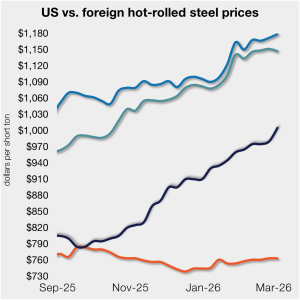
The price gap between US hot-rolled coil (HR) and landed offshore product tightened this week, as stateside tags continue to rise.
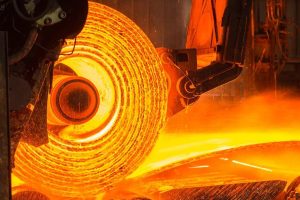
Most steel buyers responding to our market survey this week said domestic mills remain unwilling to negotiate lower prices for new spot orders.
Since the Supreme Court struck down President Trump’s use of IEEPA tariffs, a judge at the Court of International Trade (CIT) has ordered refunds of all IEEPA tariffs. Still, Trump is trying again with a Section 122 global tariff.
Economic activity across the US increased at a light-to-modest pace in seven of the 12 Federal Reserve Districts, according to the US Federal Reserve’s latest Beige Book report.
The Council on American Steel Trade (CAST) introduces itself as “pro-USA steel manufacturing and is led by trade experts representing every level of the American steel supply chain – from iron ore mining and integrated and mini-mills to processors, downstream steel-derivative producers, and the hardworking men and women of America’s steel workforce.”
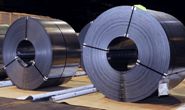
CVDs and anti-dumping duties matter when importing steel. Korea often offers very competitive import rates. The importer of record is responsible for paying any ADs, CVDs, or tariffs.
SMU's sheet and plate prices increased this week to new multi-month highs.

The US surpassed Japan in annual steel production in 2025 for the first time in 26 years, according to the World Steel Association (worldsteel).
Grupo Acerero SA de CV (GASA) reported increasing shipments at the end of 2025 as the steel producer ramps up a new slab mill in north-central Mexico.

Nucor announced Wednesday the retirement of Executive Vice President of Commercial Daniel R. Needham, effective June 20.

ArcelorMittal Mexico has replaced the transformer on its No. II electric-arc furnace, increasing casting capacity by 18%.
Crude-oil and natural-gas prices spiked, metals opened higher and some fertilizer benchmarks climbed after the US and Israel launched a “pre-emptive” strike on Iran, killing the supreme leader and plunging the region into chaos.
Domestic raw steel production has strengthened since the start of the year and reached a four-year high in mid-February.

Iron ore shipments on the Great Lakes reached 2 million short tons in January.

Tariff-related litigation in the US and around the world reflects the willingness of the president to act without consulting Congress or our trading partners. We're seeing the impulse to act without congressional approval in international relations too.

The United Steelworkers (USW) union swore in Roxanne Brown as its new international president on Sunday.

The public bankruptcy auction for the assets of Altos Hornos de Mexico has been postponed.
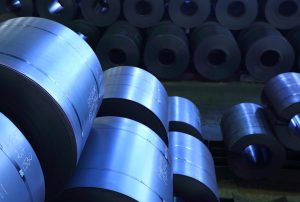
Sources in the domestic hot- and cold-rolled coil market said they are beginning to feel prices creeping up this week.
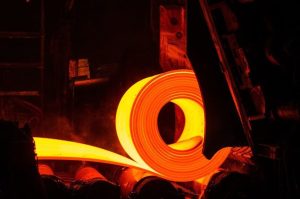
December supply increased 7% from November to the third-lowest monthly rate of the year.
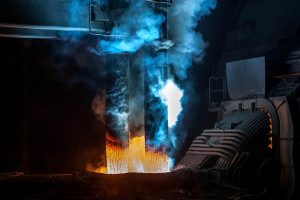
Graphite electrodes are critical to electric-arc furnace steelmaking and the production of other non-ferrous metals.
Entering 2026, tin has led a frenzied base metal rally during a historic phase for commodities. Frothy market conditions, driven by volatile investor positioning and shifting macro risk sentiment, pushed several metals—including tin—to record highs in January, before a sharp correction in February.
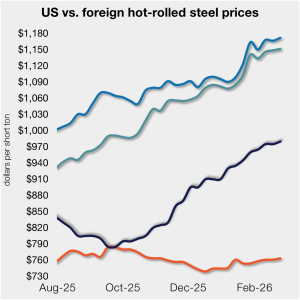
The price gap between US hot-rolled coil (HR/HRC) and landed offshore product remained largely flat again this week, as price movements stateside and abroad mirrored each other.
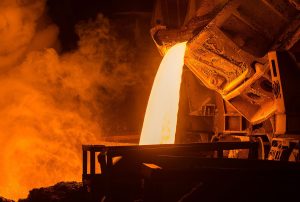
Plate industry sources said the market has been characterized by three factors lately: fewer domestic mills willing to fulfill spot buys, inconsistent lead times, and erratic demand.