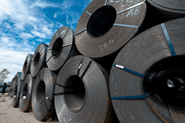
Steel exports drop to 2-year low in December
December 2024 marks the fourth month in a row that steel exports have declined, now at the lowest monthly rate recorded since December 2022.


December 2024 marks the fourth month in a row that steel exports have declined, now at the lowest monthly rate recorded since December 2022.
President Donald Trump said he would announce 25% tariffs on all steel and aluminum imported to the US, according to Bloomberg. Trump said he would make an announcement about the matter on Monday. It was not clear when the tariffs might take effect.
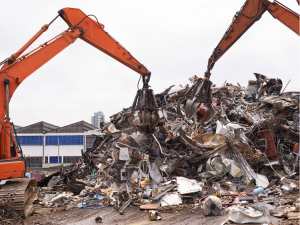
An exciting first look at the results from SMU's first scrap survey.
Nippon Steel has agreed to “invest heavily in U.S. Steel as opposed to own it,” President Donald Trump said on Friday during a press conference with Japanese Prime Minister Shigeru Ishiba. U.S. Steel is “a very important company” and was once “the greatest company in the world”. Of potential foreign ownership of the Pittsburgh-based steelmaker, Trump said, “the concept, psychologically, not good."
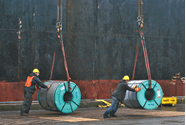
Following the one-year low recorded in November, steel imports rose by 3% in December to 2.14 million short tons (st) according to final US Commerce Department data. January could be the highest month for steel imports witnessed in nearly three years.

The day-to-day bustle of these announcements should not obscure what they signal for other potential tariff measures in the near term and a revamped trade and economic policy in the long term.
The company’s plants had been shut since just before Christmas when the company locked out union workers during negotiations.
If 2021 and 2022 was the party, 2024 is the morning after, one panelist said.

"Personally, I find it very hard to believe that we would be in a trade war with Mexico and Canada for more than a few months at any given time. I don't know how Mexico and Canada could survive that. That's a recession for them. That's a few points off GDP for us - my opinion.”
Facing weak demand and an “unsustainably low” pricing environment, GrafTech International posted another quarterly loss to close out 2024.
US rig counts remain marginally above multi-year lows. The drop in Canadian activity comes just one week after reaching a near seven-year high.
Targets include coal, liquified natural gas, crude oil, and other commodities

After reaching multi-month lows in mid-January, SMU’s Steel Buyers’ Sentiment Indices rebounded this week to some of the highest readings recorded in months.

As Wolfe Research’s Timna Tanners put it in her opening talk at Tampa on Monday afternoon, we’re living in a world of “Trumplications” now. That probably means – at least in the short term – higher scrap costs, lower imports from countries hit with or threated tariffs, and higher steel prices. SMU data reflects that. Scrap went up in January. More than 75% of the respondents to our more recent survey expect scrap to go up again February, maybe by a lot. Lead times, meanwhile, have been ticking upward this month. It started with hot-rolled coil and plate earlier this month. Now we’re seeing coated lead times extending too.
AM/NS Calvert has begun commissioning its new electric-arc furnace, with plans to reach its full annual run rate of 1.65 million short tons a year from now.
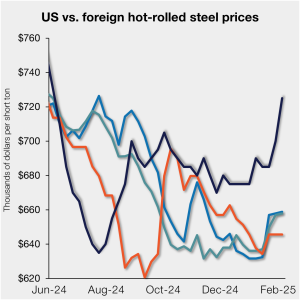
Hot-rolled (HR) coil prices moved up again in the US this week, while tags abroad were largely flat. The result: the margin US hot band holds over imports on a landed basis widened further.
While we have seen some movements in recent weeks, steel mill production times remain within a few days of the historical lows observed over the last two years, a trend observed since mid-2024.
Steel mill negotiation rates have declined in each of our last two surveys; this week’s rate is the lowest recorded since March 2024.

Since the publication of our last market update on Dec. 10, several notable developments have shaped the landscape
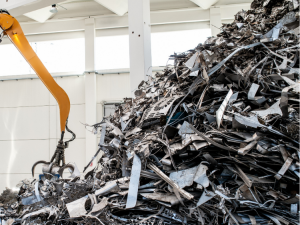
The reprieve for Canadian and Mexican tariffs this week has left some uncertainty for the February scrap market, with some sources pointing towards a $20-per-gross-ton (gt) increase.
While Canada and Mexico bent the knee to push tariff implementation out another month, the US on Tuesday instituted an additional 10% tariff on Chinese goods.
We joked in our last Final Thoughts that Wiley trade attorney Tim Brightbill – one of the nation’s leading experts on trade law and policy – would probably be revising his presentation on Trump, trade policy, and tariffs for the Tampa Steel Conference. He did. And even after those last-minute revisions, he actually got trumped […]
SMU’s steel price indices rose across the board this week. Sheet prices increased as much as $35 per short ton (st) compared to last week, while our average plate price ticked up by$10/st.
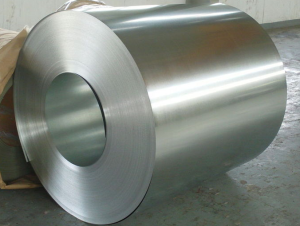
The Commerce Department on Tuesday issued preliminary subsidy rates in the corrosion-resistant steel (CORE) trade case. The agency set minimal countervailing duty (CVD) rates for Brazil and Mexico, mostly high rates for Vietnam, and low rates for Canada, except for one privately held distributor. Commerce assigned that company, Nova Steel, and a handful of Vietnamese […]
Following more than two years of contraction, US manufacturing activity rebounded in January according to the Institute for Supply Management.
Steel and aluminum have been identified as high priorities for trade
Canada fights back, a little As this article was about to be posted, Canada had not backed down to US President Trump’s 25% tariffs coming for Canadian goods at the stroke of midnight. In fact, the Government of Canada had pushed back, saying it would implement 25% tariffs on $155 billion worth of US products […]

“It is not by imposing tariffs that problems are resolved, but by talking and dialoguing,” President Claudia Sheinbaum said.
Muted demand from the auto industry took a particular toll later in the year.
The whole SMU team is packing up our laptops and our SMU polos/cardigans, loading up the PowerPoint slides, and preparing to make the trek down to Florida for the Tampa Steel Conference. There will be plenty to talk about!