SMU survey: Current Sentiment Index soars, Future Sentiment levels
SMU’s Current Steel Buyers Sentiment Index jumped this week, while the Future Sentiment Index remained flat, according to our most recent survey data.


SMU’s Current Steel Buyers Sentiment Index jumped this week, while the Future Sentiment Index remained flat, according to our most recent survey data.
Worthington Industries recently completed its separation into two distinct companies: Worthington Steel and Worthington Enterprises. SMU sat down this week with Geoff Gilmore, president and CEO of Worthington Steel, to find out how the separation process went, and what’s on the horizon for the Columbus, Ohio-based company.

Much discussion has centered on HRC futures and option liquidity. The perceived lack of liquidity is often used as a reason for not engaging in risk management, a profound folly in our opinion. Looking back over the last decade, the futures market has seen increased volume. The HRC futures volume in 2023 was 617% of 2013 numbers.

New York state saw manufacturing shrink in January, reaching its lowest reading since the depths of the pandemic in early 2020, according to the latest Empire State Manufacturing Survey.
The slipping lead times for flat-rolled steel were not just due to the holiday slowdown, it seems, as production times for four out of five products contracted again this week.
US hot-rolled coil (HRC) prices edged down this week while import prices moved higher on average. Domestic hot bands’ premium over cheaper imports declined as a result. But overall, US product remains substantially more expensive than overseas material. All told, US HRC prices are 21.4% more expensive than imports, a premium that is down three […]
Domestic buyers of steel sheet said mills were much more willing to negotiate spot pricing this week, according to our most recent survey data.
US steel exports were flat from October to November, but November took the prize for the fewest monthly exports year to date in 2023.
The LME three-month price was moving down again on the morning of Jan. 12 and was last seen trading at $2,215 per metric ton (mt). We expect a test of the $2,200/mt support to be imminent. A break would be bearish as it could mean a complete reversal of the gains seen in December, although we still estimate that as being unlikely.
Active rigs in the US dipped slightly this week, while Canada's count increased for the second consecutive week, according to Baker Hughes.

After a holiday period that saw HR futures volumes somewhat muted in December, the first week of January brought with it increased interest reflected in higher volumes.
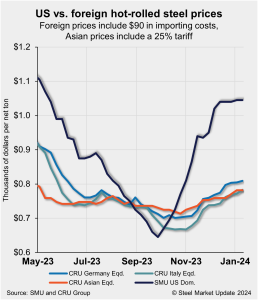
US hot-rolled coil (HRC) prices were unchanged this week but remain significantly more expensive than offshore product. While imported hot band tags increased vs. last week, gains were marginal, keeping domestic HRC substantially more expensive than imports. All told, US HRC prices are 24.3% more expensive than imports, a premium that is down only slightly […]
The Dodge Momentum Index (DMI) gained traction in December thanks to improved commercial conditions, according to the latest Dodge Construction Network (DCN) data.

Active domestic rotary rigs dipped slightly this week, but Canada's firms increased their count significantly, according to Baker Hughes.

SMU’s Buyers Sentiment Indices both fell this week, with current sentiment taking a large dive to begin the new year, according to our most recent survey data.
The iron ore price has edged up further from the already high level seen last week. The market is generally slow, meaning that the moderate price increase came from the bullish outlook from the market following last week’s stimulus announcements from China and expectations of restocking picking up. Supply fell w/w from both Australia and Brazil as […]
Trading slowed across the Midwest hot-rolled coil (HRC) futures curve in the final weeks of 2023, with prices drifting mostly sideways through the month of December.
Steel mill lead times pulled back across the board this week but are still said to be at healthy levels, according to SMU's market survey this week.
The percentage of steel buyers saying mills were willing to negotiate spot pricing on the products SMU surveys was mixed this week.
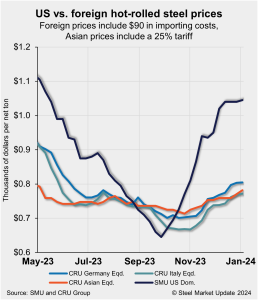
US hot-rolled coil (HRC) prices moved up again this week and remain significantly more expensive than offshore product.
An increase in residential construction brought total construction spending up by 0.4% in November, according to a report from the Associated General Contractors of America (AGC). The uptick offsets a slowdown in public spending.
After falling in November, steel imports appear to have bounced back to a five-month high in December.

Domestic manufacturing activity receded for the 14th straight month, according to the latest Institute for Supply Management (ISM) Manufacturing PMI report.
Domestic rig counts creeped up in the last 2023 report from Baker Hughes. However, Canadian firms cut back significantly on their active rotary rigs.
The Mexican government has placed anti-subsidy (CVD) duties of almost 80% on cold rolled (CR) sheets from Vietnam, with the caveat that if the importer can prove the steel comes from a country other than China then it is exempt from the levy.
November’s preliminary count shows US imports falling, but to a lesser degree than an earlier license count had suggested, according to the latest government figures.
We started 2023 with HRC spot pricing around $700 per ton and the third-month future (March ‘23) trading at $800/ton. That same future eventually settled at $1,059/ton - a $259/ton swing. Today, spot pricing is just shy of $1,100/ton for HRC, and the third-month future (March ‘24) settled at $1,091/ton. The clear takeaway: a lot can change over three months. And while future contracts are a valuable tool for hedging, they are a terrible predictor of price.
Rig counts are down in the US and Canada as of Dec. 21, according to Baker Hughes.
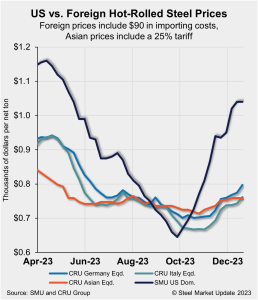
US hot-rolled coil (HRC) prices might have plateaued. But while prices for offshore product have increased in some regions, imports remain significantly cheaper that domestic material. All told, US prices are roughly 26% more expensive than imports, a premium that is down only slightly from last week.
The Architecture Billings Index (ABI) reading from the American Institute of Architects (AIA) and Deltek showed a slight uptick in November, but was still in negative territory.