
SMU Survey: Mills remain flexible on pricing, buyers say
The majority of steel buyers responding to our market survey this week continue to say that mills are negotiable on new spot order prices. Negotiation rates have remained high since May.


The majority of steel buyers responding to our market survey this week continue to say that mills are negotiable on new spot order prices. Negotiation rates have remained high since May.
US housing starts rose in July both month-on-month and year-on-year, according to figures from the US Census Bureau.

Sheet and plate prices were flat or lower again this week on continued concerns about demand and higher production rates among US mills.

Business activity in New York state improved modestly in August. It was just the second positive reading for the general business conditions index in six months.

While boarding Airforce One on Friday, US President Donald Trump stated that he would be setting more steel tariffs and putting ~100% tariffs on semiconductors and chips.

A tour of the economy as it relates to hot-rolled coil futures.
Market participants said they have high hopes that the stable hot-rolled spot market will improve as the year rolls on.
All five of SMU's steel sheet and plate price indices declined this week, falling to lows last seen in February.
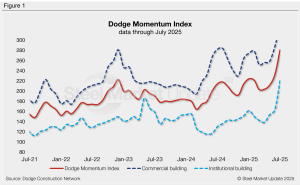
The Dodge Momentum Index (DMI) jumped 20.8% in July and is now up 27% year-to-date, according to the latest data released by Dodge Construction Network.
This week’s SMU survey reveals that a growing number of steel market participants are weary of tariffs and are awaiting evidence of progress reshoring. At the start of 2025, now-second-term President, Donald Trump, pronounced that his plan to implement tariffs would result in increased revenue for the US.
Both SMU Sentiment Indices continue to show that buyers remain optimistic for their company’s chances of success, though far less confident than they felt earlier in the year.

Since the last writing of this article, CME hot-rolled coil (HRC) futures have been largely steady and lifeless, though there’s been some brief bouts of intraday volatility.
Mill production times for sheet products are holding just above multi-year lows, while plate lead times remain elevated.
Most steel buyers continue to report that mills are open to negotiating spot prices. Negotiation rates have remained high for most of the past three months.

Sheet and plate prices were either flat or modestly lower this week on softer demand and increasing domestic capacity.
US manufacturing activity slowed again in July to a 10-month low

The cautious neutrality and summertime blues we discussed just a few weeks ago have evolved into something decidedly more bearish.
Sheet prices slipped again this week amid discounting from certain mills and ongoing concerns about demand.
Chief executive of the Institute for Supply Management (ISM), Tom Derry highlighted how reactive buying behavior has shifted the market into a quiet demand period. Derry presented ISM data during the weekly SMU community chat.
SMU’s Steel Buyers’ Sentiment Indices eased this week, both approaching multi-year lows.
Steel mill lead times on sheet products contracted across the board this week compared to early July, while plate production times moderately extended, according to steel buyers responding to this week’s market survey.
More than nine out of every ten steel buyers polled by SMU this week reported that mills are negotiable on new order prices. Negotiation rates have increased in each of our last three surveys following the early-June lull, reaching a record high this week.
After a period of backwardation driven by headlines and CRU index anchoring, the CME HRC curve structure has undergone a notable shift.
The Architecture Billings Index (ABI), a leading indicator for non-residential construction activity, declined for an eighth straight month in June.
Steel prices continued to decline this week across all of the sheet and plate products tracked by SMU, pressured by short lead times and the typical summer slowdown.
Not much to report on from the sleepy HRC futures market in the thick of the summer doldrums with trading volume nearly grinding to a halt.
US sheet and plate prices were flat or lower as reduced import volumes were offset by so-so demand.
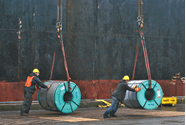
US steel exports rose 10% from April to May but remained low compared to recent years. This came just one month after exports fell to the lowest level recorded in nearly five years.
The volume of raw steel produced by US mills inched higher last week, according to the American Iron and Steel Institute (AISI). After steadily increasing in April and May, domestic mill output stabilized in early June and has remained historically strong since.
SMU’s Steel Buyers’ Sentiment Indices moved in opposite directions this week. After rebounding from a near five-year low in late June, Current Sentiment slipped again. At the same time, Future Sentiment climbed to a four-month high. Both indices continue to show optimism among buyers about their company’s chances for success, but suggest there is less confidence in that optimism than earlier in the year.