GrafTech appoints Flanagan as president and CEO
GrafTech International has appointed Timothy K. Flanagan as the company’s president and CEO, effective March 26.


GrafTech International has appointed Timothy K. Flanagan as the company’s president and CEO, effective March 26.
SMU’s sheet prices firmed up modestly this week, even as CME hot rolled futures declined. What gives? My channel checks suggest that demand remains stable and that buyers have returned to the market following new HR base prices announced by mills earlier this month. I’m looking forward to seeing whether lead times, which have stabilized, will start extending. SMU will have more to share on that front when we release updated lead time figures on Thursday. As for HR futures, what a reversal! As David Feldstein wrote last Thursday, bulls expected mill price increase announcements. And we briefly saw the May contract climb as high as ~$1,000 per short ton (st).

Mercury Resources CEO Anton Posner will be the featured speaker on SMU’s next Community Chat webinar on Wednesday, April 3, at 11 am ET. The live webinar is free. You can register here. A recording of the webinar and the slide deck are available only SMU members.
I’ve had questions from some of you lately about how we should think of the spread between hot-rolled (HR) coil prices and those for cold-rolled (CR) and coated product. Let’s assume that mills are intent on holding the line at least at $800 per short ton (st) for HR. The norm for HR-CR/coated spreads had been about $200 per short ton (st). That would suggest CR and coated base prices should be ~$1,000/st. Good luck finding anyone offering that.
SMU caught up with Barry Zekelman, executive chairman and CEO of Zekelman Industries, on Wednesday’s Community Chat. As one of the largest independent steel pipe and tube manufacturers in North America, his company is also one of the largest steel buyers in the region. This year alone, the Chicago-based company will buy roughly 2.8 million tons of steel. As such, Zekelman provides a great perspective on the steel industry and the markets it serves.
SMU’s price for hot-rolled (HR) inched lower this week. I wouldn’t be surprised, however, if we start to see prices and lead times move higher in the weeks ahead. The modest declines in HR this week are probably the result of lingering deals cut at “old” prices, as sometimes happens after mill price increases. But those deals will probably be out of the market soon if they aren’t already. So why do I float the idea of higher prices? Some big buys have been placed. It reminds me a little of what we saw last fall, when people restocked in anticipation of higher prices once the UAW strike was resolved.
Sheet and plate prices mostly moved lower this week after little change was noted the week prior. Despite edging down, sentiment is mixed, and many suggest a bottom may be near.
As uncertainty swirls around Nippon Steel Corp.’s (NSC) proposed buy of U.S. Steel, the Japanese steelmaker continues to make assurances that it has the best interests in mind for running the iconic Pittsburgh-based steelmaker.
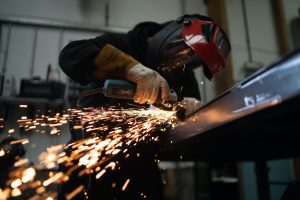
Data on US industrial production, capacity utilization, new orders, and inventories remained overall steady and strong through January and February figures, indicating a healthy manufacturing sector. The strength of the manufacturing economy has a direct bearing on the health of the steel industry.
To the surprise of few if any, prices are in a holding pattern – a trend not seen since late December. The pause comes largely in response to a pricing notice blitz from mills late last week.
Prices of most steelmaking raw materials have moved lower over the last 30 days, according to Steel Market Update’s latest analysis.
Join SMU’s next Community Chat webinar with Barry Zekelman, executive chairman and CEO of Zekelman Industries – the largest independent steel pipe and tube manufacturer in North America. The webinar will be on Wednesday, March 20, at 11 a.m. ET. It’s free for all to attend. A recording will be available to SMU members. You can register here.

Sheet and plate prices were mostly flat this week – largely in response to the mill price blitz from last week – pausing the downtrend they’d been on for the better part of 2024.
What does it mean to be a domestic steelmaker in the 21st century? Of course, that idea is open to interpretation. The vibrancy of the US industry is a testament to that. Between integrateds, EAFs, how to approach decarbonization, downstream ventures, American innovation goes in many directions.
Worthington Steel began trading publicly on New York Stock Exchange on Dec. 1. In one sense, this marked the “finish line” of the company’s separation process. As the company gets ready to release its first earnings report as a standalone company, president and CEO Geoff Gilmore reflected on the journey, and what lies ahead.
India’s JSW Steel has selected steel industry veteran Robert Simon as CEO of JSW Steel USA.
Sheet and plate prices this week continued the downward trend they’ve been on for most of 2024. Some market sources predicted that a wave of spring maintenance outages would help to stabilize lead times and prices in the weeks ahead – especially should service center inventories, high at the beginning of the year, come down meaningfully.
The United Auto Workers (UAW) executive board has voted to start a new “solidarity project” to support auto workers in Mexico.

Kimberly A. Fields, current president of specialty metals producer ATI, has been named president and CEO of the Dallas-based company, effective July 1. Fields has served as COO of ATI since 2022 and president since July 2023. Prior to joining the company in 2019, she worked for IDEX Corp., Evraz, and GE. Fields will succeed […]
SunCoke Energy Inc. announced the retirement of its current CEO and the appointment of a new leader on Friday.
Canada will soon require steel imports to report “country of melt and pour” information.
Canadian steelmaker Stelco swung to a loss in the fourth quarter as revenue declined due to decreased shipping volume and average selling prices.
What a difference a month makes. There are a few full bulls left in the room, but their numbers are dwindling. We’ll release results of our full steel market survey tomorrow afternoon. I took a sneak peak at the data on Thursday. And more people than I expected think that US hot-rolled (HR) coil prices will be in the $700s per short ton (st) two months from now. Vanishingly few think prices will be above $1,000/st in mid-April.
Sheet prices have fallen again this week on shorter lead times, higher imports, and potentially higher inventories. (We’ll see for sure when we release our service center shipment and inventory data next week.) I remember reporting almost exactly the same thing about a month ago and getting a fair amount of pushback. Not so much these days.
ArcelorMittal swung to a loss in the fourth quarter largely because of costs associated with a deadly coal mining disaster last year in Kazakhstan. The Luxembourg-based steelmaker sold its Kazakhstan operations in December and no longer owns and operates coal mines as a result of the move, according to comments released along with earnings data on Thursday.
SBQ producer Alton Steel Inc. (ASI) has appointed a new chief executive.
I thought Nippon Steel’s $14.1-billion deal for U.S. Steel might become a political football in this year’s presidential election. Now there is little doubt that it will after Trump told reporters in Washington, D.C., earlier this week that he would “absolutely” block the transaction – and that he would do so “instantaneously.”
The pig iron market has risen in recent months from the high $390s per metric ton (mt) last fall to $490/mt for Brazilian material and a bit more for Ukrainian product - for an overall average of $495/mt CFR.
Steel Dynamics Inc.’s (SDI’s) top executive sees hot band demand remaining strong in 2024, which should support pricing.
The capacity for EAF steelmaking is growing both in the US and abroad. Ferrous scrap supply has never been more important. A lot of people have viewed the scrap industry as old-fashioned and resistant to change. However, the same forces affecting the steel and other industries are also at play in recycling.