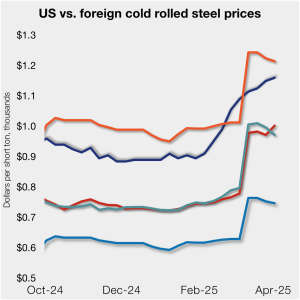
US CRC prices move ahead of imports
US cold-rolled (CR) coil prices moved higher again this week, while offshore prices were mixed.


US cold-rolled (CR) coil prices moved higher again this week, while offshore prices were mixed.
The US Commerce Department on Friday released preliminary anti-dumping margins in a trade case targeted imports of coated flat-rolled steel from 10 countries. Certain countries and mills were hammered while others were largely spared. Brazilian steelmaker CSN, for example, received a preliminary rate of 137.76%. Some Turkish mills – including Boreclik and ArcelorMittal Celik Ticaret – received no dumping margin at all.
The Commerce Department has made a preliminary determination that ‘critical circumstances’ exist for certain imports of corrosion-resistant (CORE) flat-rolled steel from the United Arab Emirates (UAE). Commerce decided that critical circumstances did not apply to CORE from South Africa. The department also found that critical circumstances did not apply to CORE from UAE producers Al-Ghurair Iron & Steel LLC and United Iron & Steel Company LLC.
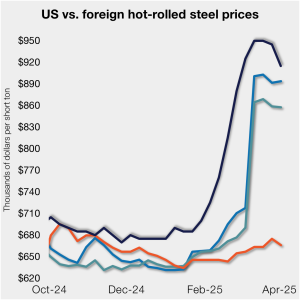
Domestic hot-rolled (HR) coil prices declined this week, a trend again reflected in most offshore markets. Despite similarities, the shifting tariff landscape has made for a wild ride in Q1.
The United Arab Emirates’ Emirates (UAE) Emirates Global Aluminum (EGA) announced plans to spend $1.4 trillion dollars in the US over the next 10 years, including a greenfield primary aluminum smelter. Is this real or another soundbite?
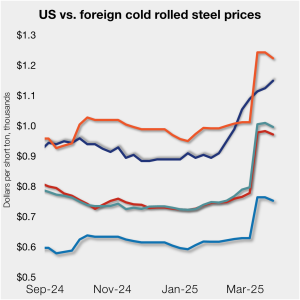
US cold-rolled (CR) coil prices increased again this week, while offshore prices declined.
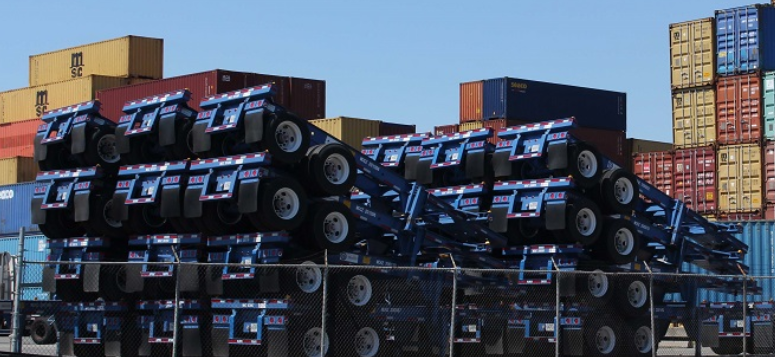
Upon the request of US chassis manufacturers, the Commerce Department this week initiated investigations into the alleged dumping and subsidization of chassis imported from Mexico, Thailand, and Vietnam.
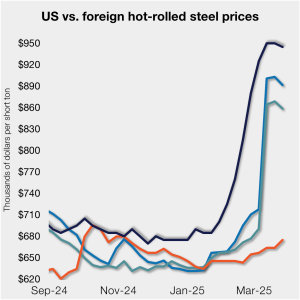
The threat of tariffs over the past two months has been a springboard for US prices. But the Section 232 reinstatement on March 13 narrowed the domestic premium over imports on a landed basis.
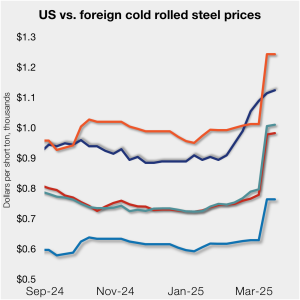
US cold-rolled (CR) coil prices moved higher this week, a trend not evenly shared by offshore prices.
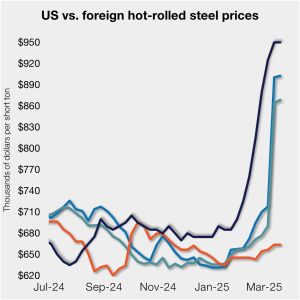
Domestic hot-rolled (HR) coil prices were flat this week, a trend mirrored in offshore markets.
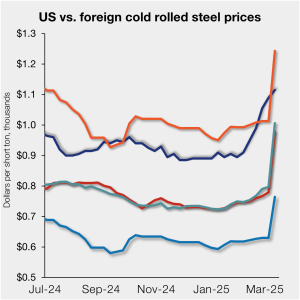
Fully restored Section 232 tariffs on steel on March 12 cut the widening premium US prices had over most imports on a landed basis.

President Trump’s tariffs are aimed in large part at bringing manufacturing back to the United States. In theory, it’s simple enough: Want to avoid a big tariff? Make it in the US!
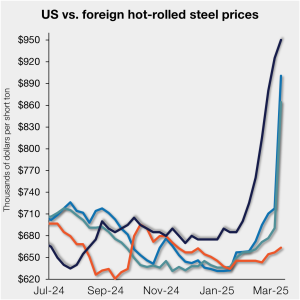
Domestic hot-rolled (HR) coil prices moved higher this week, still largely outpacing increases seen in offshore markets. But the reinstatement of undiluted Section 232 tariffs on steel on March 12 cut the ballooning premium stateside prices had gained on most imports on a landed basis. The premium stateside tags had over prices abroad stood at […]
The volume of finished steel entering the US market in January climbed to the highest level recorded in two and a half years.
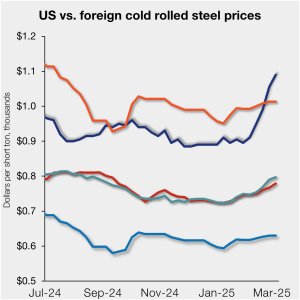
US cold-rolled (CR) coil prices continued to rise this week, well ahead of offshore prices. The price spread between stateside-produced CR and imports reached a 14-month high in the week ended March 7. Steady price gains in overseas markets continue to be overshadowed by increases in domestic prices. The result? The US premium over imports […]
Steel imports ended 2024 on a low note, with November trade falling to a one-year low and December seeing a modest 3% recovery. Then as the new year began, import volumes spiked.

Wonder what the fallout from all the Trump tariffs might be? A manufacturing renaissance? A post-WWII order in ashes? Or something a little more down the middle? Then register for our next Community Chat on Thursday, March 13 at 11 am ET. Yes, you read that correctly, SMU is shattering precedent by holding a Community Chat on a day that is not Wednesday. Our featured speaker will be Alan Price, a leading trade attorney at Wiley and someone whose columns you read regularly in SMU.
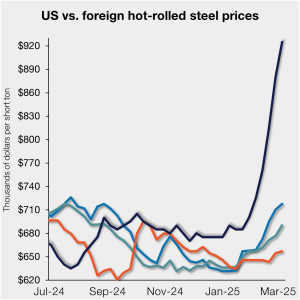
Domestic hot-rolled (HR) coil prices moved higher this week, widely outpacing increases seen in offshore markets.
The demise of the VAT rebate system in China might be the most tangible sign that Beijing realizes that its unbridled access to global markets is over. There was no point in continuing a system of financial incentives to the export sector when the tariff headwinds were getting stronger.
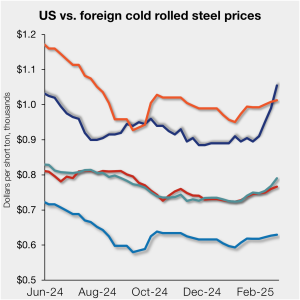
The price spread between stateside-produced CR and imports reached its widest margin in over a year.
That’s not to say Section 232 shouldn’t be tightened up. Or that certain trade practices – even among our traditional allies – weren’t problematic. But when it comes to the reboot of Section 232, I do wonder whether there will be some unintended consequences.
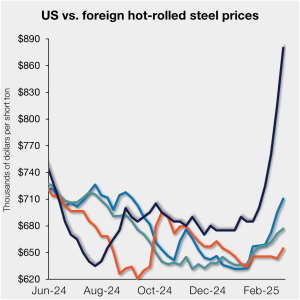
Hot-rolled (HR) coil prices continued to rally in the US this week, quickly outpacing price gains seen abroad. The result: US hot band prices have grown widely more expensive than imports on a landed basis. The premium US HR tags carry over HR prices abroad now stands at a 14-month high. SMU’s average domestic HR […]
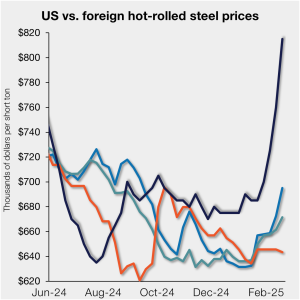
Hot-rolled (HR) coil prices leaped in the US this week, while tags abroad saw more measured gains. The result: US hot band prices have become even more expensive than imports on a landed basis. In fact, the premium US HR prices carry over HR prices abroad now stands at a 12-month high.
"Recent activity in the marketplace strongly indicates that these imports are being rushed into the United States in an effort to avoid the imposition of antidumping duties," petitioners said.

With a chronic trade deficit, the administration will continue to cite more tariffs as necessary. This is in error, as noted above. Yet the base of President Trump’s support does not see it that way. More tariffs are possible. But the only way to reduce the US trade deficit substantially is to close the gap between savings and investment in the United States.
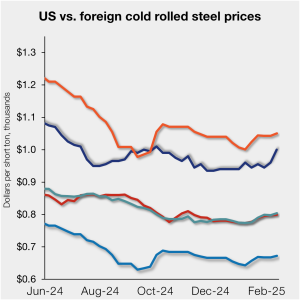
The price spread between US-produced cold-rolled (CR) coil and offshore CR products widened again in the week ended Feb. 14, as prices for US product accelerated ahead of imports. Domestic CR coil tags jumped week on week (w/w), while offshore markets moved higher at a slower pace. The result? The US premium over imports widened […]
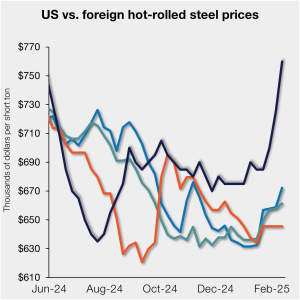
Hot-rolled (HR) coil prices rose further in the US this week, while tags abroad saw minor gains. The result: the margin US hot band holds over imports on a landed basis increased.
US steel prices set to jump after President Trump levies new tariffs.
President Donald Trump said he would announce 25% tariffs on all steel and aluminum imported to the US, according to Bloomberg. Trump said he would make an announcement about the matter on Monday. It was not clear when the tariffs might take effect.
Following the one-year low recorded in November, steel imports rose by 3% in December to 2.14 million short tons (st) according to final US Commerce Department data. January could be the highest month for steel imports witnessed in nearly three years.