• Skip to main content

    Market Segment

    Dodge Momentum Drops on Slowdown in Institutional Planning

    Written by Becca Moczygemba


    The Dodge Momentum Index (DMI) dropped in July due to varying trends in the commercial sector, according to the latest data from the Dodge Construction Network (DCN).

    The DMI dropped 0.9% from June’s revised reading of 195.1 to 193.4 in July, but it was still 21% higher than the same time last year.

    “While both segments of the index fell this month, underlying project data points to divergent trends in the nonresidential sector,” said Sarah Martin, associate director of forecasting for the Dodge Construction Network.

    Commercial planning activity is down 10% from January 2023, Martin noted.

    Conversely, institutional planning is up 16% in the same time period.

    Large institutional projects in May inflated month-over-month trends, but have since tapered off.

    The two largest institutional segments, healthcare and education, slowed down in July leaving a hole in the institutional sector.

    Weaker commercial activity is expected in response to tighter lending standards and higher interest rates. However, institutional projects that are supported by public funding will help balance the remainder of 2023, Martin added.

    Month-over-month, the commercial component of the DMI decreased by 0.2%, while the institutional component dropped by 1.9%. However, year-over-year the institutional component was up 35% and commercial component was up 13%.
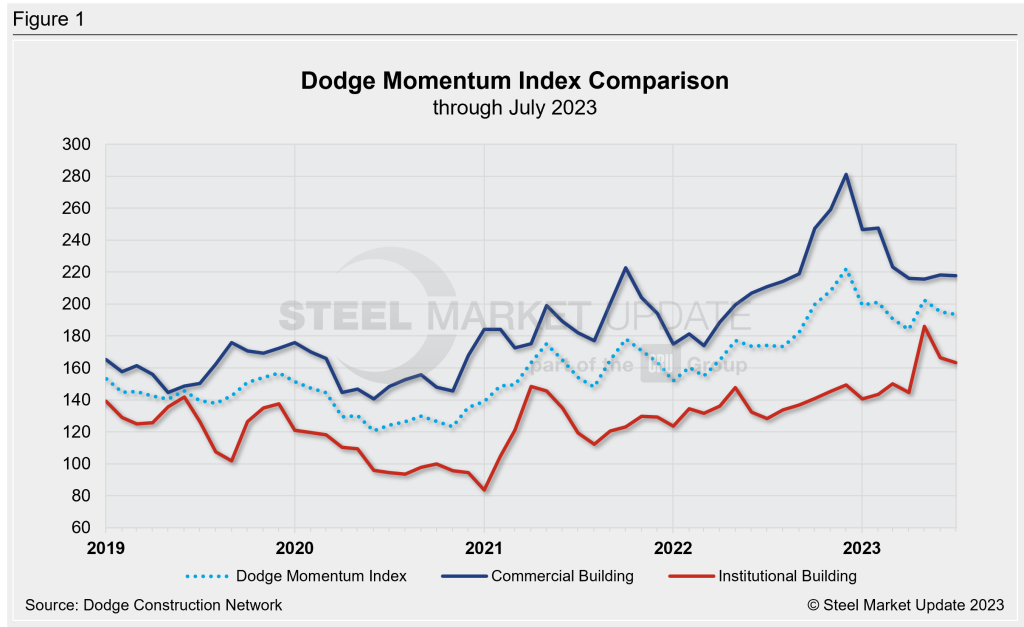
    Dodge is the leading index for commercial real estate, using the data of planned nonresidential building projects to track spending in the important steel consuming sector for the next 12 months. An interactive history of the DMI is available on our website.

    Becca Moczygemba

    Read more from Becca Moczygemba

    Latest in Market Segment

    Mill Orders log fresh high, as on-order volumes swell

    SMU’s Mill Order Index (MOI) increased further in October, up for a sixth straight month and setting a new top mark. The increase came as service center on-order volumes and new mill order entries extended their record highs, including the post-pandemic snapback in demand, according to SMU’s latest service center inventory data. Results suggest inventories remain uncomfortably lean as service centers try to restock in a market where spot tons are scarce, and contract tons are significantly delayed.

    Honda to add 240,000 vehicles of annual capacity with $3B Ohio plant

    Honda plans to invest $3 billion in a new auto plant in central Ohio, adding capacity for 240,000 vehicles annually. Production is expected to start in 2029, pending final government approvals. The company is also planning upgrades at production operations in Ohio, Alabama, and Georgia. The new Ohio plant will be built between Honda’s existing East Liberty and Marysville plants and will make hybrid, gasoline-powered and battery-electric vehicles, according to a company announcement.

    Russel Metals plans CFO succession

    Mississauga, Ontario-based Russel Metals has announced a succession plan for its top finance officer. Current EVP and Chief Financial Officer Martin Juravsky plans to retire from the company as of February 2027. Stephen Reitknecht, the current CFO of Savaria Corp., will succeed him, effective Jan. 1. “We are very pleased to welcome Stephen as our new Chief Financial Officer,” commented President and CEO John G. Reid. “With his extensive experience in financial and capital markets across public and private companies in various sectors, I believe he will be an excellent executive with Russel Metals and will thrive in our decentralized and entrepreneurial environment.”

    AISI: Southern rebound lifts US steel production, again

    US raw steel production continues its broad seesaw pattern, bouncing back from the prior week’s decline, according to the latest American Iron and Steel Institute (AISI) figures. Raw steel output has fluctuated sharply since late summer, reaching an 18-year high at the end of October before returning to more typical levels the following week. Despite the wide ebb and flows of late, production has generally trended lower since seeing sustained growth through May, though it remains historically strong compared to recent years.

    Alacero Summit rundown: China pressure sharpens calls for steel protection, regional cooperation

    Mexico and Latin America need a stronger response to subsidized steel and manufacturing overcapacity, according to speakers at Alacero Summit 2026. “What we cannot do is compete against a state,” said Máximo Vedoya, Ternium CEO, in his opening remarks. Vedoya maintained that Latin American (Latam) steelmakers can compete in the international landscape under fair conditions, but state-backed competition requires a stronger policy response.