
Prices

June 3, 2025
HR futures remain sensitive to tariff talk
Written by Gaby Ain
The US HRC futures market didn’t waste time reacting to Friday’s bombshell: President Trump’s announcement that steel tariffs would be doubled from 25% to 50%. Futures exploded, and the curve went from drifting to sprinting nearly overnight.
CME Midwest HRC Futures Curve (6/3 early, mid-day in white, 6/2 in orange, 5/29 in blue)
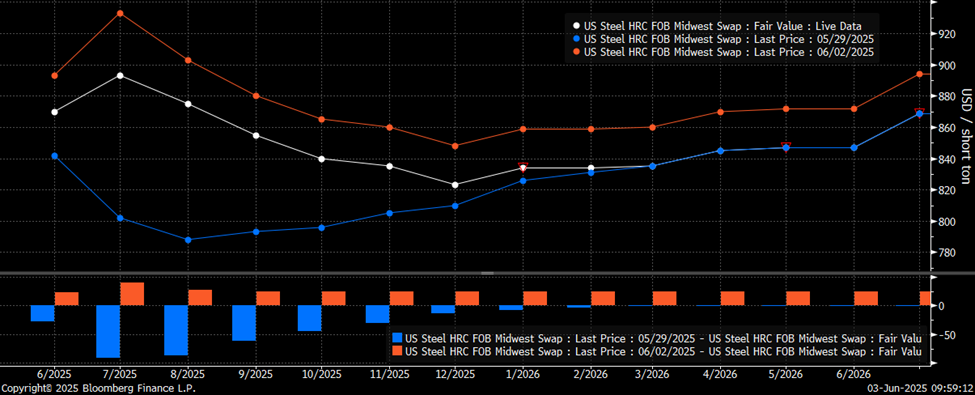
From the time of my previous column on May 29 (blue), the curve reflected a cautious and fairly flat structure, with prices hovering around $800 in the front months with little directional conviction. Sentiment was hesitant.
Post-announcement, Monday, June 2 (orange), the curve steepened aggressively, particularly in the front months: June +$51, July +$131, and August +$115. A pretty textbook case of behavior in the face of a shock: first a surge (panic), then a partial reversion (reassessment).
At first, today’s curve, June 3 (white in the chart above) looked like a classic correction: The curve moderately pulled back and flattened, suggesting the market was catching its breath. But by the final hour of the session, sentiment had turned again. The curve steepened once more (white in the chart below), this time led by gains in the back half of 2025 and into early 2026.
CME Midwest HRC Futures Curve (6/3 EOD in white, 6/2 in orange, 5/29 in blue)
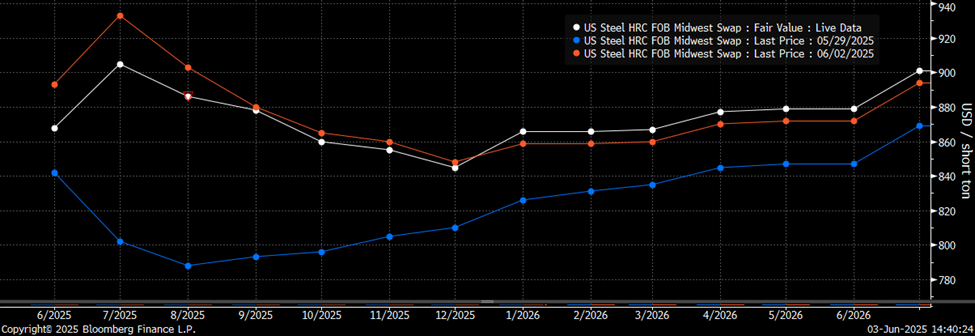
What started off the day indicated a reserve in judgement about the lasting impact, reflecting market skepticism about the durability of the policy and long-term demand elasticity. Inviting the questions, “How lasting will the tariffs be, and how much real disruption will they cause?” This was potentially speaking to a maturing market, one more experienced in dealing with tariff-driven headlines. After all, there’s been no shortage of them.
To close the day with such a shift implies the market is beginning to assign more weight to the longer-term implications of the policy, or headlines are creating a choppy environment.
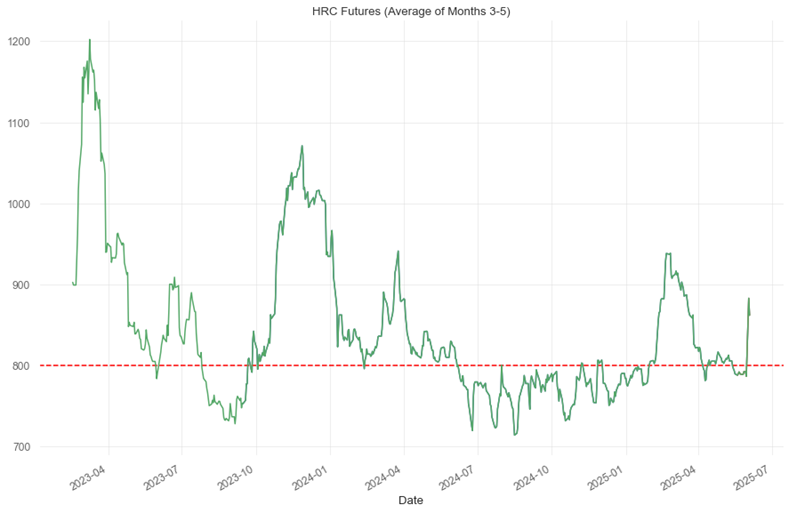
All-in-all, a takeaway is clear: weird things happen around $800. As I mentioned last week, when this market is given even a little hope, or in this case, a headline, it can sprint. And just as quickly, it can question itself. And if it turns out the story sticks, it runs even farther. The speed and scale of these moves are reminders of just how sensitive HRC futures remain to structural shifts and sentiment cues. Whether this holds or fizzles will likely depend on how mill behavior unfolds.
Disclaimer
The content of this article is for informational purposes only. The views in this article do not represent financial services or advice. Any opinion expressed by Flack Global Metals or Flack Capital Markets should not be treated as a specific inducement to make a particular investment or follow a particular strategy, but only as an expression of his opinion. Views and forecasts expressed are as of date indicated, are subject to change without notice, may not come to be and do not represent a recommendation or offer of any particular security, strategy or investment. Strategies mentioned may not be suitable for you. You must make an independent decision regarding investments or strategies mentioned in this article. It is recommended you consider your own particular circumstances and seek the advice from a financial professional before taking action in financial markets.