Analysis

August 20, 2026
HR Futures: Canadian tariff news shakes up market
Written by Gaby Ain
It’s been a little while since my last column, and at the beginning of this week I was struggling to come up with something new to say. The HRC futures story had largely remained the same, a market continuing to adjust expectations around the supply response mechanism under a 50% tariff regime. And just when things start to feel a little same old, same old, that sneaky volatility shows up.
Yesterday, Aug. 19, reports emerged that the US is set to halve tariffs on Canadian steel and aluminum. Details of the tentative agreement have yet to be finalized, but the initial reaction in the HRC futures market was swift. A way to think about this catalyst is as a partial release valve on the near-term scarcity premium that had been building in the curve for several months.
CME Midwest HRC futures curve (8/20 in white, 8/18 in blue, 6/18 in orange)
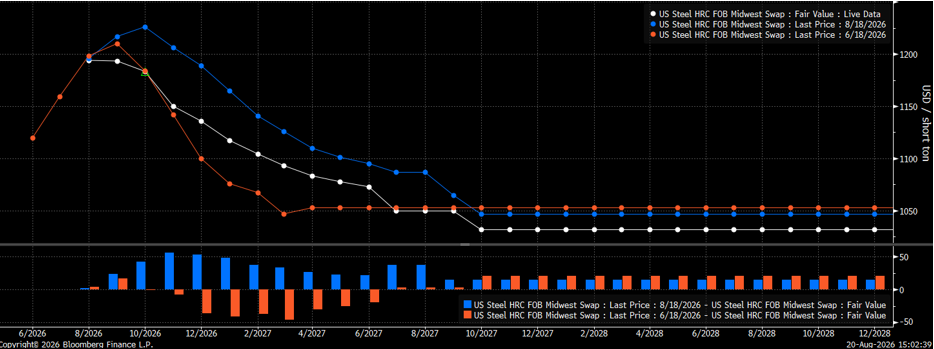
That scarcity premium is easy to see in how much the curve has changed since my last column. From June 18 (orange) to Aug. 18 (the day before news, blue), the front of the curve continued to reprice higher, with the strip’s peak shifting from September to October. The first half of 2027 also notably strengthened, suggesting the market was increasingly questioning how quickly supply could respond.
Then the tariff headline hit.
The entire curve softened, with the front end selling off sharply (white). Canada remains an important supplier to the US market, and cutting the tariff from 50% to 25% changes the economics of those tons. Even before additional physical material arrives, the possibility of easier import availability reduces the scarcity premium embedded in nearby futures.
Still, the curve remains backwardated, just less steep. A 25% tariff is still meaningful, and significant uncertainty remains. The deal is not yet finalized, and details remain unresolved. Until formal documentation is signed, the curve is likely to remain volatile, with the risk that a breakdown in talks could rapidly re-steepen the front end.
Another interesting takeaway from initial reactions is that the deferred end of the curve has seen comparatively less repricing. The market appears much more willing to reassess the immediate supply picture than dramatically change its view of longer-run HRC values.
CME HRC money-manager positioning
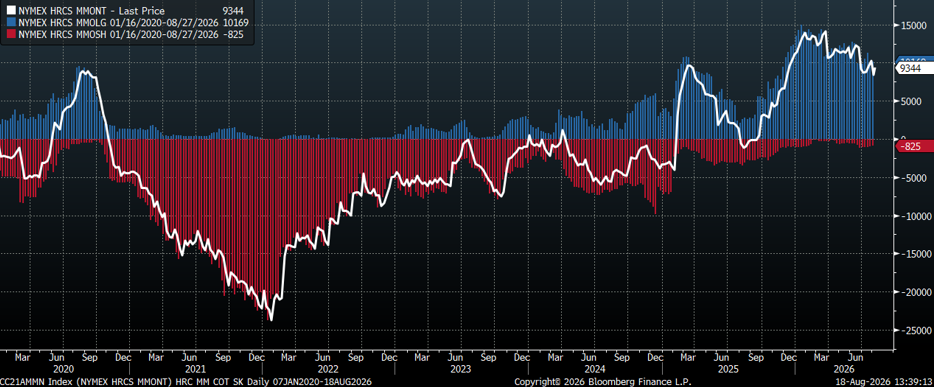
Positioning adds another layer. Net length peaked at 14,082 contracts on March 27 and has since fallen to 9,344 contracts as of Aug. 20, a ~34% reduction. Importantly, that unwind occurred while front-month HRC futures remained near their highs, suggesting money managers had already begun reducing risk or profit taking before yesterday’s news.
The net-long position is still substantial, but we’ve seen how quickly positioning can swing (February 2025). The potential trade agreement challenges an important pillar of the bull case a lot of that long positioning is based on, and if finalized, would encourage further long liquidation. But uncertainty cuts both ways. If negotiations stall or the terms change materially, some of that exposure could be rebuilt quickly.
Mexico is another factor to watch. The US-Canada framework is reportedly pressuring Mexico to seek comparable terms. A broader North American tariff reduction would compound the bearish impact.
So where does that leave the market?
The tariff announcement clearly changes the near-term equation. Lower tariffs on Canadian imports improve the economics of foreign supply and have already taken some premium out of the futures curve. So, while the news provides a relatively straightforward bearish catalyst, there is still a considerable amount of uncertainty, some more factors being that imports won’t arrive overnight and fall outages are quickly approaching. And that uncertainty will most likely translate to volatility in the HRC futures market as more information gets released. I’m expecting some pretty eventful times ahead, just as the dog days of summer come to a close.