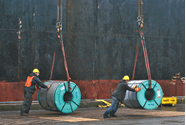
SDI subsidiary acquires Ohio metals recycler
OnmiSource LLC, a subsidiary of Fort Wayne, Indiana-based steel producer and recycler, Steel Dyanmics, Inc., has acquired Toledo Shredding, LLC, in Ohio.
On Monday and Tuesday of this week, SMU polled steel buyers on an array of topics, ranging from market prices, demand, and inventories to imports and evolving market chatter.
Steel companies in Mexico have lined up capex plans totaling $5.7 billion in the next three years. The focus is on replacing imports with domestic production, said David Gutierrez, outgoing president of sector association Canacero. “The investments are aimed at reducing imports, strengthening national production, and ensuring that the benefits stay in the country,” he was quoted as saying at Canacero’s annual congress by regional news service Business News Americas.
Numerous mid-sized export yards in California and in Baja Mexico had little to no inventory on the ground last week because most had sold forward in the falling March market. Looking to secure their margins, they dropped prices across the scale. That resulted in lower-than-normal flows. “I’m sold out through mid-April and even longer if the flow doesn’t pick up” one yard owner said. That turned out to be the position of numerous West Coast suppliers.
I can’t really define “Bidenomics” because it is so filled with contradictions. It seems to aim to increase manufacturing output in the United States. But not all increases are created equal.
SMU’s sheet prices firmed up modestly this week, even as CME hot rolled futures declined. What gives? My channel checks suggest that demand remains stable and that buyers have returned to the market following new HR base prices announced by mills earlier this month. I’m looking forward to seeing whether lead times, which have stabilized, will start extending. SMU will have more to share on that front when we release updated lead time figures on Thursday. As for HR futures, what a reversal! As David Feldstein wrote last Thursday, bulls expected mill price increase announcements. And we briefly saw the May contract climb as high as ~$1,000 per short ton (st).
There’s that concept from Adam Smith we all learn about in our Econ 101 classes: The Invisible Hand. A simple Google search will provide a refresh, but if memory serves I would classify it as something akin to “the market is magic” or “the market’s gonna market.” Today, obviously, we live in a mixed environment. There are a lot of hands out there, and they’re not too difficult to see. In this election year of 2024, one of the most visible hands out there probably belongs to the federal government.
Worthington Steel is taking a pause on M&A activity as it focuses on progressing its electrical steel expansions in Mexico and Canada.
SMU caught up with Barry Zekelman, executive chairman and CEO of Zekelman Industries, on Wednesday’s Community Chat. As one of the largest independent steel pipe and tube manufacturers in North America, his company is also one of the largest steel buyers in the region. This year alone, the Chicago-based company will buy roughly 2.8 million tons of steel. As such, Zekelman provides a great perspective on the steel industry and the markets it serves.
North American auto assemblies edged down in February vs. the prior month, according to LMC Automotive data. While assemblies did fall month on month (m/m), they are up nearly 3% year on year (y/y).
Earlier this week SMU polled steel buyers on an array of topics, ranging from market prices, demand, and inventories to imports and evolving market chatter.
US light-vehicle (LV) sales rose to an unadjusted 1.25 million units in February, up 9.6% vs. year-ago levels, the US Bureau of Economic Analysis (BEA) reported. The year-on-year (y/y) growth in domestic LV sales was boosted by a 6% month on month (m/m) gain.
SMU’s price for hot-rolled (HR) inched lower this week. I wouldn’t be surprised, however, if we start to see prices and lead times move higher in the weeks ahead. The modest declines in HR this week are probably the result of lingering deals cut at “old” prices, as sometimes happens after mill price increases. But those deals will probably be out of the market soon if they aren’t already. So why do I float the idea of higher prices? Some big buys have been placed. It reminds me a little of what we saw last fall, when people restocked in anticipation of higher prices once the UAW strike was resolved.
Sheet and plate prices mostly moved lower this week after little change was noted the week prior. Despite edging down, sentiment is mixed, and many suggest a bottom may be near.
In this Premium analysis we cover North American oil and natural gas prices, drilling rig activity, and crude oil stock levels.
US senators have introduced the "Stop Mexico’s Steel Surge Act," which seeks to reimpose 25% Section 232 tariffs on Mexican steel imports.
US steel exports jumped to 770,649 short tons (st) in January, rising 25% from the 12-month low recorded one month prior.
In 2023, Mexico emerged as the largest trading partner with the United States—larger than Canada, and even China. The growth in trade with Mexico has been truly historic—Mexico has never captured the title of the largest exporter to the US. At $475 billion for the year, the value of US imports from Mexico exceeded that […]
The LME three-month price continued to strengthen through Friday, March 8, defending its position close to its five-week high and rising further to $2,262 per metric ton (mt), up 0.3%, on the day. Gains were also noted over the last week in other industrial metals, including copper, zinc, and lead. The price gains appeared to be due to weakness in the US dollar, which fell sharply against a basket of currencies after Fed Chairman Jerome Powell said on Wednesday that rate cuts were still expected this year.
What are folks in the steel industry talking about at present? Respondents to SMU’s mini-survey this week shared some of their thoughts with us about what's going on in the market. Rather than summarizing their responses, here’s some of what they had to say in their own words.
The news in the West was that a mill in the Rocky Mountain region made a significant reduction in their usual purchase program, while still another small mill in the region also apparently reduced their buying program for February.
Mexico has said it will place retaliatory steel tariffs on the United States if the US acts to reimpose Section 232 on its neighbor, according to an article in Reuters.
What are some “Black Swans” to watch out for? With the war in Ukraine entering its third year, your mind might understandably move to conflicts overseas. Here is one closer to home to consider: US trade relations with Mexico taking a turn for the worse. I mention that because the Office of the United States Trade Representative (USTR) dropped a (virtual) bombshell earlier this month.
January’s import level was even higher than an earlier license count had suggested, making it the highest month for imports since June 2023.
The United Auto Workers (UAW) executive board has voted to start a new “solidarity project” to support auto workers in Mexico.
Domestic prices have been sliding since the beginning of the year, and I don’t see any obvious reasons why the slide might stop this week. But let’s put the timing of a bottom aside for a minute. The question among some of you seems to be whether we’ll see another price spike, or at least a “dead-cat bounce,” before the typical summer doldrums kick in.
US Trade Representative Katherine Tai has voiced the United States’ unease at a marked increase in steel and aluminum imports from Mexico, and what she termed a lack of transparency about Mexican imports of the metals from third countries.
At SMU, our goal is not to tell you what to think but to keep the conversation going. We asked you in our survey this week what you were seeing when it comes to steel prices, demand, imports, and wildcards. In your own words, with minimal editing, here’s what some of you in the SMU community shared with us this week.
North American auto assemblies recovered in January after a usual seasonal slowdown at year-end, according to LMC Automotive data. The result was driven by improved production across the region vs. December’s output.
US light-vehicle (LV) sales rose to an unadjusted 1.08 million units in January, up 2.8% vs. year-ago levels, the US Bureau of Economic Analysis (BEA) reported. Despite the year-on-year (y/y) boost, domestic LV sales were down 5.6% month on month (m/m). On an annualized basis, LV sales were 15 million units in January, down from […]