Plate market cautiously optimistic about duration of 2026
Market sources say 2026 could be a stronger year for plate market participants than 2025 if this week’s conditions are indicative of how the rest of the year plays out.


Market sources say 2026 could be a stronger year for plate market participants than 2025 if this week’s conditions are indicative of how the rest of the year plays out.

Last week, Steel Market Update and CRU hosted our inaugural VIP Briefing in Chicago ahead of the Scouting America Metals Industry Dinner.

Nucor executives said US steel demand remains stable, with pockets of strength in data centers, energy, border fence work, and infrastructure.
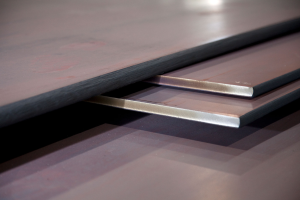
Recent conversations with plate market participants across the US revealed a wide range of experiences contingent on a variety of factors.
Sheet market participants reported steady to elevated demand over the past week. But while spot prices continued to edge up, some sources said lead times were becoming more closely aligned to industry norms.

Over the past few years, the slab market has changed significantly – Iran filled the position previously occupied by Ukraine before the war, Brazilian merchant slab supply fell, and the introduction of CBAM drew more interest into slab imports to the EU.
The price gap between US hot-rolled coil (HR) and landed offshore product tightened this week. The dynamic continues as both stateside and offshore prices have largely trended higher.

According to the latest findings from SMU’s survey, more respondents answered that President Trump’s tariff policies have been helpful to their businesses than in the prior survey.
North American steel buyers are signaling stronger interest in foreign material amid a tight market and rising global substrate costs, which are complicating purchasing decisions.

Core to the negotiations will be the need for a fundamental rebalancing of the relationship between the United States, Mexico, and Canada - especially when it comes to the steel and autos supply chain.
Apparent steel supply declined 3% from January to February to the third-lowest rate recorded in the past two years, just 5% above the near-five-year low set last November.
Factors like fluctuating demand, import availability, domestic product lead times, fuel surcharges, and end-user consumption left plate sources feeling unsettled.
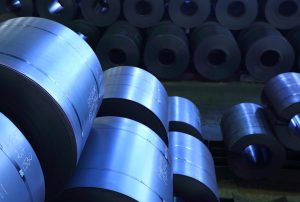
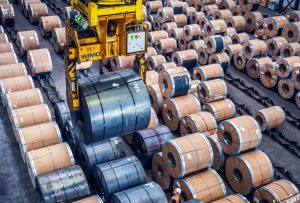
Participants in the hot- and cold-rolled coils market are optimistic about the market's health.
Conditions in the US market remain tight as domestic demand is holding up with support from border wall projects and data center investments. The supply side has struggled to keep pace with weak import volumes, impacting the market.

Remember the “Got Milk?” advertising campaign of the 1990s. Maybe we should start a “Got Steel?” campaign. Or maybe “Got Spot Tons?” would be more accurate, if less catchy.

No doubt, events will scramble the status quo. Meanwhile, the global systems that have prevented major wars for 80 years are sagging.
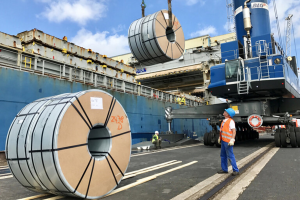
Steel imports remain near some of the lowest volumes recorded in over five years.
Sheet market participants said they expect hot-rolled coil prices to continue to rise. A Midwest service center source said some mills are not taking spot orders. And even on the contract side, certain mills are “keeping customers at the ‘middle’ of their contract buys to help get lead-times back into shape,” he said. That’s a […]
The petitions allege that foreign producers are selling seamless and welded OCTG at unfairly low prices and, in Austria’s case, benefitting from countervailable subsidies.
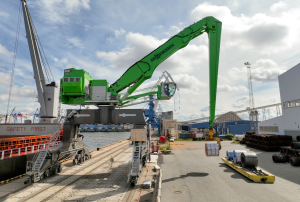
The price gap between US hot-rolled coil (HR) and landed offshore product tightened this week.
Spot market participants worry that limited availability for certain grades of domestically produced plate will extend lead times even further.
The Commerce Department has launched another duty circumvention inquiry targeting coated steel imports at the request of two US mills.
Could we see prices continue to inch higher, plateau, and then start to slide back? A lot hinges on whether and how long it takes mills to catch up on orders.
With global capacity projected to increase by 138 million mt by 2028, the gap between capacity and demand will continue to grow over the next three years. And that assumes the conflict in Iran does not stifle global demand.
CR imports from Germany, Italy, and Japan on a landed basis remain much more expensive than domestic product. But South Korean imports remain competitive, in theory, even with the 50% Section 232 tariff.

AMU's March survey results show lead times remaining extended as supply tightness persists, even as import competitiveness declines and logistics costs increase.
APAC steel prices are expected to rise due to high energy and freight costs stemming from the Middle East conflict. Imports will remain subdued in the EU due to rising freight rates but are expected to pick up marginally in the USA.

Most steel buyers see prices continuing to inch higher on stable or improving demand. But some are concerned higher energy prices stemming for the Iran war could dent the overall economy.

The US Department of Commerce has launched two trade investigations to determine if certain corrosion-resistant (CORE) steel imports are being transshipped through Indonesia to avoid paying anti-dumping and countervailing duties (AD/CVDs).
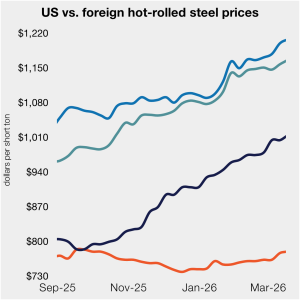
The price gap between US hot-rolled coil (HR) and landed offshore product remained within a tight band this week. The dynamic continues as both stateside and offshore prices have trended higher.