Nucor board OKs new rebar micro mill for Pacific Northwest
Nucor Corp. announced plans to build a new rebar micro mill in the Pacific Northwest.
We’ve all heard a lot about mill “discipline” following a wave of consolidation over the last few years. That discipline is often evident when prices are rising, less so when they are falling. I remember hearing earlier this year that mills weren’t going to let hot-rolled (HR) coil prices fall below $1,000 per short ton (st). Then not below $900/st. Now, some of you tell me that HR prices in the mid/high-$800s are the “1-800 price” – widely available to regular spot buyers. So what comes next, and will mills “hold the line” in the $800s?
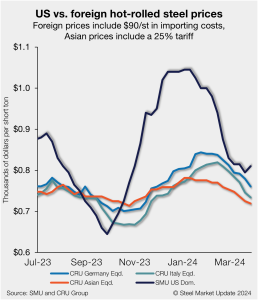
US hot-rolled (HR) coil prices have fallen below $900 per short ton (st) on average for the first time since early November. SMU’s HR price stands at $875/st on average, down $65/st from a week ago and down $170/st from the beginning of the year.
While seaborne trade has been challenging due to weak global steel production, demand for ferrous scrap in the US remains strong, according to Sims Ltd.
Domestic production of raw steel moved higher again last week, improving for the third consecutive week, according to the most recent data from the American Iron and Steel Institute (AISI).
Australia's BlueScope Steel has begun making plans to potentially add cold rolling and coating capabilities in the US.
US housing starts fell for the second consecutive month in January, according to the most recent data from the US Census Bureau.
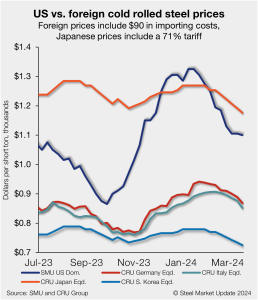
Everyone knows the old saying that “a picture is worth a thousand words.” Just because it’s a cliché doesn’t mean that it’s wrong. A lot of inked has been spilled trying to figure out why prices are falling now. I thought it might be as simple as this: Market dynamics in the fourth quarter (UAW strike, companies buying ahead of an anticipated post-strike price spike, etc.) pulled forward restocking activity that typically happens in the first quarter.
The International Trade Commission (ITC) voted earlier this month against imposing antidumping and countervailing duties on imports of tin mill products from four countries. When Cliffs filed trade cases on tin mill products in early 2023, the company claimed that the failure to get massive duties on imports would result in the closure of its mill in Weirton, W.Va. We don’t know the reasoning behind this decision, only that all four sitting Commissioners voted not to impose duties. We do know that Cliffs plans to close Weirton.
The CRUmpi declined by 1.7% month over month (m/m) to 325.2 in February, compared to a 4.3% m/m increase in February 2023.
What's the steel market talking about at present?
Rig counts in the US and Canada were mixed again for the week ended Feb. 16. The US saw totals move down, while Canadian rig figures ticked up week on week (w/w), Baker Hughes’ latest data shows.
SMU’s Current Steel Buyers’ Sentiment Index was flat this week, while the Future Sentiment Index slipped, according to our most recent survey data.
The LME 3-month price was broadly stable again on the morning of Feb. 16, and was last seen trading at $2,230 per metric ton (mt). On Feb. 16, LME stocks were reported at 534,925 mt, an increase of nearly 10,000 mt from last Friday. The change comes after 15,125 mt of metal was delivered into […]
The scrap export market has demonstrated resiliency so far this year from the US East Coast. This strength has mainly come from the Turkish market. Despite weakening orders for rebar in their domestic market, imported scrap prices have held up until the last several days. The US West Coast is not as active, but there are orders in South Asia and in South America that are keeping things afloat.
What a difference a month makes. There are a few full bulls left in the room, but their numbers are dwindling. We’ll release results of our full steel market survey tomorrow afternoon. I took a sneak peak at the data on Thursday. And more people than I expected think that US hot-rolled (HR) coil prices will be in the $700s per short ton (st) two months from now. Vanishingly few think prices will be above $1,000/st in mid-April.
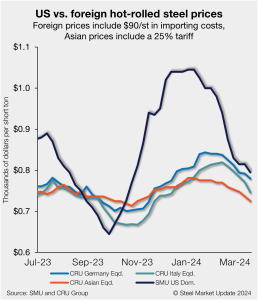
US hot-rolled coil (HRC) prices moved lower again this week, remaining largely on a downtrend since mid-January. The result has caused domestic tags to lessen their price premium over imported products week on week (w/w).
Mill lead times for flat-rolled steel were mostly stable over the past two weeks. With several mills slow to come out of outages and upgrades, cold rolled and coated lead times have been holding up better than hot rolled.
Flat Rolled = 60.3 Shipping Days of Supply Plate = 63.4 Shipping Days of Supply Flat Rolled US service center flat-rolled steel supply declined in January, though less than expected because of a weaker-than-normal seasonal increase in shipments to start the year. At the end of January, service centers carried 60.3 shipping days of supply […]
Reliance Inc. – formerly Reliance Steel & Aluminum Co. – introduced its “new company identity” that emphasized its “evolution to more than steel,” the company said in its fourth-quarter and full-year earnings report.
Cleveland-Cliffs Inc. announced on Thursday, Feb. 15, that it will indefinitely idle tinplate production at its mill in Weirton, W.Va.
Reliance has entered into an agreement to purchase Houston-based American Alloy Steel Inc. for an undisclosed sum.
Sheet prices have fallen again this week on shorter lead times, higher imports, and potentially higher inventories. (We’ll see for sure when we release our service center shipment and inventory data next week.) I remember reporting almost exactly the same thing about a month ago and getting a fair amount of pushback. Not so much these days.
The pace of sheet price declines accelerated this week as steel buyers said that domestic mills were competing against each other while also coping with higher-than-expected import volumes. “They are getting rid of the fluff. When you can pit 2-3 mills against each other, the fat margins get cut,” one industry source said.
Bull Moose Tube Co. (BMT) is now offering jumbo hollow structural sections (HSS) in the US market.
The US apparent steel supply moved up to 7.79 million short tons (st) in December, a rise of 2% from 7.67 million st in November, according to data from the Department of Commerce and the American Iron and Steel Institute (AISI). Apparent steel supply is determined by combining domestic steel mill shipments and finished US […]
US busheling scrap prices fell this month, while HMS and shredded grades remained largely unchanged.
The latest statistics from the Air Conditioning, Heating, and Refrigeration Institute (AHRI) show that December shipments of heating and cooling equipment in the US inched higher from the previous month but declined from last year’s levels.
Domestic production of raw steel increased again last week, according to the most recent data from the American Iron and Steel Institute (AISI). Output moved higher for the second straight week after declining for more than a month to start the year.
What’s something going on in the market that no one is talking about? That’s a question on our survey, and was also posed to many who graced the stage at our Tampa Steel Conference. Perhaps another way to phrase that is “not talking about publicly” or connecting the dots of steel market chatter to find a uniting central issue. I thought one respondent to our survey really summed up the current moment: “Right now it is all politics.”