AMU: The art and science of Midwest Duty-Paid Premium discovery
Hashing out duty costs


Hashing out duty costs

If you’re feeling a sudden jerk and a case of tariff whiplash coming on, you’re not alone.
SMU’s Steel Buyers’ Sentiment Indices moved in opposing directions this week. Our Current Steel Buyers’ Sentiment Index sharply fell to one of the lowest levels recorded in five years, while Future Buyers’ Sentiment marginally improved.
Despite high expectations, the export scrap market has not moved up.
Subdued demand has continued to weigh on steel sheet prices globally.

Steel equities and steel futures fell hard after news broke earlier this week that the US and Mexico might reach an agreement that would result in the 50% Section 232 tariff coming off Mexican steel. The sharp declines didn’t make much sense, especially if, as some reports indicate, Mexico might agree to a fixed quota. They didn't make sense even if steel flows between the US and Mexico remain unchanged.

Never a dull moment in today's HR futures market.
All five of the averages for sheet and plate mill lead times tracked by SMU extended moderately this week, according to buyers responding to our latest market survey.
Most steel buyers responding to our market survey this week reported that domestic mills are considerably less willing to talk price on sheet products than they were in recent weeks, but remain open to bargain on plate prices.
The US steel industry is edging closer to independence from imports, and it may only take one more mill to tip the scales, according to Timna Tanners, managing director at Wolfe Research.
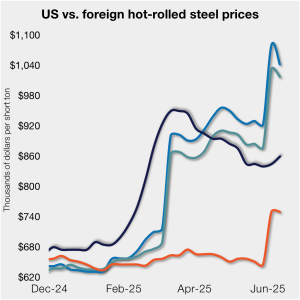
Domestic hot-rolled (HR) coil prices edged up marginally again this week, while offshore prices ticked down.
ArcelorMittal’s (AM) Hamilton location to be shuttered, wire production shifting to Montreal.
Even before the news about Mexico, I didn’t want to overstate the magnitude of the change in momentum. As far as we could tell, there hadn’t been a frenzy of new ordering following President Trump’s announcement of 50% Section 232 tariffs. But higher tariffs had unquestionably raised prices for imports, which typically provide the floor for domestic pricing. We’d heard, for example, that prices below $800 per short ton for hot-rolled (HR) coil were gone from the domestic market – even for larger buyers.
Steel prices climbed for a second straight week across all five sheet and plate products tracked by SMU.
Brazilian pig iron prices fail to rise after ferrous scrap market settle.
US steel exports totaled 579,000 short tons (st) in April, according to US Department of Commerce data. That's the lowest monthly volume recorded since July 2020.
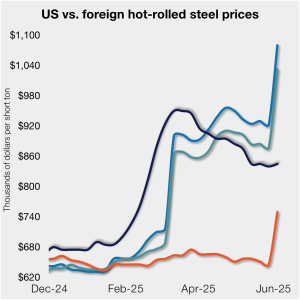
Domestic hot-rolled coil prices edged up marginally this week, while offshore prices ticked down.

Oil and gas drilling activity was mixed this week, according to Baker Hughes. US totals slipped for a sixth straight week, while Canada saw a slight bump in activity.
This CRU Insight examines how the increase in Section 232 tariffs on steel to challenging levels will lead to significatively higher prices for end consumers in the US market.
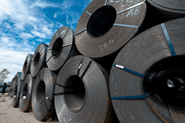
April now represents the third-lowest monthly import rate witnessed in nearly two and a half years, with several steel products falling to multi-year lows
I think there is an obvious case for sheet and plate prices going higher from here. That’s because, on a very basic level, the floor for flat-rolled steel prices, which is typically provided by imports, is now significantly higher than it was a week ago.

A fierce flat price rally started this week that saw the nearby months rally by over $120/ short tons, exceeding the contract highs seen in February ahead of the first batch of tariffs.
All districts reported "hesitancy and a cautious approach to business and household decisions,” according to the Beige Book.
Mexican steel trade group Canacero has condemned the US’ actions of raising tariffs on steel and aluminum to 50% from 25%.
The US scrap market has traded sideways from May prices in basically one day without any significant descent, sources say. All major steelmakers, with maybe one exception, issued orders at prices paid in May.
President Donald Trump on Tuesday evening signed a proclamation that officially doubled Section 232 tariffs on imported steel and aluminum from 25% to 50%. There was one exception: Section 232 tariffs on steel and aluminum from the United Kingdom will remain at 25%, according to a fact sheet published by the White House.

Cleveland-Cliffs Chairman, President and CEO Lourenco Goncalves offered full-throated support for Section 232 tariffs on imported steel being doubled to 50%. And the top executive of the Cleveland-based steelmaker said the steel industry wanted to see as few exceptions as possible to the tariffs.
Following eight consecutive weeks of declines, sheet and plate prices saw some upward movement this week in the wake of last Friday’s Section 232 tariff increase announcement. Gains varied by product.
The speed and scale of recent moves are reminders of just how sensitive HRC futures remain to structural shifts and sentiment cues.
Meanwhile, several US trade groups applauded the latest trade announcement.