Worthington expands European presence with closing of Sitem deal
The Ohio-based steel processor is now the majority owner of Italy's Sitem Group, which has six manufacturing sites across Italy, Switzerland, Slovakia, and France.


The Ohio-based steel processor is now the majority owner of Italy's Sitem Group, which has six manufacturing sites across Italy, Switzerland, Slovakia, and France.
How have tariff revelations affected the June market?
May marks the third consecutive month US manufacturing activity declined, according to supply executives contributing to the Institute for Supply Management (ISM)’s latest report.
Late Friday, President Trump said he would double down on tariffs, raising duties on imported steel and aluminum from 25% to 50%.

Briefing on the stay motion will be completed by June 9. If a stay pending appeal is granted, it will likely remain in effect until the Court of Appeals issues a decision, which could be months in the future. The case is almost certain to be appealed to the Supreme Court.

International trade attorneys discuss court decisions this week that left many importers, manufacturers, and even casual observers wondering: What’s next?

Highlights from the week and things to keep an eye on.
Oil and gas drilling activity declined again this week in both the US and Canada, according to Baker Hughes.

The Chicago Business Barometer reports that decreases in new orders, order backlogs, and softer production pulled the index down by 4.1-points to 40.5, in May.
After reaching multi-month lows in mid-May, SMU’s Buyers’ Sentiment Indices modestly recovered in our latest survey.
CRU analysts discuss how downward pressure on the US premium has persisted due to weakness in key consuming sectors, while concerns over zinc supply have been largely alleviated for the time being.

The evolution of the U.S. HRC futures curve since my last update on April 17 tells a familiar story: fleeting optimism giving way to renewed caution.
Mill lead times shrunk this week for all of the sheet products tracked by SMU and held steady on plate, according to buyers responding to our latest market survey.

The “on again, off again” Trump tariff train continues to chug along, with several important court rulings this week.
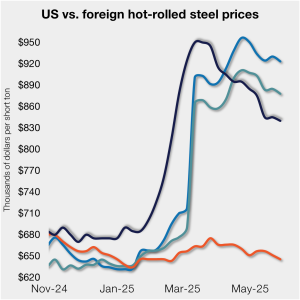
Domestic hot-rolled coil prices moved lower again, maintaining the downward move seen in eight of the last 10 weeks.
Most steel buyers responding to our latest market survey report that domestic mills are willing to talk price to secure new orders. Mill negotiability has continued to rise across all sheet and plate products we track, now at some of the highest levels recorded since late 2024.

I sort of expected big news last Friday and over the long, Memorial Day weekend. Because that's become more the norm than the exception for steel this year. Sure enough, Trump posted on Truth Social on Friday afternoon that he had given his blessing to a “partnership” between Nippon Steel and U.S. Steel. And then over the weekend we had market moving new on tariffs, this time involving the EU.
Sheet and plate prices marginally declined again this week for the second consecutive week, pausing the strong downward trend seen from April through early May.

Rio Tinto is embarking on a major upgrade of the nearly century-old hydroelectric station in Quebec to secure low-carbon power for its aluminum smelters in the region.
Oil and gas drilling activity declined in both the US and Canada this week, according to Baker Hughes.

Which way will the herd move?
For the third month in a row, architecture firms reported a reduction in billings through April, according to the latest Architecture Billings Index release.
Most sheet and plate prices edged lower again this week, albeit at a slower pace compared to the movements seen over the last seven weeks. Buyers remain cautious and hesitant to hold onto much inventory, citing lingering demand concerns, ongoing tariff uncertainty, and a potentially weakening scrap market in June.
After recently receiving an industry honor on behalf of Ternium, I had the opportunity to reflect and share my vision on the state and future of our industry.
International trade remains at the forefront of President Trump’s agenda, especially as new negotiations and investigations continue to be announced.
The budget proposal has big implications for steel and manufacturing.
SMU’s Buyers’ Sentiment Indices resumed their downward trend this week, erasing the modest recovery seen two weeks ago.
Manufacturing activity in New York state declined for the third consecutive month, according to the May Empire State Manufacturing Survey from the Federal Reserve Bank of New York. Responding firms continue to forecast weaker business conditions in the coming months.
Sheet and plate lead times declined across the board this week, according to buyers responding to the latest SMU market survey. While our lead time ranges were unchanged compared to mid-April levels, average production times for each steel product we measure have declined from they were two weeks ago.
Domestic mills are largely negotiable on spot prices, according to the majority of steel buyers responding to our latest market survey.