
AISI: Weekly raw steel mill output ticks lower
Domestic raw steel production edged lower last week, according to the latest data released by the American Iron and Steel Institute (AISI).


Domestic raw steel production edged lower last week, according to the latest data released by the American Iron and Steel Institute (AISI).
U.S. Steel’s board of directors has approved the funding for the full $350-million Gary Works blast furnace (BF) reline project.
SMA's Philip Bell looks back at 2025 and ahead to next year.
The US Department of Commerce has officially published the anti-dumping and countervailing duty orders on corrosion-resistant steel sheet imports, the final step in the trade case originally filed more than a year ago. At the same time, Commerce also revealed it is allowing some CORE imports into the country without paying the AD or CVDs.
Metalforming manufacturers are more upbeat on the prospect of improved near-term economic activity despite lower shipping levels in December, according to the Precision Metalforming Association’s (PMA) December report.

Nucor raised its weekly hot-rolled coil spot list price by $10 per short ton (st) this week, marking the company's ninth consecutive increase.

The US and Canadian rig counts both fell this week, according to the latest Baker Hughes data released on Friday, Dec. 19.

An SMU Community Chat with Timna Tanners.

US Midwest sheet prices continued to rise alongside continued mill prices increases as lead times remained extended.

Canadian Prime Minister Mark Carney said the US probably won't reduce tariffs on steel, aluminum, and other goods from Canada anytime soon.
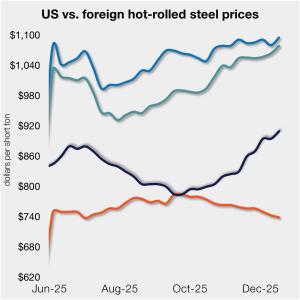
The price gap between stateside hot band and landed offshore product continues to narrow, inching closer toward parity. The premium is now, on average, at its lowest level since July.

Worthington Steel executives emphasized on an earnings conference call on Thursday that the company’s standout fiscal Q2 performance came from capturing new automotive business, with direct automotive shipments rising 26% year over year.

Architecture firms across the United States continued to grapple with weak billings in November, amid uncertain economic conditions, according to the AIA.

Steel Dynamics Inc. expects its fourth-quarter earnings to be weaker than in the previous quarter, albeit still higher than last year. Longer-than-expected mill outages impacted flat-rolled steel volumes in the quarter.

Posco has confirmed a 20% stake in a joint EAF mill in Louisiana with fellow South Korean firm Hyundai, an investment valued at $582 million.
Nucor has guided to lower earnings sequentially in the fourth quarter but higher on-year.
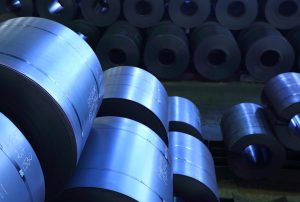
Apparent steel supply rose to 8.64 million short tons in September, driven primarily by higher domestic mill shipments despite a sharp drop in finished imports.

In this Premium analysis we examine North American oil and natural gas prices, drill rig activity, and crude oil stock levels through December

Following last week’s pause, SMU’s price indices were overall steady to higher this week, holding at or near multi-month highs.

Martin Baker is joining Hybar as its strategic metallics manager, responsible for further developing the metallics procurement and global strategic initiatives for the Osceola, Ark.-based steelmaker.

US shipments of heating and cooling equipment fell 11% in October from September to the lowest monthly rate of the year, and an eight-year low, according to AHRI.
SMU and AMU are pleased to announce that Wells Fargo Managing Director Timna Tanners will be joining us for a Community Chat webinar on Wednesday, Dec. 17, at 11 am ET.

Following August’s modest 4% uptick, the volume of steel shipped outside of the country slipped 8% in September to 594,000 short tons, according to recently released data from the US Department of Commerce.

SSAB has tapped Tom Cox to lead its Americas division. Currently GM of SSAB Iowa, he'll assume the position of Head of SSAB Americas as of Feb. 1, 2026.
The volume of raw steel produced by US mills ticked higher last week, according to the latest figures published by the American Iron and Steel Institute (AISI).

Business activity in New York state retreated in December, according to the Empire State Manufacturing Survey conducted by the Federal Reserve Bank of New York.

US Congressmen Mike Kelly (R-Pa.) and Chris Deluzio (D-Pa.) have introduced the Strengthening Trade Enforcement and Evasion Limitations Act (STEEL Act) into the House of Representatives. The bipartisan bill aims to curb unfairly traded imports and strengthen US trade enforcement.
Flat rolled = 50.6 shipping days of supply Plate = 52.8 shipping days of supply Flat rolled US service centers’ flat-rolled steel supply declined for the fourth straight month, reaching 50.6 shipping days of supply on an adjusted basis at the end of November, according to SMU data. Flat roll supply is at its lowest […]
Nucor increased its weekly hot-rolled coil spot list price by $10 per short ton (st) again on Monday, Dec. 15. This was its eighth increase in as many weeks, moving up $65/st over that span.
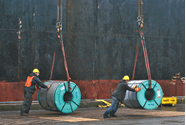
According to recently finalized US Commerce Department data, US steel imports tumbled to a near five-year low in September