Cliffs to idle Weirton mill after tinplate trade case decision
Cleveland-Cliffs Inc. announced on Thursday, Feb. 15, that it will indefinitely idle tinplate production at its mill in Weirton, W.Va.
Sheet prices have fallen again this week on shorter lead times, higher imports, and potentially higher inventories. (We’ll see for sure when we release our service center shipment and inventory data next week.) I remember reporting almost exactly the same thing about a month ago and getting a fair amount of pushback. Not so much these days.
The US apparent steel supply moved up to 7.79 million short tons (st) in December, a rise of 2% from 7.67 million st in November, according to data from the Department of Commerce and the American Iron and Steel Institute (AISI). Apparent steel supply is determined by combining domestic steel mill shipments and finished US […]
What’s something going on in the market that no one is talking about? That’s a question on our survey, and was also posed to many who graced the stage at our Tampa Steel Conference. Perhaps another way to phrase that is “not talking about publicly” or connecting the dots of steel market chatter to find a uniting central issue. I thought one respondent to our survey really summed up the current moment: “Right now it is all politics.”
Last week, steel consumers prevailed in a rare victory over US petitioners in trade cases on tin mill steel products. The US International Trade Commission (ITC) voted 4—0 that Cleveland-Cliffs, the sole remaining domestic producer of tin mill products (used to make containers such as “tin cans”) was neither injured nor threatened with injury by imports of competing products from Canada, China, and Germany. Imports from South Korea were found to be “negligible,” and the investigation on Korean imports was terminated.
Based on initial license data for January, steel imports appear to have risen to a six-month high, and flat-rolled steel imports to a seven-month high.
There seems to be bit of high-stakes chicken going on in the domestic sheet market. Prices have been moving lower for most of the year, and our hot-rolled (HR) coil price on Tuesday fell below $1,000 per short ton (st) on average. Crossing that threshold does not seem to have resulted in a flurry of buying activity.
After holding steady for most of January, the hot rolled (HR) index has started to gain some downward momentum. In the last 30 days, it has declined $89 per short ton (st) and is sitting just above $1,000/st.
More supply coming online and an unchanging demand environment – two key themes for 2024 – could soon bring the steel sheet storm to a market near you.
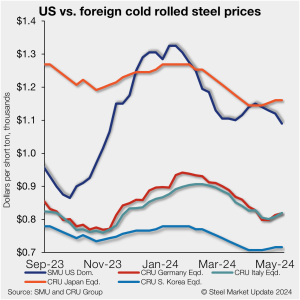
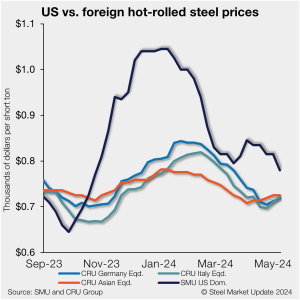
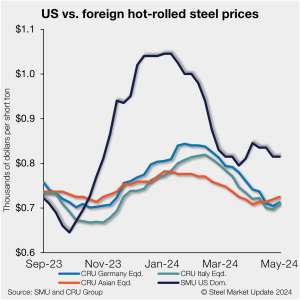
US hot-rolled coil (HRC) prices were again lower this week, pushing the price premium domestic hot band carries over imported products lower vs. the prior week.
What are folks in the steel industry talking about? SMU polled steel buyers on a variety of subjects this past week, including domestic steel prices, import offers, buying activity, and more. Rather than summarizing the comments we received, we are sharing some of them in each buyer’s own words.
2023 was the third-lowest year for steel imports in the last decade, according to an SMU analysis of data from the US Department of Commerce.
Timna Tanners, managing director of equity research at Wolfe Research, will be the featured speaker on our next SMU Community Chat. The chat will be on Wednesday, Feb. 7, at 11 a.m. ET. You can join the ~600 people who have already registered here.
At the final hour, the trade case investigating unfairly traded imports of tin mill products has been terminated.
Former President Donald Trump discussed, if re-elected, placing a 60%-or-more tariff on all Chinese imports in an interview with Fox News on Sunday.
I participated in the 35th annual Tampa Steel Conference last week, a conclave of steel producers, consumers, traders, logisticians, and (a few) trade lawyers. I participated in a panel discussion concerning challenges in managing supply chains in these troubled times. Things appear to be heading in the wrong direction in this field. Supply chains were shown to be vulnerable to pandemics in 2020 and 2021, and, in 2022 and 2023, to regional conflicts and weather slowing or stopping the free movement of goods through trade bottlenecks (the Suez Canal, the Panama Canal, the Bosporus, etc.)
Timna Tanners, managing director of equity research at Wolfe Research, will be the featured speaker on our next SMU Community Chat on Feb. 7.
The Department of Commerce has adjusted the countervailing duty (CVD) rates on imports of corrosion-resistant (galvanized/Galvalume) steel from South Korea after an administrative review.
Speaking during a fireside chat at the Tampa Steel Conference on Monday, Jan. 29, Hybar CEO David Stickler provided a status update on the company’s new rebar mill project and its plans for the future, including the possibility of a flat-rolled steel mill.
The US Midwest premium was flat week over week (w/w) at 18.8–19.4¢/lb. Again, the premium has exhibited remarkably low levels of volatility and has yet to react to news in the geopolitical or macroeconomic spaces.
I thought Nippon Steel’s $14.1-billion deal for U.S. Steel might become a political football in this year’s presidential election. Now there is little doubt that it will after Trump told reporters in Washington, D.C., earlier this week that he would “absolutely” block the transaction – and that he would do so “instantaneously.”
Steel mill lead times for sheet products saw substantial declines over the past two weeks, while production times for plate held steady during the month of January.
If reelected in the November presidential election, Donald Trump said he would block the sale of U.S. Steel to Japan’s Nippon Steel Corp. (NSC).
US hot-rolled coil (HRC) prices law little movement this week, a similar trend seen in offshore markets. Thus, the price premium domestic hot band carries over imported products was largely unchanged vs. the prior week.
I’m writing these final thoughts from the JW Marriott in Tampa. And I’m looking forward to seeing some of you reading this in just a few hours at the opening networking reception of the Tampa Steel Conference. Nearly 550 people will be there – a new record for the event. If you’re looking for things […]
Trade is not the major focus of the campaigns for the 2024 elections, either at the presidential or congressional level. But it is there as a live issue for business. And last August, former President Trump suggested a 10% tariff on virtually all imports as a “ring around the collar” of the US economy.
The Steel Manufacturers Association (SMA) outlined its praise for the US and EU extension on negotiations towards the proposed Global Arrangement on Sustainable Steel and Aluminum.
This week Magnitude 7 Metals issued a statement to announce the curtailment of its New Madrid smelter in Marston, Mo. The plant, one of only five remaining primary smelters in the US, employs approximately 450 union workers. With over 275,000 metric tons (mt) of capacity per year, New Madrid is the second-largest plant by capacity […]
December’s import level was slightly lower than an earlier license count had suggested, resulting in December marking the second-slowest month for imports in 2023.
Brazilian steel maker Usiminas has resumed operations at blast furnace (BF) No. 3 at its Ipatinga works in the state of Minas Gerais. The restart comes after a BRL2.7-billion ($546-million) refurbishment on the unit, which has capacity of three million metric tons (mt) per year.