US HR prices rebound, no longer near parity with imports
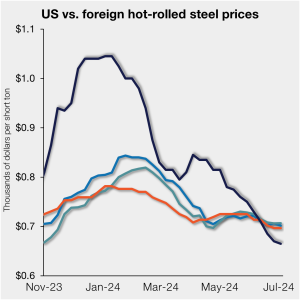
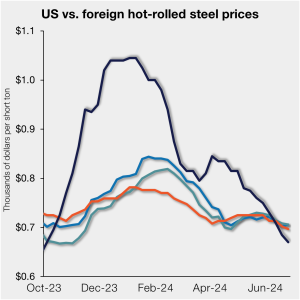
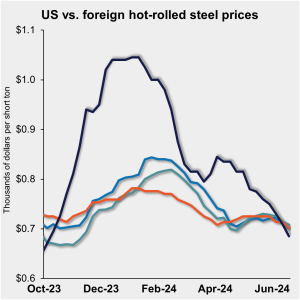
US hot-rolled coil and offshore hot band moved further away from parity this week as stateside prices have begun to move higher in response to mill increases.
A container ship collided with the Francis Scott Key Bridge in Baltimore on March 26, causing it to collapse. This has blocked sea lanes into and out of Baltimore port, which is the largest source of US seaborne thermal coal exports. The port usually exports 1–1.5 million metric tons (mt) of thermal coal per month. It is uncertain when sea shipping will be restored. But it could be several weeks or more. There are coal export terminals in Virginia, though diversion to these ports would raise costs.
SMU’s sheet prices firmed up modestly this week, even as CME hot rolled futures declined. What gives? My channel checks suggest that demand remains stable and that buyers have returned to the market following new HR base prices announced by mills earlier this month. I’m looking forward to seeing whether lead times, which have stabilized, will start extending. SMU will have more to share on that front when we release updated lead time figures on Thursday. As for HR futures, what a reversal! As David Feldstein wrote last Thursday, bulls expected mill price increase announcements. And we briefly saw the May contract climb as high as ~$1,000 per short ton (st).
Mercury Resources CEO Anton Posner will be the featured speaker on SMU’s next Community Chat webinar on Wednesday, April 3, at 11 am ET. The live webinar is free. You can register here. A recording of the webinar and the slide deck are available only SMU members.
There’s that concept from Adam Smith we all learn about in our Econ 101 classes: The Invisible Hand. A simple Google search will provide a refresh, but if memory serves I would classify it as something akin to “the market is magic” or “the market’s gonna market.” Today, obviously, we live in a mixed environment. There are a lot of hands out there, and they’re not too difficult to see. In this election year of 2024, one of the most visible hands out there probably belongs to the federal government.
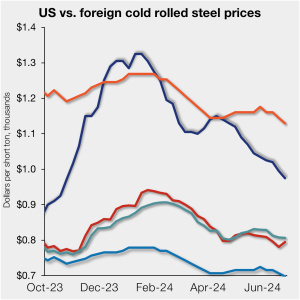
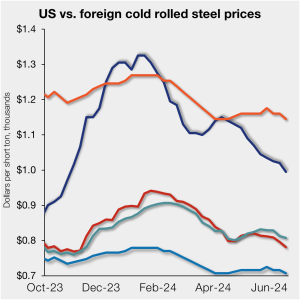
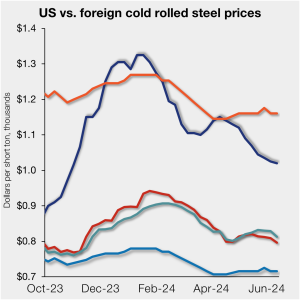
Foreign cold-rolled (CR) coil remains notably less expensive than domestic product even with repeated tag declines across all regions, according to SMU’s latest check of the market.
APAC steel prices are likely to bottom out in the near term as seasonally higher demand coupled with production cuts may support prices. In the EU, prices are likely to remain under pressure, while fresh price increases are expected in the US. APAC steel prices are likely to bottom out in the near term In […]
As the month of March goes into the second half, the scrap community is trying to cope with the large drop in ferrous scrap earlier this month.
I’ve had questions from some of you lately about how we should think of the spread between hot-rolled (HR) coil prices and those for cold-rolled (CR) and coated product. Let’s assume that mills are intent on holding the line at least at $800 per short ton (st) for HR. The norm for HR-CR/coated spreads had been about $200 per short ton (st). That would suggest CR and coated base prices should be ~$1,000/st. Good luck finding anyone offering that.
US hot-rolled coil (HRC) remains more expensive than offshore hot band but continues to move closer to parity as prices decline further. The premium domestic product had over imports for roughly five months now remains near parity as tags abroad and stateside inch down.
SMU caught up with Barry Zekelman, executive chairman and CEO of Zekelman Industries, on Wednesday’s Community Chat. As one of the largest independent steel pipe and tube manufacturers in North America, his company is also one of the largest steel buyers in the region. This year alone, the Chicago-based company will buy roughly 2.8 million tons of steel. As such, Zekelman provides a great perspective on the steel industry and the markets it serves.
Earlier this week SMU polled steel buyers on an array of topics, ranging from market prices, demand, and inventories to imports and evolving market chatter.
SMU’s price for hot-rolled (HR) inched lower this week. I wouldn’t be surprised, however, if we start to see prices and lead times move higher in the weeks ahead. The modest declines in HR this week are probably the result of lingering deals cut at “old” prices, as sometimes happens after mill price increases. But those deals will probably be out of the market soon if they aren’t already. So why do I float the idea of higher prices? Some big buys have been placed. It reminds me a little of what we saw last fall, when people restocked in anticipation of higher prices once the UAW strike was resolved.
Are we still looking for a bottom on sheet prices? In what direction are steel and scrap prices headed? How’s demand holding up at the moment?
Happy St. Patrick’s Day. “To govern is to choose.” Those words, reportedly first uttered by the late French Premier Pierre Mendes-France in the 1950s, resonate vividly in our time. It means that choices have consequences and that priorities must be set based on goals. Interested parties, in and out of government, raise their voices in […]
Foreign cold-rolled coil (CR) remains significantly less expensive than domestic product even as US tags continue to decline in a hurry, according to SMU’s latest check of the market.
Steel mill lead times were flat to slightly up, according to our market survey this week.
US hot-rolled coil (HRC) remains more expensive than offshore hot band, even as domestic prices remain under pressure. The premium domestic product had over imports for roughly five months now remains near parity as tags abroad and stateside inch down.
US senators have introduced the "Stop Mexico’s Steel Surge Act," which seeks to reimpose 25% Section 232 tariffs on Mexican steel imports.
The apparent supply of steel in the US increased in January, rising to a five-month high, according to data compiled from the US Department of Commerce and the American Iron and Steel Institute (AISI).
As I see it, the market looked to be a perfect storm for consumers this month while two large steel mills tried to put a floor on hot-rolled coil (HRC). One source speculated that “flat rolled mills coordinated their downtime and will take out 250,000 tons of capacity in April,” which made them attempt to put a bottom on flat-rolled product.
In 2023, Mexico emerged as the largest trading partner with the United States—larger than Canada, and even China. The growth in trade with Mexico has been truly historic—Mexico has never captured the title of the largest exporter to the US. At $475 billion for the year, the value of US imports from Mexico exceeded that […]
The LME three-month price continued to strengthen through Friday, March 8, defending its position close to its five-week high and rising further to $2,262 per metric ton (mt), up 0.3%, on the day. Gains were also noted over the last week in other industrial metals, including copper, zinc, and lead. The price gains appeared to be due to weakness in the US dollar, which fell sharply against a basket of currencies after Fed Chairman Jerome Powell said on Wednesday that rate cuts were still expected this year.
The latest steel import license data from the US Commerce Department shows 2.39 million short tons (st) of steel entered the country in February 2024, down 6% from the month prior.
A weak start for sheet demand this year has continued to weigh on global prices. European demand outside of the renewable energy sector was weak enough that market participants said mills are likely to cut output further after several furnace restarts earlier in the year. In China, demand has also failed to pick up after recent holidays, and even government announcements of more stimulus measures during the country’s “Two Sessions” meetings failed to boost market confidence.
The US plate market has been largely quiet over the past week since Nucor’s $90-per-ton price cut at the close of February.
A Detroit-area mill entered the scrap market on Thursday offering down $70 per gross ton (gt) on #1 busheling. And Nucor announced a minimum base price of $825 per short ton (st) for hot-rolled (HR) coil. What's the best way to interpret would could be read as contradictory trends?
Antidumping and countervailing duty (AD/CVD) rates on imports of cut-to-length plate from two major South Korean producers may soon be adjusted.
US hot-rolled coil (HRC) is now just about 5% more expensive than offshore hot band. The premium domestic product had over imports for roughly five months is all but gone, and nearing parity.
What are folks in the steel industry talking about at present? Respondents to SMU’s mini-survey this week shared some of their thoughts with us about what's going on in the market. Rather than summarizing their responses, here’s some of what they had to say in their own words.