Leibowitz: Middle East War and tariff changes mean more market uncertainty incoming
No doubt, events will scramble the status quo. Meanwhile, the global systems that have prevented major wars for 80 years are sagging.
The president’s April 2 proclamation restructures how derivative products are classified, valued, and tariffed – a shift that industry groups say will close loopholes but could raise costs for certain downstream imports.
If I had to sum it up, I’d say “pain at the pump” is back. AAA says gasoline now averages more than $4 per gallon nationally ($4.08 to be precise) for the first time in for years. Meanwhile, diesel prices average $5.40 per gallon, according to the US Energy Information Administration. That’s up $1.81 per gallon from a year ago.
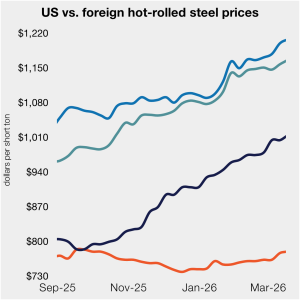
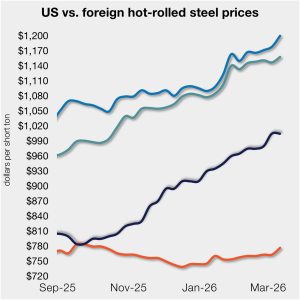
The price gap between US hot-rolled coil (HR) and landed offshore product tightened this week.
The Trump administration has implemented changes to its steel and aluminum tariff framework that alter how duties are applied to imported manufactured goods, according to an April 2 presidential proclamation.
With global capacity projected to increase by 138 million mt by 2028, the gap between capacity and demand will continue to grow over the next three years. And that assumes the conflict in Iran does not stifle global demand.
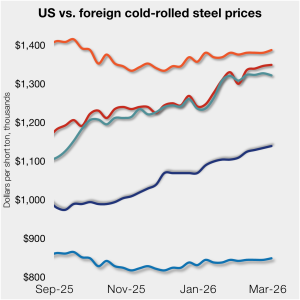
CR imports from Germany, Italy, and Japan on a landed basis remain much more expensive than domestic product. But South Korean imports remain competitive, in theory, even with the 50% Section 232 tariff.
Most steel buyers see prices continuing to inch higher on stable or improving demand. But some are concerned higher energy prices stemming for the Iran war could dent the overall economy.
The price gap between US hot-rolled coil (HR) and landed offshore product remained within a tight band this week. The dynamic continues as both stateside and offshore prices have trended higher.
Ken Simonson, chief economist for The Associated General Contractors of America (AGC), will join SMU for a Community Chat webinar on Wednesday, April 15, at 11 a.m. ET.
North American auto assemblies gained ground in February, up more than 8% vs. January, but still down more than 4% year on year (y/y), according to GlobalData.
The public will soon have the opportunity to request Section 232 tariff coverage on imports of automobile parts.
The layoffs at Algoma Steel’s integrated facility went into effect today. Going forward, it will use the electric arc furnace (EAF) for producing its steel.
The ongoing Middle East conflict, the resurgence of broad-based tariffs under Section 122 of the Trade Act of 1974, and the looming US midterm elections are not isolated developments. Rather, they form a kind of feedback loop in which each issue influences, and is influenced by, the others.
Since the Supreme Court ruled the IEEPA (reciprocal) tariffs imposed by the Trump administration were illegal, the subject of refunds has been circulating. A lower court has ruled refunds are due to importers affected by these tariffs, which amounted to an estimated $166 billion.
When nations eye their trade policy these days, are they only seeing tariffs? It might seem that way, especially after reading a presidential executive order or five over the last year. But is the condition spreading?
The UK will reduce steel import quotas and raise outside caps to 50%.
The Steel Manufacturers Association’s (SMA's) Philip K. Bell believes President Trump’s steel tariffs have been effective so far, and thinks we should remain “solution-focused” regarding the upcoming USMCA review.
The office of the US Trade Representative has opened a major Section 301 investigation into structural excess capacity across global manufacturing, with steel and aluminum at the center of the inquiry.
The price gap between US hot-rolled coil (HR) and landed offshore product widened this week, as stateside tags were little changed.
A year after being blindsided by hefty tariffs from its top trading partner, Canadian steelmakers are renewing their call for tariff-free trade between the US and Canada.
Earlier this week, SMU polled steel buyers on an array of topics, ranging from market prices, demand, and inventories to tariffs, imports, and evolving market events.
Sometimes it feels like current events are like a fireworks show that got set off all at once by mistake. In all the commotion, it's hard to know where to look... or where to run.
Cold-rolled (CR) coil prices ticked up in the US this week, matching a similar trend seen in most offshore markets as well.
The price gap between US hot-rolled coil (HR) and landed offshore product tightened this week, as stateside tags continue to rise.
Since the Supreme Court struck down President Trump’s use of IEEPA tariffs, a judge at the Court of International Trade (CIT) has ordered refunds of all IEEPA tariffs. Still, Trump is trying again with a Section 122 global tariff.
Economic activity across the US increased at a light-to-modest pace in seven of the 12 Federal Reserve Districts, according to the US Federal Reserve’s latest Beige Book report.
The US surpassed Japan in annual steel production in 2025 for the first time in 26 years, according to the World Steel Association (worldsteel).
Tariff-related litigation in the US and around the world reflects the willingness of the president to act without consulting Congress or our trading partners. We're seeing the impulse to act without congressional approval in international relations too.
Entering 2026, tin has led a frenzied base metal rally during a historic phase for commodities. Frothy market conditions, driven by volatile investor positioning and shifting macro risk sentiment, pushed several metals—including tin—to record highs in January, before a sharp correction in February.