US CR remains more expensive than most imports
Cold-rolled (CR) coil prices were unchanged in the US this week, while offshore prices varied, though mostly trended up.


Cold-rolled (CR) coil prices were unchanged in the US this week, while offshore prices varied, though mostly trended up.
SMU’s average price for domestic HR was unchanged vs. last week. In offshore markets last week, while prices diverged, the dynamic between stateside and imported product varied little.

Earlier this week, SMU polled steel buyers on an array of topics, ranging from market prices, demand, and inventories to tariffs, imports, and evolving market events.
Imports from Europe are at parity with domestic hot rolled, while Southeast Asian products remain at a considerable discount. The result comes because a stateside rally coincides with faltering offshore prices.
We asked our readers what they thought the outcome of the ongoing USMCA talks might be as far as Section 232 tariffs go. Very few see an elimination of tariffs as likely.

Barry Zekelman, executive chairman and CEO of Zekelman Industries, will be the featured guest on our next Community Chat on Wednesday, July 15, at 11 am ET.
Limited spot product and extended lead times continue to characterize the domestic plate market, prolonging upward price pressure.

We’ve gotten so used to the slow, steady increases by now that $5/ton feels like the new flat. And flat, after so many consecutive weeks of gains, feels like a decrease.

North American steel buyers are navigating a market where demand is firming, but import activity remains cautious. Buyers reported mixed import activity in SMU’s June 26 flat-rolled steel buyers’ survey.

Wells Fargo's Timna Tanners thinks the steel price rally will be falling off as we get further into the second half.

As all these initiatives unfold, one is left with the feeling that disruption of the global order is their primary purpose. As the old order is destroyed, it is time to think carefully about what will take its place.
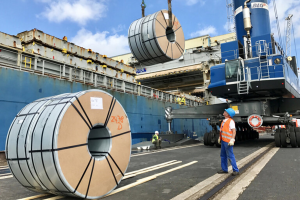
Cold-rolled coil prices moved higher in the US this week, as offshore prices trended lower. Imports are, as a result, increasingly more competitive, even with the 50% Section 232 tariff.
Domestic steelmakers told the Congressional Steel Caucus that strong trade enforcement and Section 232 tariffs continue to drive higher production, new investment, and facility restarts nationwide.
SMU’s average price for domestic HR was $1,145 per short ton (st) this week, $15/st higher week over week (w/w). In offshore markets last week, prices moved down, largely maintaining a trend seen since late April.
SMA's Philip K. Bell writes about the upcoming USMCA joint review.

As the US enters negotiations and possible annual reviews of the USMCA, policymakers should preserve the S232 tariffs, which have clearly been necessary to protect the US steel industry.
Cold-rolled (CR) coil prices ticked up in the US this week, as offshore prices mostly trended lower.
Earlier this week, SMU polled steel buyers on an array of topics, ranging from prices, demand, and inventories to tariffs, imports, and evolving market conditions.
SMU’s average price for domestic HR was $1,130 per short ton (st) this week, $15/st higher week over week (w/w). In offshore markets last week, prices were largely down, following a trend seen since late April.

SMU’s Steel Demand Index ticked back up from late May, remaining in elevated territory, according to mid-June indicators.
SMU’s June 12 Flat-Rolled Steel Buyers’ Survey shows a divided steel community on the effects of President Trump’s tariff policies, emerging but uneven signs of reshoring, and near-universal cost pressures tied to the Iran conflict.
SMU and AMU are pleased to announce that Wells Fargo Managing Director Timna Tanners will be joining us for a Community Chat webinar on Wednesday, June 24, at 11 am ET.
The United States has repeatedly called for stronger action to protect North American manufacturing. Canadian steel agrees. We are ready to do the work necessary. Now Washington must remove the tariffs that stand in the way.
The Office of the US Trade Representative has proposed a Section 301 tariff carve-out for direct-reduced iron (DRI) and hot-briquetted iron (HBI) from Brazil while planning higher tariffs for other major suppliers.
The price gap between US hot-rolled coil (HR) and landed offshore product continues to narrow, as stateside prices are now, on average, carrying a premium over imports. Domestic tags are still outpacing imported hot band as pricing dynamics diverge.
The next few months are poised to be momentous for US trade and tariff policy. Of note, the United States, Mexico, and Canada are beginning the six-year review of the US-Canada-Mexico Agreement (USMCA).

Canada plans to extend tariffs on certain steel and aluminum products for one year, Minister of Finance and National Revenue François-Philippe Champagne announced.
The price gap between US hot-rolled coil (HR) and landed offshore product continues to narrow toward parity.
Steel market chatter this week: Buyers predict prices to continue rising from here, report steady to improving demand, and most see tariffs as unhelpful.
Catherine Cobden, President and CEO of the Canadian Steel Producers Association (CSPA) called the past year’s 50% tariff imposed on Canada’s steel exports to the US ‘severe and unsustainable.’