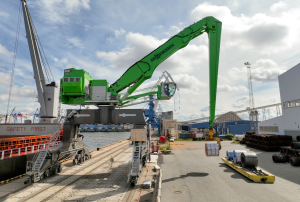
The gap between US HR prices, imports keeps narrowing
The price gap between US hot-rolled coil (HR) and landed offshore product continues to narrow toward parity.


The price gap between US hot-rolled coil (HR) and landed offshore product continues to narrow toward parity.

Catherine Cobden, President and CEO of the Canadian Steel Producers Association (CSPA) called the past year’s 50% tariff imposed on Canada’s steel exports to the US ‘severe and unsustainable.’

AISI's Kevin Dempsey argues USMCA needs stronger rules of origin to strengthen manufacturing.

US steel buyers report firmer domestic demand, but long lead times, rising freight costs, and geopolitical uncertainty continue to cause caution on imports.
Canadian Steel Producers Association President and CEO stepping down July 31.

If an industry suffers from high labor and energy costs, inefficient facilities, or lower productivity, tariffs do not solve those problems. They only mask them, transferring costs from inefficient producers to consumers.

Steel imports could become even more prohibitive, facing even higher tariffs, pending the outcome of the Trump administration’s Section 301 investigation.
Through a tariff carve-out, Tata Steel UK is able to send steel products melted in the Netherlands to the US at the UK’s reduced 25% Section 232 rate.
Two Ontario-based steel importers and their president have agreed to pay $19 million to settle US allegations that they avoided customs duties on flat-rolled steel by falsely declaring its origin, the Department of Justice said.
Trading-company sentiment in the May 15 SMU flat-rolled steel buyers survey shows a market split between anecdotal optimism and numerical decline.

Unsurprisingly, the Trump-Xi Beijing summit ended without a major announcement on trade. Behind the celebratory mood and photo-ops are years of economic harm from China’s predatory trade practices that cannot be overcome in a single meeting.
The Canada-United States-Mexico Agreement (CUSMA) is envied by many as one of the strongest trading partnerships in the world.
US steel exports improved in March but remain historically low, having trended lower for over a year now.

US Commerce Secretary Howard Lutnick said the US should pursue separate, bilateral trade negotiations with Canada and Mexico instead of renewing the US-Mexico-Canada Agreement (USMCA).
Lewis Leibowitz: Recent rulings suggest courts are reinforcing legal limits on tariff authority.

The process to reduce Section 232 steel and aluminum tariffs for producers in Mexico and Canada garnered mixed reactions from steel and metals’ supply chain advocacy groups.

Century Aluminum CEO Jesse Gary said his company could start up its new smelter in Oklahoma ahead of schedule if the permitting process moved more quickly.
Following the historical lows seen in recent months, steel import volumes marginally increased in March and April.
Steel traders continue to report strong interest from North American buyers, with their import orders ticking higher, according to our latest survey results. Many manufacturers and service centers, however, report that they have not yet taken the bait.
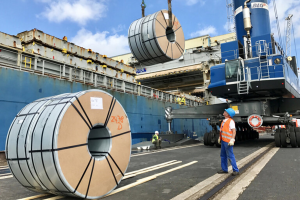
The price gap between US hot-rolled coil (HR) and landed offshore product tightened this week. The dynamic continues even as stateside and import prices diverged a bit vs. the prior week.
USMCA provides strong support for North American competitiveness. US manufacturing has lost considerable capabilities over the last few decades. “Cheating” by other countries is not the only reason. Nor is it even the most important reason
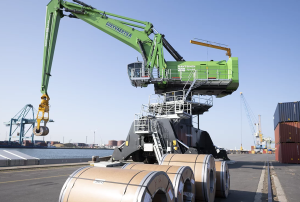
The price gap between US hot-rolled coil (HR) and landed offshore product tightened this week. The dynamic continues as both stateside and offshore prices have largely trended higher.
The Canadian International Trade Tribunal (CITT) determined oil country tubular goods (OCTG) sold by Tenaris S.A. and certain exporters from South Korea, Turkey, and the Philippines are subject to antidumping tariffs.
Dozens of Canadian United Steelworkers (USW) labor union members lobbied federal politicians on Thursday, April 23 in Ottawa.
North American steel buyers are signaling stronger interest in foreign material amid a tight market and rising global substrate costs, which are complicating purchasing decisions.
US steel exports held steady from January to February and remain near historical lows.
Steel imports remain near some of the lowest volumes recorded in over five years.
Military strikes on major aluminum facilities in the United Arab Emirates and Bahrain have introduced a new layer of uncertainty into a market that was already operating with limited flexibility.
Iron ore shipments on the Great Lakes in March were down 23.5% from a year earlier, according to the latest report by Lake Carriers’ Association.
The price gap between US hot-rolled coil (HR) and landed offshore product tightened this week.