
SMU Community Chat: UK trade deal could set template for others
Quotas featured in the UK agreement may show up in future deals.


Quotas featured in the UK agreement may show up in future deals.
Domestic mills are largely negotiable on spot prices, according to the majority of steel buyers responding to our latest market survey.

The Tariff Town amusement park ride shows no signs of slowing down.
All of SMU’s sheet and plate steel price indices declined this week, easing by $30-40 per short ton (st) on average since early May. Prices continue to slide lower as buyers remain on the sidelines, wary of holding much excess inventory and expecting further declines.

The price spread between hot-rolled coil (HRC) and prime scrap narrowed again in May, according to SMU’s most recent pricing data.
Since the US ferrous scrap settlements for May have been finalized, steelmakers are turning their attention to continued pig iron flows with the wind behind their backs.
This is the kind of partnership that stands out. A global trading powerhouse, a sharp and growing recycled metals producer, and a seasoned commercial team are coming together to reshape how recycled aluminum is processed and delivered to customers across the United States.
Domestic mill output continues to grow, with raw steel production rising last week to the highest rate recorded since last September, according to the American Iron and Steel Institute (AISI).

The volume of finished steel entering the US market rebounded in March, according to our analysis of US Department of Commerce and American Iron and Steel Institute (AISI) data.
A Pennsylvania state senator plans to submit legislation to incentivize steelmaking in the state.
Nucor lowered its weekly spot price for hot-rolled (HR) coil for a second straight week, down $10 per short ton (st), after keeping it in a holding pattern for most of April.
Longtime Steel Dynamics Inc. (SDI) executive Glenn Pushis will be retiring from the company to become CEO of Project Aero, a company that plans to build a titanium plant in North Carolina.

Shipments of water heaters, air conditioner/heat pumps, and warm-air furnaces all increased from February to March. Total monthly shipments are now at a seven-month high.
The recently announced US tariffs on vehicles and key components from all markets are expected to significantly disrupt global production.
However, in a month plagued by tariff and economic uncertainty, both current and near-term outlooks for our scrap survey respondents remained surprisingly optimistic.
Here are highlights of what’s happened and a few things to keep an eye on this upcoming week.
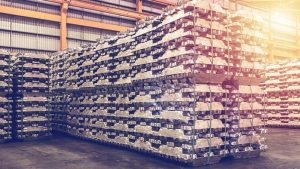
Tariffs, sanctions, and embargoes, oh my! And they’re hitting aluminum just as hard as steel. So join SMU on Wednesday, May 14, at 11 am ET (10 am CT) for a special Community Chat focusing on the impact of Trump’s trade policies on the aluminum market. We’ll bring you expertise from Aluminum Market Update (AMU), an SMU sister publication that’s scheduled to launch this summer.
Oil and gas drilling activity declined again this week in the US and Canada, according to Baker Hughes.
The volume of steel exported from the US marginally increased from February to March, according to the latest US Department of Commerce figures. Although up month over month (m/m), export levels have generally trended downward over the past year.

Cliffs came tantalizing close to buying U.S. Steel in 2023. There were rumors in 2024 that Cliffs might buy NLMK USA before it ultimately purchased Stelco for $2.5 billion in November of last year. Who would have thought that asset sales would have been the focal point of discussion just six months later?
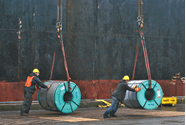
US steel imports rebounded from February to March, rising to the second-highest monthly rate witnessed in the past ten months, according to final data recently released by the US Commerce Department. April license data shows that gain has likely been erased, with trade falling to the lowest rate of the year and several product categories hitting multi-year lows.
SMU polled steel buyers on an array of topics earlier this week, including market prices and demand, tariffs and reshoring, inventories and imports, and evolving market trends.
Steel buyers said Nucor’s price decrease was a public acknowledgement of what most of the market had already known - that sheet prices were moving lower in a more significant way. The question now is whether mills and service centers will manage the decline or whether prices might fall rapidly, they said.

Please take a moment to complete our short survey and share your views on how our prices, methodologies, and definitions can better support your work. Your feedback plays a key role in how we continue to serve you and the wider steel market.
SunCoke Energy posted lower earnings in the first quarter. Meanwhile, the company said it has extended the cokemaking contract for U.S. Steel’s Granite City Works in Illinois through the end of September 2025.
Baosteel exec comments on market rumors of 50 million tons of output being cut this year, less than 0.5% of the 1 billion tons-plus China has produced annually in recent years.
Given the news about tariffs and bringing back industries to the US, a brief look back in time may show how our economy changes with technological advances and the shifting economies of scale.
Raw steel mill output ticked higher last week, now up to the highest weekly rate recorded in over seven months, according to the American Iron and Steel Institute (AISI).
After holding its weekly spot price for hot-rolled (HR) coil steady for three weeks at $930 per short ton (st), Nucor lowered the price this week by $20/st.

We’ve talked about tariffs ad nauseam for much of the year. And I’m afraid this topic isn’t going away anytime soon. There’s a feeling that the tariff “can” will just be kicked down the road again and again, and again.