
HR Futures: Market blues turn bearish
The cautious neutrality and summertime blues we discussed just a few weeks ago have evolved into something decidedly more bearish.


The cautious neutrality and summertime blues we discussed just a few weeks ago have evolved into something decidedly more bearish.
Earlier this week, SMU polled steel buyers on an array of topics, ranging from market prices, demand, and inventories to tariffs, imports, and evolving market events.
ArcelorMittal expects less demand growth across most of the markets it operates in, including the US, because of President Donald Trump’s tariffs. But the Luxembourg-based steelmaker also thinks it stands to benefit from an increasingly regionalized world thanks to investments like the new EAF at its mill in Calvert, Ala.
Latin American steel producer Ternium delivered a solid performance in the second quarter of 2025. Performance was driven primarily by higher realized steel prices in Mexico, even as shipment volumes declined slightly across its regional portfolio.

The Trump administration has exempted Brazilian pig iron and iron ore from an aggressive "reciprocal" tariff ahead of the Aug. 1 deadline.
North American auto assemblies declined in June, down 10.6% vs. May. And, according to GlobalData, assemblies were 3.1% down year on year (y/y).

Sheet prices slipped again this week amid discounting from certain mills and ongoing concerns about demand.

US and European steel trade groups were at odds over their reaction to the recent trade deal President Trump brokered with the EU.

GrafTech International attributed its second-quarter net loss to a non-cash tax expense and lower weighted average realized prices.
Attorneys representing domestic petitioners and foreign respondent companies have been busy filing case briefings and making rebuttals as the corrosion-resistant steel unfair trade investigations begin to wind down.

The Brazilian pig iron community is playing defense ahead of the Aug. 1 deadline for a 50% US tariff on imports from the South American country. The moves indicate the Brazilian producers do expect the tariff to go into effect.

Is this just a severe case of the summer doldrums? Will demand improve in the fall, as it often does? Or has uncertainty around tariffs and the economy created a more lasting impact?

As the president’s August 1 tariff deadline approaches, the “Let’s Make a Deal” game show returns to primetime (the Monty Hall version, of course). As the administration begins rolling out trade deals, we are starting to see what’s behind door number one and who is getting a “zonk.”
Chief executive of the Institute for Supply Management (ISM), Tom Derry highlighted how reactive buying behavior has shifted the market into a quiet demand period. Derry presented ISM data during the weekly SMU community chat.

Drilling activity slowed in the US and increased in Canada last week, according to the latest oil and gas rig count data released by Baker Hughes.
SMU’s Steel Buyers’ Sentiment Indices eased this week, both approaching multi-year lows.
President Trump said a negotiated deal with Canada might not occur, and all existing tariffs, along with those set to take effect soon, will stay in place, according to media reports.
With 30 years of experience at Steel Dynamics, Barry Schneider reflects on the company and the state of the steel industry.
Algoma Steel applied to Canada’s federal Large Enterprise Tariff Loan (LETL) program for $500 million to support its long-term operations.
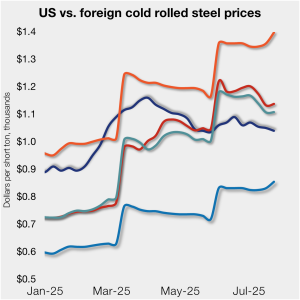
Cold-rolled (CR) coil prices continued to decline in the US this week, while prices in offshore markets ticked higher.
US tariff expansion to stainless material in imported downstream products will not be enough on its own to incentivize capital investment

Is there any clarity to be hoped for on the tariff front?
Steel mill lead times on sheet products contracted across the board this week compared to early July, while plate production times moderately extended, according to steel buyers responding to this week’s market survey.
More than nine out of every ten steel buyers polled by SMU this week reported that mills are negotiable on new order prices. Negotiation rates have increased in each of our last three surveys following the early-June lull, reaching a record high this week.
After a period of backwardation driven by headlines and CRU index anchoring, the CME HRC curve structure has undergone a notable shift.
Hot-rolled (HR) coil prices in the US edged lower again this week but have remained in a tight band for roughly four months. Stateside prices continue to trail imports from Europe, supported by Section 232 steel tariffs that were doubled in early June.
The Architecture Billings Index (ABI), a leading indicator for non-residential construction activity, declined for an eighth straight month in June.
Steel Dynamics Inc. (SDI) executives called a 50% tariff on Brazilian pig iron “concerning,” but think tariffs will be a “mainstay” of trade agreements going forward.
Steel prices continued to decline this week across all of the sheet and plate products tracked by SMU, pressured by short lead times and the typical summer slowdown.
Galvanized steel prices ping-ponged in the $50/hundredweight range during the month of July, settling in at roughly the same position as in June.