SMU price ranges: Sheet indices mixed, plate stable
SMU’s steel price indices were mixed this week as the market seeks direction. All of our indices have fluctuated within relatively narrow ranges across September.
SMU’s steel price indices were steady to higher this week. Each of our sheet indices crept upwards from last week, while our plate index was unchanged.
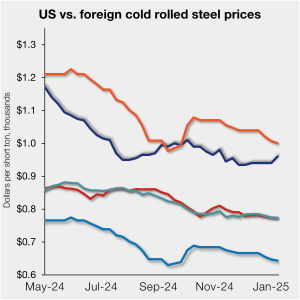
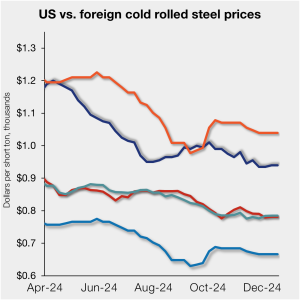
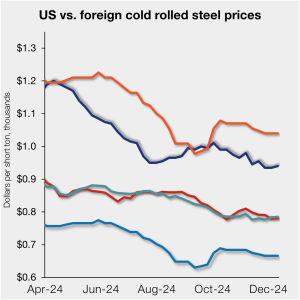
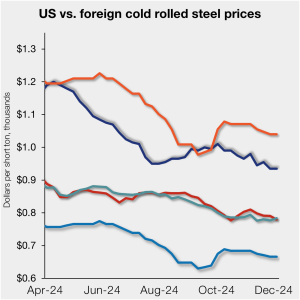
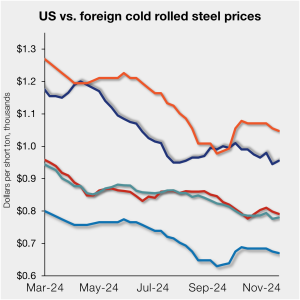
The price gap between US cold-rolled (CR) coil and offshore product is a bit broader this week despite slightly lower tags stateside. The premium is still widening since falling to a 10-month low in late July.
The US plate market finds itself in unfamiliar territory, well maybe unfamiliar territory for this side of the post-Covid “normal,” that is.
Negotiation rates have edged lower from our previous market check, a downward trend witnesses since July.
SMU’s steel price indices showed mixed signals for a second consecutive week. Our hot rolled, cold rolled, and plate price indices inched lower from last week, as the galvanized index held steady and Galvalume's ticked higher.
U.S. Steel has rolled out “ZMAG,” a flat-rolled coated steel product intended to endure harsh weather conditions.
July represents the second-lowest monthly rate for steel imports so far this year.
This month’s column on the markets could be a response to the question of last month, “Are the forward curve prices on Aug. 7 high enough to price in trade case risks?" The market’s answer has been a pretty resounding YES so far, I think.
SMU indices moved higher on cold rolled products this week, while galvanized prices were flat. Our indices for plate, hot rolled, and Galvalume all edged lower.
Current steel mill lead time averages are a few days longer than levels seen one month prior, but remain near historical lows for both sheet and plate products.
Hybar CEO David Stickler and SMU Managing Editor Michael Cowden shared a candid conversation about Hybar's ambitious plans on Tuesday morning at the SMU Steel Summit, held in Atlanta this week.
Swampy. Sticky. Mushy. Murky. These were all words galvanized buyers used this week to describe the current state of the US steel market.
Sheet prices trended sideways to modestly up this week in a market that appears to be in “wait-and-see” mode.
SMU’s sheet prices increased across the board this week, marking the third consecutive week of rising prices, while plate prices held stable.
Flat-rolled steel prices have begun inflecting up on the back of mill prices hikes over the past couple of weeks. It’s a notable shift after tags slid downhill for most of the year. (There was a slight bump upward in late March/early April before the decreases resumed.) And now, after reaching levels not seen since […]
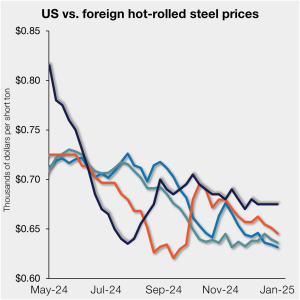
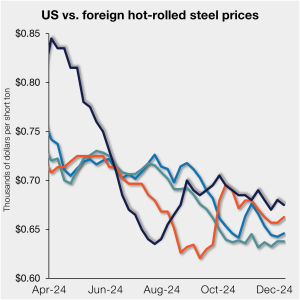
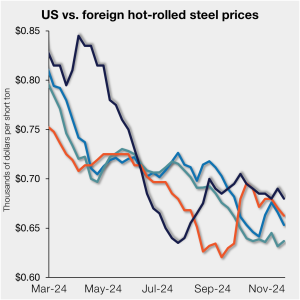
US hot-rolled (HR) coil remains cheaper than offshore material on a landed basis despite domestic tags inflecting upward lately. But the spread between domestic and foreign HR has tightened on the heels of price hikes by US mill over the past two weeks. (Visit SMU’s price increase calendar to keep track of the latest mill price announcements).
The company is in the process of being acquired by Cleveland-Cliffs in a deal valued at USD$2.5 billion.
SMU’s sheet prices rose by an average of $10 per short ton (st) this week on most products, the second consecutive week of recovering prices. Aside from the marginal uptick seen last week, this is the first instance of increasing sheet prices since the first week of April.
Buyers continue to report very short mill lead times on sheet and plate products, according to our latest market canvass of steel service center and manufacturer executives
Ryerson's earnings slumped in the second-quarter on-year but swung to a profit from the first quarter.
Sheet steel buyers continue to report that mills are willing to talk price on new orders, according to our most recent survey data collected this week.
Longs producer and metal recycler CMC plans to open a new rebar fabrication plant in Akron, Ohio.
The US and Mexico announced measures on Wednesday to prevent tariff evasion and protect North America’s steel and aluminum industries.
US sheet prices saw a similar pattern this week, customary for much of the year – new week, lower prices. Domestic tags moved lower this week, aligning with the typically slower summer period – but maybe a further indication of dwindling demand.
First off, we hope everyone had a safe and happy July 4th holiday, with fireworks seen and BBQs attended. Many parts of the country are quite toasty at the moment, signaling that, yes, summer has indeed arrived. And looking at our most recent survey results, the summer doldrums have arrived as well.
Domestic steel shipments increased in May month over month but have fallen on-year.
Sheet steel buyers found mills more willing to negotiate spot pricing this week, according to our most recent survey data.
US sheet prices moved lower again this week, continuing a trend seen since early April. The slowdown aligns with the typical summer doldrums, when lax demand and shorter lead times often take center stage. The current market is also characterized by ample supply and concerns about restocking – especially with few signs of a bottom […]
Low global sheet demand continued to weigh on prices around the world this week. In the US, mills were forced to remain aggressive to secure orders during this period of demand weakness. And compounded by recent new capacity ramp-ups, has forced US hot rolled (HR) coil prices down closer to levels seen in offshore markets. […]