
SMU Price Ranges: Steel prices tick higher, brushing off US-Canada trade tensions
Sheet prices mostly ticked upward again this week on a series of factors long familiar to the market: long lead times, limited spot availability, and solid demand.


Sheet prices mostly ticked upward again this week on a series of factors long familiar to the market: long lead times, limited spot availability, and solid demand.

US raw steel production increased last week, further recovering from the four-month low seen in early August, according to recently published American Iron and Steel Institute (AISI) data. Production has been historically strong for most of this year.

Nucor said on Monday, Aug. 24, that its CSP for hot-rolled coil will be $1,180 per short ton (st) for the week, a $10/st increase from a week earlier.
SMU’s average price for domestic hot rolled (HR) rose to $1,195 per short ton (st) week on week (w/w). In offshore markets, prices saw a more controlled rise.

SMU’s Steel Demand Index saw a negligible decline in growth, slightly behind early August, but remaining in elevated territory, according to mid-to-late August indicators.
SMU’s Mill Order Index (MOI) grew further in July, up for a third straight month. The result came as service center on-order volumes and new order entries accelerated, according to our latest service center inventories data.

CRU: Global finished steel prices have diverged in August, with longs softening while sheet and plate firmed in most regions. Weak construction demand persisted across most longs markets, with the US the notable exception. Higher sheet prices were driven by tightening supply in the US and reduced import attractiveness in Europe, even as APAC sheet prices declined. Plate prices were mostly firmer across APAC, stable to down in Europe, and continued climbing in the US.

Just when things start to feel a little same old, same old in the futures market, that sneaky volatility shows up.
Steel mill lead times remained extended on both sheet and plate products this week, according to buyers responding to our latest market survey. Production times have been historically long for most of the summer, remaining at or near multi-year highs across all of the products we track.

Most steel buyers who responded to our market survey this week reported that mills are holding a firm grip on sheet and plate prices. The share of buyers reporting that mills were negotiable fell to the lowest rate seen in almost five years. Negotiation rates for three sheet products are down to multi-year lows.
Sheet prices and plate prices continued their relentless march higher over the last week as more participants said they were effectively on allocation, especially when it comes to hot-rolled (HR) coil.
Domestic raw steel production rose by 13,000 short tons (st) last week, a marginal recovery from the four-month low set one week prior, according to recently published American Iron and Steel Institute (AISI) figures.

BlueScope’s North American operations posted a sharply stronger 2026 fiscal year, driven by wider spreads at North Star and steady gains across Buildings and Coated Products (BCP).
Algoma Steel Inc. has halted its electric-arc furnace (EAF) in Sault Ste. Marie, Ontario, after an unplanned outage at its Lake Superior Power (LSP) plant.
Nucor said on Monday, Aug. 17, that its consumer spot price (CSP) for hot-rolled (HR) coil will be $1,170 per short ton (st) for the week, a $10/st increase from a week earlier.
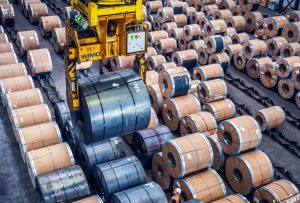
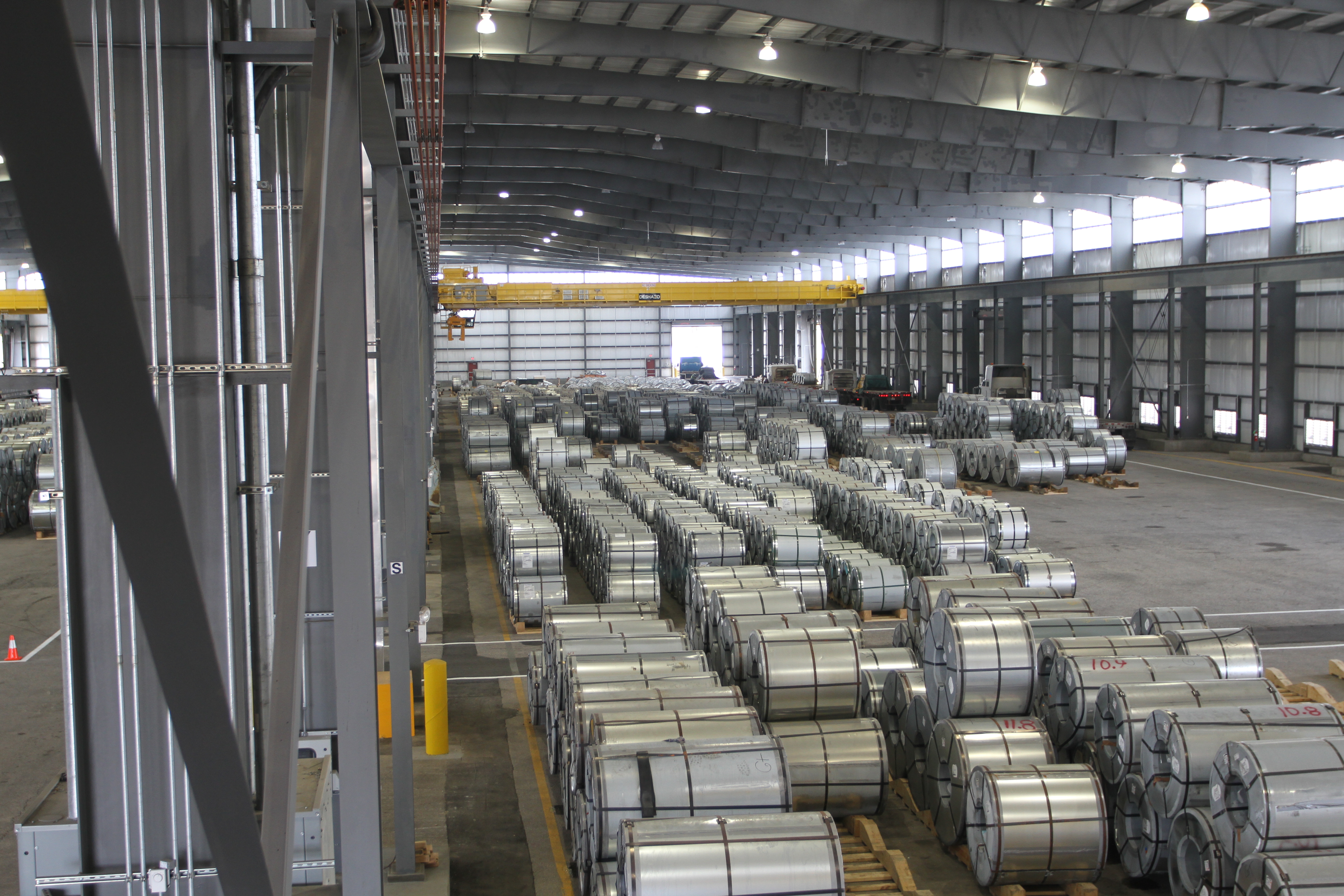
Premium Report: US service centers’ flat-rolled steel supply rose marginally in July, reversing course for the first time all year. Shipping days of supply ticked up to 45.6, according to SMU data. Service center shipments in were more than 4% below intake, noticeably trailing inbound volumes.

Labor contract talks between the United Steelworkers (USW) union and U.S. Steel have made some headway. But the Pittsburgh-based steelmaker and the USW have somewhat different views about how much progress has been made to date.

Total shipments of heating and cooling equipment improved 10% from May to June, according to the latest figures from the Air Conditioning, Heating, and Refrigeration Institute (AHRI). The improved month-on-month (m/m) pace also marks the highest shipment rate of the past two years.
The spread between hot-rolled (HR) and galvanized coil has widened over the last month. As of Tuesday, Aug. 11, the gap stood at $230 per short ton (st), up $30 from $200/st on July 14 and a $10 increase from the prior week’s $220/st. On Aug. 12, 2025, the spread was $145/st.
CRU analysis of trade policy's impact on markets in China, US, Europe, India, and Southeast Asia.
Foreign steel remains sharply competitive, inventory levels are mostly steady, and demand is strengthening, according to SMU's Aug. 7 market survey. But buyers are more selective than earlier in the year, even as pricing momentum continues to push spot levels higher.

Apparent steel supply rose 3% from May to June to the highest rate recorded in over four years, according to recent Department of Commerce and American Iron and Steel Institute (AISI) figures. June’s supply increased to 9.31 million short tons, driven primarily by higher domestic shipments, and partly offset by lower finished imports and increased exports.

The spread between domestic hot-rolled coil and prime scrap prices widened again in August, a trend that began nearly a year ago.
CME Group’s HR coil futures continue to show a near-term price peak, yet prices on the forward curve have increased for not only the balance of 2026, but for 2027 as well.
SMU’s average price for domestic hot rolled was unchanged week on week at $1,180 per short ton. In offshore markets, prices mainly moved up.

Earlier this week, SMU polled steel buyers on an array of topics, ranging from market prices, demand, and inventories to tariffs, imports, and evolving market events. We are sharing a selection of the comments we received below, in each buyer’s own words.
Sheet and plate prices either held their ground or increased this week amid what remains an historically tight spot market.
The amount of raw steel produced by US mills declined last week to the lowest rate recorded in over four months, according to recently released American Iron and Steel Institute (AISI) data. Domestic production has been historically strong for over five months now, recently touching a six-year high.

Canadian steel producers will get new help moving material across the country under a federal freight rebate plan launched on Aug. 10.
US steel exports recovered 7% in June, marking the highest monthly rate recorded since January 2025. Despite the recoveries seen over the last six months, trade has been historically weak for over a year and remains weak compared to 2022-2024 volumes.