Steel market chatter this week
SMU polled steel buyers on a variety of subjects this past week, including purchasing practices, steel sheet prices, scrap, and the future market.


SMU polled steel buyers on a variety of subjects this past week, including purchasing practices, steel sheet prices, scrap, and the future market.
After a brief decline in the price of scrap for the Turkish market, which peaked in December at approximately $424 per metric ton (mt) for HMS 80/20, the market has bottomed at $405/mt on cargoes from Europe.
Steel mill lead times pulled back across the board this week but are still said to be at healthy levels, according to SMU's market survey this week.
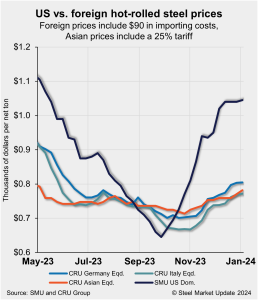
US hot-rolled coil (HRC) prices moved up again this week and remain significantly more expensive than offshore product.
After falling in November, steel imports appear to have bounced back to a five-month high in December.
SMU doesn’t do forecasts. We leave that to our colleagues at CRU. But we’re pretty good at surveys, and we’ve got a great group of readers. That’s why we decided to ask you what’s in store for 2024. The results are below, along with some insightful comments in italics.
The Mexican government has placed anti-subsidy (CVD) duties of almost 80% on cold rolled (CR) sheets from Vietnam, with the caveat that if the importer can prove the steel comes from a country other than China then it is exempt from the levy.
November’s preliminary count shows US imports falling, but to a lesser degree than an earlier license count had suggested, according to the latest government figures.
The tariff rate quotas (TRQ) on steel and aluminum imports from the European Union are being extended for another two years.
We started 2023 with HRC spot pricing around $700 per ton and the third-month future (March ‘23) trading at $800/ton. That same future eventually settled at $1,059/ton - a $259/ton swing. Today, spot pricing is just shy of $1,100/ton for HRC, and the third-month future (March ‘24) settled at $1,091/ton. The clear takeaway: a lot can change over three months. And while future contracts are a valuable tool for hedging, they are a terrible predictor of price.
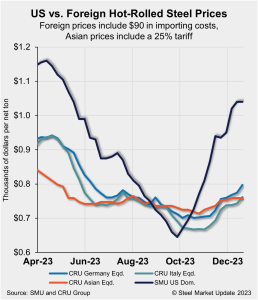
US hot-rolled coil (HRC) prices might have plateaued. But while prices for offshore product have increased in some regions, imports remain significantly cheaper that domestic material. All told, US prices are roughly 26% more expensive than imports, a premium that is down only slightly from last week.
On Monday and Tuesday of this week, SMU polled steel buyers on a variety of subjects, including purchasing practices, steel sheet prices, scrap, and the future market. Rather than summarizing the comments we received, we are sharing some of them in each buyer’s own words.

A World Trade Organization (WTO) dispute panel has ruled in favor of the US in a case regarding retaliatory tariffs imposed by Turkey in response to Section 232 tariffs on steel and aluminum.
Over many years—even centuries—the wisdom and utility of tariffs as an instrument of government policy in peacetime have been debated. That incessant debate continues, and is likely to persist.
Flat Rolled = 54.0 Shipping Days of Supply Plate = 61.7 Shipping Days of Supply Flat Rolled After three months of inventory cuts, US service center flat-rolled steel inventories grew in November as shipments slowed. At the end of November, service centers carried 54 shipping days of flat-rolled steel supply on an adjusted basis, up […]
Thursday felt eerily quiet after a frenzy of steel and financial market news on Wednesday.

A bipartisan group of US senators has written a letter requesting a clear deadline for an export monitoring agreement of Mexican steel products into the US market.
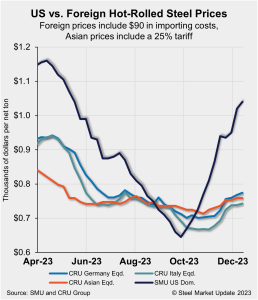
US hot-rolled coil (HRC) prices continued their upward movement this week, distinctly outpacing increases for offshore product once again. Domestic tags are now 27% more expensive than imports - the widest pricing gap in nearly two years.

Most steel markets will be more balanced in 2024, according to the latest sector outlook from Fitch Ratings.
The US Department of Commerce’s International Trade Administration (ITA) has updated the antidumping duties on coated sheet imports from South Korea and Taiwan.
On Monday and Tuesday of this week, SMU polled steel buyers on a variety of subjects, including steel sheet prices, demand, inventory, imports, and what people are talking about in the market. Rather than summarizing the comments we received, we are sharing some of them in each buyer’s own words. We want to hear your […]
US apparent supply increased to 8.11 million net tons in October, up 4% compared to 7.82 million tons in September, according to data from the US Department of Commerce and the American Iron and Steel Institute (AISI).
The International Trade Commission (ITC) made its final injury determination in a sunset review of import duties on circular welded pipe from a handful of countries.
The latest SMU market survey results are now available on our website to all premium members. After logging in at steelmarketupdate.com, visit the pricing and analysis tab and look under the “survey results” section for “latest survey results.” Historical survey results are also available under that selection. If you need help accessing the survey results, […]
A count of November license applications suggests steel imports were at their lowest monthly level in 33 months.
The US presidential elections will take place on Nov. 5, 2024.
We have seen a wave of service center transactions announced since the beginning of the month.
The prices for all grades of pig iron have dramatically risen since SMU’s last report from Nov. 18.
On Dec. 6, US Senator Sheldon Whitehouse (D-RI) reintroduced the Clean Competition Act, an environmental trade directive that would impose charges on imports from more carbon-intensive manufacturers.
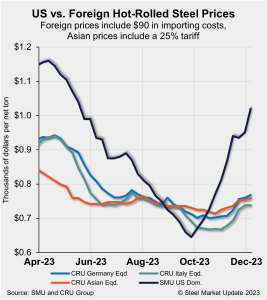
US Hot-rolled coil (HRC) prices keep rising on the heels of continued mill hikes, outpacing increases for offshore product. Domestic tags are now 26% more expensive than imports, the widest pricing gap since January 2022.