CRU: Tariffs set to dampen global auto growth
The recently announced US tariffs on vehicles and key components from all markets are expected to significantly disrupt global production.
Here are highlights of what’s happened and a few things to keep an eye on this upcoming week.
The Mexican government aims to transform Manzanillo into the largest seaport in Latin America, capable of processing some 10 million TEU (20-foot equivalent units) per year by 2030. It is already Mexico's largest port and the third largest in Latin America, handling nearly 4 million 20-foot containers in 2024.
Cliffs came tantalizing close to buying U.S. Steel in 2023. There were rumors in 2024 that Cliffs might buy NLMK USA before it ultimately purchased Stelco for $2.5 billion in November of last year. Who would have thought that asset sales would have been the focal point of discussion just six months later?
The US and UK governments have announced a trade deal in which an “alternative” to the Section 232 steel and aluminum tariffs will be provided.
Meanwhile, its Canadian operations have been hurt by the broader tariffs proposed by the United States.
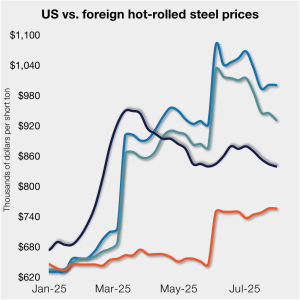
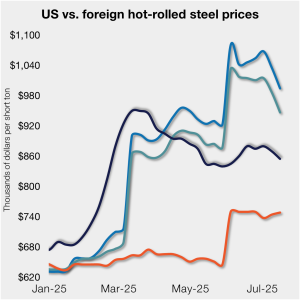
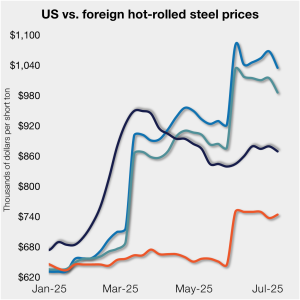
Domestic hot-rolled (HR) coil prices moved lower this week, now down six of the last seven weeks. Recent price erosion has been seen in offshore markets, keeping the price gap between imports and domestic products largely flat week on week (w/w).
SMU polled steel buyers on an array of topics earlier this week, including market prices and demand, tariffs and reshoring, inventories and imports, and evolving market trends.
Mercedes-Benz is planning to move production of a “core segment vehicle” to Tuscaloosa, Ala., by 2027.
US Sen. Jim Banks (R-Ohio) and Rep. Frank Mrvan (D-Ind.) have written a letter in support of a “domestically owned and operated American steel industry” being vital to national security.
Baosteel exec comments on market rumors of 50 million tons of output being cut this year, less than 0.5% of the 1 billion tons-plus China has produced annually in recent years.
Given the news about tariffs and bringing back industries to the US, a brief look back in time may show how our economy changes with technological advances and the shifting economies of scale.
AMU’s Greg Wittbecker, an aluminum industry veteran, will address not only US tariffs but also evolving trade routes - and how supply chains are (or aren’t) adjusting. He’ll also touch on broader industrial impacts, from auto layoffs to the potential ripple effect of maritime tax policies.
We’ve talked about tariffs ad nauseam for much of the year. And I’m afraid this topic isn’t going away anytime soon. There’s a feeling that the tariff “can” will just be kicked down the road again and again, and again.
The tariffs are intended to produce more investment and jobs in US manufacturing. But first, there will be a cosmic change, potentially wiping out millions of jobs in the short run. While administration officials will no doubt cringe at the comparison, it reminds me of the effort to undercut fossil fuels production to address climate change. Led by Democrats, the effort was to destroy fossil fuels so that renewable energy sources would have more space to grow. The result: inflation and electoral defeat in 2024.
The US Commerce Department has set up an “inclusions process” to add derivative aluminum and steel articles within the scope of the new Section 232 tariffs.
With so much happening in the news cycle, we want to make it easier. Here are highlights of what’s happened and a few things to keep an eye on this upcoming week.
Brent Wilson talks about the different takes on President Trump's tariffs in Europe and the US.
Containers sailing from China in April are down 15%-20% and Hapag Lloyd says their future bookings transpacific are down 30%.
Can technology help with pig iron and DRI/HBI tariffs?
Activity had trended up for most of Q1
The facility at AMNS Calvert will be the first EAF in North America capable of supplying exposed automotive grades with domestically melted and poured material.
Nucor’s top exec Leon Topalian said the benefit of the current administration’s aggressive trade policies “trumps” any risk of potentially higher raw materials prices.
It's just the latest change for US trade policy
But profits slipped vs. last year.
President Trump cast a wide net with the proposed, reciprocal tariffs. The negotiating stage will be critical to determining the success of his strategy. And for those suffering tariff whiplash, don’t expect the pace of change to slow down just because the reciprocal tariffs are entering a negotiating phase.
Bilstein Cold Rolled Steel LLC CEO Brent Wilson will be the featured speaker on the next SMU Community Chat webinar on Wednesday, April 30, at 11 am ET. You can register here. Reminder: The live webinar is free to attend. A recording will be available only to SMU subscribers. About Bilstein and Wilson Bilstein Cold […]
The constant flow of information we all receive can be a bit overwhelming, but SMU is here to help with a weekly snapshot.
Chinese export prices for longs were almost steady this week, while those for flats generally declined as producers cut prices to secure deals.
Steel Dynamics' top exec thinks Trump’s tariff policies, as well as the results from the recent CORE case, will prove advantageous to the Fort Wayne, Ind.-based steelmaker and aluminum company.