Final Thoughts
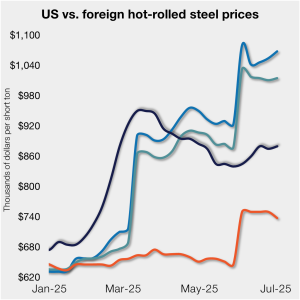
Tariff-related noise aside, there is one basic factor keeping buyers on the sidelines. Despite recent declines, HR prices remain at historically high levels. And there is no obvious support to keep them there.
Most sheet and plate steel prices declined yet again this week, with four of SMU’s five indices moving lower.
If you’re looking to build a solid foundation in steel or sharpen the knowledge you already have, the SMU Steel 101 Workshop is a great place to start. Our next workshop will be held in Memphis, Tenn. on June 10-11, 2025
US steel mills produced more raw steel last week than they have over the past seven months, according to the American Iron and Steel Institute.
Nucor’s weekly consumer spot price (CSP) for hot-rolled (HR) coil remained unchanged this week.
United Airlines raised eyebrows earlier this month when it provided two forecasts for 2025 – one assuming a relatively stable economy and another assuming a recession. The reason? Uncertainty around the impact of President Trump’s policy shocks on the broader economy. And it sometimes feels like we’re seeing a battle between those two narratives (stable vs recession) play out within in the pages of this newsletter.
The constant flow of information we all receive can be a bit overwhelming, but SMU is here to help with a weekly snapshot.
Chinese export prices for longs were almost steady this week, while those for flats generally declined as producers cut prices to secure deals.
Global raw steel production increased in March, according to the latest figures released by the World Steel Association (worldsteel).
Container shipping lines have sharply increased blank sailings on Transpacific routes in response to escalating trade tensions between the US and China.
Despite some scary headlines lately (especially about Trump potentially firing Fed Chair Jerome Powell) this is not October 2008 (financial crisis) or March 2020 (onset of the pandemic). But it sure seems like we’ve taken a relatively strong economy and poured a thick sauce of uncertainty over it.
Chinese steel export prices are expected to remain stable or fall in the coming weeks as trade restrictions rise and tensions between the country and the US escalate.
Recent Federal Reserve data paints a positive picture of the US manufacturing sector. Manufacturing indicators remained strong through February and March figures
Earlier this week, SMU polled steel buyers on an array of topics, ranging from market prices, demand, and inventories to tariffs, imports, and evolving market events.
I put some of our survey data through ChatGpt, with interesting results.
SMU’s flat-rolled steel prices were flat or lower as tariff-related uncertainty continued to drag on the market.
The pig iron markets have been quiet for the last several weeks, as tariff implementation on imports into the US became a reality. There has been debate on which party will have to pay the tariff. A recent transaction could provide the answer to that question.
Representatives from bulk commodity shippers and consumer goods argued against the fees, saying it could cripple supply chains because of the very dominance that China has in the existing shipping fleet.
US domestic sheet price gains have begun to slow as previously pulled-forward demand has led to a decline in orders.
Nearly 50% of respondents to our latest survey thought hot-rolled coil prices have already peaked. And where will those prices be two months from now? Responses were decidedly split on that question.
In this Premium analysis we examine North American oil and natural gas prices, drill rig activity, and crude oil stocks. Trends in energy prices and rig counts serve as leading indicators for oil country tubular goods (OCTG) and line pipe demand.
Meanwhile, an increasing number think it's too early to say whether the penalties are going to bring more manufacturing to the US.
Steel buyers responding to this week’s SMU market survey report a continued softening in sheet lead times. Meanwhile, plate lead times have moderately extended and are at a one-year high.
Operational results painted a picture of a company that produced more aluminum but shipped less of it as a result of tariffs and timing mismatches.
Steel Market Update will be taking time off in observance of Good Friday and Easter.
Iron ore prices were largely steady in March, hovering around $100–102 per dry metric ton (dmt) in a quiet market.
Nearly half of the steel buyers responding to this week’s SMU market survey say domestic mills are showing increased willingness to negotiate pricing on new spot orders. This marks a significant shift from the firmer stance mills held in prior weeks.
Current Sentiment Index dropped six points to +42 this week compared to two weeks earlier. It has fallen in every successive survey since reaching a 2025 high of +66 on Feb. 19.
A modest week-to-week change in HR price understates a huge swing in expectations.
Steel prices slipped again this week, with all five of SMU’s sheet and plate indices trending lower for the second week in a row.