Nucor weekly HR price not intended to compete with indices
Nucor said its new weekly hot-rolled coil spot price is not meant as a substitute for any current price indices.


Nucor said its new weekly hot-rolled coil spot price is not meant as a substitute for any current price indices.
Nucor said its spot hot-rolled (HR) coil price this week will be $830 per short ton (st).
April scrap prices came in sideways in the US, sources told SMU.

It has been six weeks since Flack Global Metals wrote our last SMU column, and if you simply look at the futures curve from then (blue) until now (white), you could argue that very little has changed.

Low manufacturing activity and higher interest rates took a toll on Radius Recycling’s profits during the Oregon-based company’s most recent quarter. Radius reported a net loss of $34 million, or $1.19 per share, during its fiscal second quarter. In the previous quarter, Radius saw a net loss of $18 million, or 64 cents per share.
Nucor plans to publish a weekly spot price for hot-rolled (HR) coil beginning on Monday, April 8, according to a press release and letters to customers. The Charlotte, N.C.-based steelmaker said its published HR price would be derived from “both quantitative and qualitative data” in the letter to customers on Thursday, April 4.
Several large buyers in the North came into the market on a sideways basis from prices paid in March. The development comes after recent speculation about what prices US-based steelmakers would pay for scrap for April shipments.
On the eve of the April ferrous scrap buy, there is no firm consensus on the market’s direction. The safe predictions are “soft” sideways to “strong” sideways. That may mean down $10 per gross ton (gt) to up $10/gt.

Jack Marshall, a beloved member of the Crunch Risk team, has decided to retire. Jack started his career on the CME floor in 1983, working as a clerk. He then became part of the Chicago origination/trading team in forex at Bank of America, where he worked for 23 years.
There is growing hope that the US scrap market has bottomed, according to industry sources. The steep price declines in March may have ushered in a floor because dealers say their stocks are a bit depleted. Their concern: that the flow of obsoletes could be cut severely with any further drop in prices. Is this wishful thinking, or do the fundamentals support the prediction of a market bottom? Let’s take a look!
Nucor intends to keep plate prices unchanged with the open of its May order book, according to a letter to customers dated Thursday, March 28. The Charlotte, N.C.-based steelmaker said the announcement would be effective with new orders received on Friday, March 29.
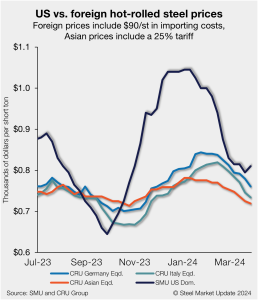
US hot-rolled coil and offshore hot band moved further away from parity this week as stateside prices have begun to move higher in response to mill increases.
Numerous mid-sized export yards in California and in Baja Mexico had little to no inventory on the ground last week because most had sold forward in the falling March market. Looking to secure their margins, they dropped prices across the scale. That resulted in lower-than-normal flows. “I’m sold out through mid-April and even longer if the flow doesn’t pick up” one yard owner said. That turned out to be the position of numerous West Coast suppliers.
Galvanized buyers reported solid demand and balanced inventories this week and were anticipating the sheet price increase announced by Cleveland-Cliffs on Wednesday.

Sheet prices reversed course and moved higher this week, while plate priced remained flat, according to our latest canvas of the market.
Prices for pig iron in Brazil have increased despite efforts by US-based buyers to lower them.
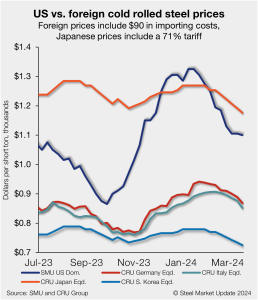
Foreign cold-rolled (CR) coil remains notably less expensive than domestic product even with repeated tag declines across all regions, according to SMU’s latest check of the market.
As the month of March goes into the second half, the scrap community is trying to cope with the large drop in ferrous scrap earlier this month.
2024 started with a $200 per short ton (st), one-week demon drop in the CME Midwest hot-rolled (HR) coil futures. Then, HR futures consolidated in the low $800s/st with the April future trading to as low as $770/st as the curve shifted into contango or upward sloping. A big move was expected, and a big […]
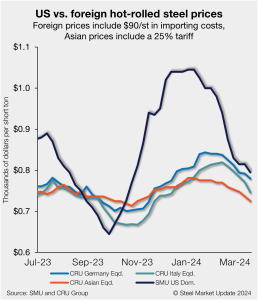
US hot-rolled coil (HRC) remains more expensive than offshore hot band but continues to move closer to parity as prices decline further. The premium domestic product had over imports for roughly five months now remains near parity as tags abroad and stateside inch down.
Sheet and plate prices mostly moved lower this week after little change was noted the week prior. Despite edging down, sentiment is mixed, and many suggest a bottom may be near.
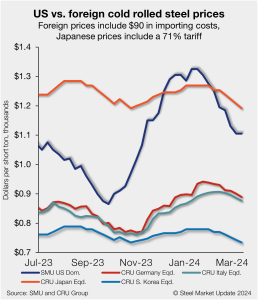
Foreign cold-rolled coil (CR) remains significantly less expensive than domestic product even as US tags continue to decline in a hurry, according to SMU’s latest check of the market.
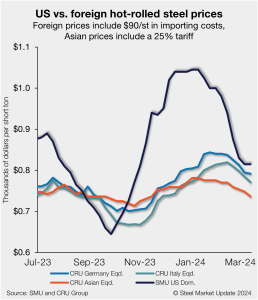
US hot-rolled coil (HRC) remains more expensive than offshore hot band, even as domestic prices remain under pressure. The premium domestic product had over imports for roughly five months now remains near parity as tags abroad and stateside inch down.
The spread between hot-rolled coil (HRC) and prime scrap prices has narrowed for the third consecutive month in March, according to SMU’s most recent pricing data.
The ferrous scrap market experienced a sharp decline for March shipments. Prime scrap fell $60-70 per gross ton (gt) while shredded and other obsolete grades declined $40-50/gt. It seems these prices were accepted in the trade by dealers across the continent.

Sheet and plate prices were mostly flat this week – largely in response to the mill price blitz from last week – pausing the downtrend they’d been on for the better part of 2024.
US ferrous scrap prices fell steeply in March for HMS, shredded, and prime scrap, sources told SMU.
As I see it, the market looked to be a perfect storm for consumers this month while two large steel mills tried to put a floor on hot-rolled coil (HRC). One source speculated that “flat rolled mills coordinated their downtime and will take out 250,000 tons of capacity in April,” which made them attempt to put a bottom on flat-rolled product.
A weak start for sheet demand this year has continued to weigh on global prices. European demand outside of the renewable energy sector was weak enough that market participants said mills are likely to cut output further after several furnace restarts earlier in the year. In China, demand has also failed to pick up after recent holidays, and even government announcements of more stimulus measures during the country’s “Two Sessions” meetings failed to boost market confidence.
ArcelorMittal is targeting a minimum base price for hot-rolled (HR) coil of $825 per ton. The Luxembourg-based steelmaker said the new floor price was effective immediately in a letter to its commercial team dated Friday, March 8.