• Skip to main content

    Prices

    HRC futures: Still waiting for clarity

    Written by Daniel Doderer


    “One thing we know for certain, however, is that when we write our next column, things will have certainly shaken loose.” – Daniel Doderer, April 4, 2024

    Above is a good reminder that whenever someone is “certain” of anything, you should probably look at that line of thinking with a healthy dose of skepticism. So, what has transpired since our last column? To put it plainly, things have not “shaken loose,” and that is likely in large part due to the uncertainty around how the Nucor weekly price will impact near-term spot buying going forward. At this point it is far too early to have any certainty, but Monday will be an interesting stress test.

    The chart below shows the forward curve from four weeks ago (blue) and today (white).
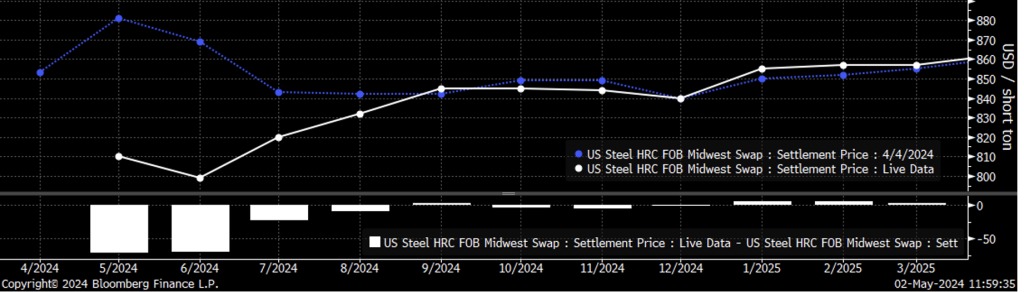
    The overall takeaway, much like in the month prior, is that the front of the curve is where the action is. While it is not a new phenomenon, it should be noted with interest that the back of the curve continues to hold well above $800, which suggests that a new long-term expected average is being established.

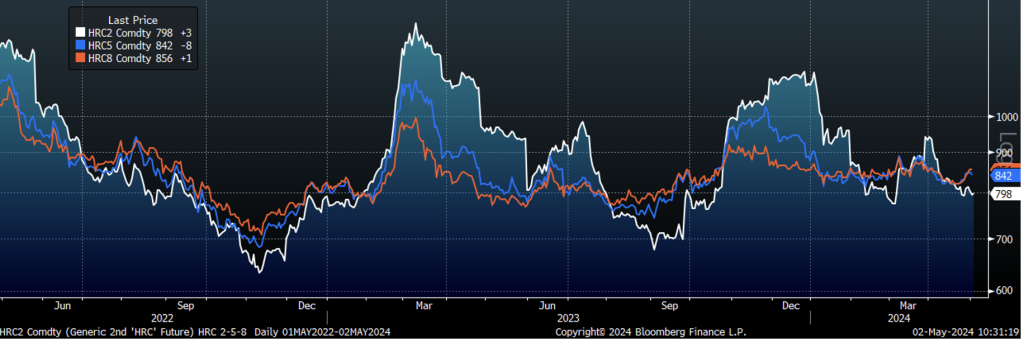
    The chart below is another way to think about the overall curve shape over time, but it takes a little more effort. The white line is the rolling second-month future, the blue line is the fifth-month future, and the orange line is the eighth-month future. Each can be thought of roughly as the front, middle, and back of the futures curve, respectively.

    Here we see that the curve is once again back in contango (front of the curve trading below the back), which suggests there is a moderate surplus of material available in the market, resulting in a drag on spot prices. In this case, a major contributor is the fact that import arrivals are currently at their highest level in nearly two years. Another reason I pulled this chart in conjunction with the forward curve above, is to remind readers that any singular snapshot of the futures curve is a poor predictor of spot pricing due to reevaluations of risks. The market in Q4 will undoubtedly be impacted by something entirely unforeseen from today’s perspective. However, over that time supply-and-demand dynamics will cut through that noise and provide an underlying signal.
    Finally, the chart below is managed money net contracts in white, with long (blue) and short (red) positioning broken out. The data is as of April 23, the most recent report, and we look at managed money because it is the best stand-in for speculative positioning – these are the firms that are furthest away from the physical market.
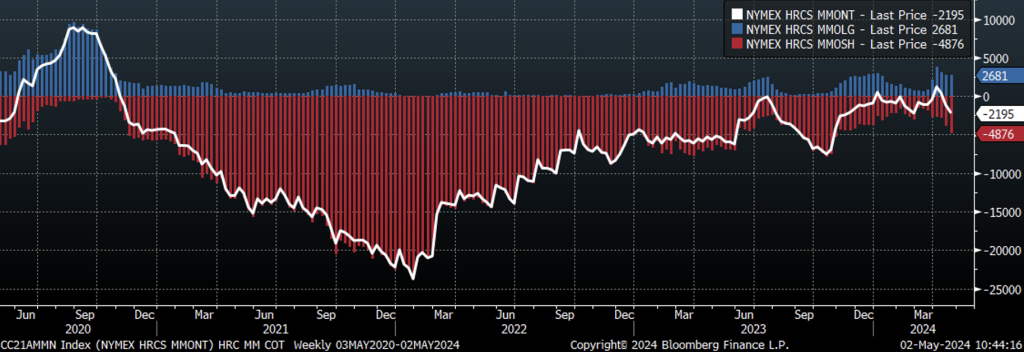
    A few takeaways here:

    1. “Short” firms are positioned as short as they have been since the end of September last year.
    2. “Long” firms continue to hold some of the longest positions of the last three years. However, they peaked in the first week of April, and are starting to sell out of them.
    3. The overall net position is just shy of being as short as it was leading up to February/March when futures had their short-lived mini rally.

    So, what is the difference between February and today? For one, seasonal maintenance is largely in the rearview mirror, but so is the expected lion-share of the surge in import arrivals. Another difference is that both BOF and EAF mill costs are lower now. Still another important factor to consider is that the demand outlook is improving, as the manufacturing sector recently started moving off low levels seen in 2023.

    Disclaimer: The content of this article is for informational purposes only. The views in this article do not represent financial services or advice. Any opinion expressed by Flack Global Metals or Flack Metal Bank should not be treated as a specific inducement to make a particular investment or follow a particular strategy, but only as an expression of his opinion. Views and forecasts expressed are as of date indicated, are subject to change without notice, may not come to be and do not represent a recommendation or offer of any particular security, strategy or investment. Strategies mentioned may not be suitable for you. You must make an independent decision regarding investments or strategies mentioned in this article. It is recommended you consider your own particular circumstances and seek the advice from a financial professional before taking action in financial markets.


    Daniel Doderer

    Read more from Daniel Doderer

    Latest in Prices

    Steel market chatter this week

    Steel market chatter this week Earlier this week, SMU polled steel buyers on an array of topics, ranging from market prices, demand, and inventories to tariffs, imports, and evolving market events. We are sharing a selection of the comments we received below, in each buyer’s own words. Before diving in, we reviewed all of the responses collected and compiled these key takeaways: • Most buyers continue to expect higher prices in the near future and report that demand is stable to improving. • Inventories are moving faster than they were this time last year for most respondents, attributed to limited availability and leaner supply chains. • Imports are attractive for many buyers on both price and availability, though quotas, long lead times, and quality concerns continue to limit their appeal. • Buyers were split on whether tariff policies are helping their businesses, while a slight majority reported some evidence of manufacturing reshoring, though many said it is still too early to tell. Want to share your thoughts? Contact david@steelmarketupdate.com to be included in our market questionnaires. How do you expect prices to trend over the next three months? “I expect prices to rise at a fairly rapid pace for at least the next two to three months because inventories will continue to decrease.” “Upward, capacity remains tight.” “Climbing for several months.” “Trending toward $1,300/st HRC, only because one small player is driving prices up with no one else selling spot.” “Higher, the Q1 bump is not showing in the futures market.” “We expect things to keep going up from here. Next year could get ugly, but we're not there yet.” “Still trending up. There are some soft spots getting softer, but still steady demand and a shortage of supply.” “Continue to rise slowly.” “Slow increases like they have been doing.” “Upward due to continued demand and mill maintenance outages.” “Will remain high but steady due to demand and tariff implications.” “Plate prices most likely will be flat to up over the next three months.” Is demand improving, declining or stable? “Demand is stable (if anything, overstated), with inventories so lean, late mill deliveries, and contract prices increasing next year.” “Demand is fairly consistent with the rest of the year.” “Stable, but very strong for our products.” “Stable as many projects are trying to get ahead of potential additional price increases.” “Stable due to the ‘slow season’ in our market.” “Plate demand is stable to improving.” “Demand is good to improving. We'll take it!” “Improving, but still not to 100% capacity.” Is inventory moving faster or slower than this time last year? “Faster... once it arrives (late), it goes right back out.” “Faster due to lack of availability and bullwhip buying.” “Inventory is moving faster this year than last because demand is stronger than last year and many of our competitors don't have as much steel to offer.” “Inventory is moving faster with supply chains so lean.” “Inventory is moving at a good clip. Just based on costs/spends, we're stocking less sheet, coil and plate though.” “Plate inventory is moving at a much faster pace year over year due to several factors.” “Faster due to a shortage of supply plus added demand.” “About the same.” Are President Trump's tariff policies helping your business? Buyers were split this week, with 44% believing the tariffs are helping their business and 44% saying they are not. The remaining 11% were unsure how the policies will impact them. Comments included: “Yes for now. Prices are very high, which causes people to buy before prices get higher.” “Yes, I credit Trump's policies and data centers for improving demand.” “Yes, inventory values continue to go up.” “They are helping on the sell side and hurting on the buy side.” “No, they are creating shortages and increasing the cost of steel.” Are you seeing evidence of manufacturing reshoring to the US because of Trump's tariffs? The slight majority of respondents (39%) reported they have seen some evidence of reshoring, a higher rate compared to recent surveys. A third said it is too early to say, and 28% answered they are not seeing any signs of reshoring. Comments included: “Yes. Perhaps reshoring has added to the increased demand in 2026.” “Yes, with machining and turning.” “Yes, capacity versus demand in North America is creating pressure to reshore products.” “Too early to say. There have been a lot of announcements, but steel availability has limited immediate moves.” Are imports more attractive than domestic material? “Imports are more attractive on a pricing front and an availability standpoint, but lead times are extended.” “Imports are attractive in both price and because they offer additional availability. Whether or not they show up and or as offered is another issue.” “Imports are certainly attractive. They're coming in in earnest, so this run will peter out early next year.” “Attractive due to price and availability.” “Attractive, domestic tons are unavailable.” “Yes on light gauge painted.” “Without quotas, yes, the price is more attractive. But if you get caught with the quota, pricing is very high.” “Not to us, but we are hearing more about affordable imports.” “Plate imports are only slightly more attractive than domestically produced plate.” “Not yet, shipping lag is still too large.” “No due to tariffs.” What's something that's going on in the market that nobody is talking about? “What is the latest on SDI/BlueScope? I had heard it was back on the ‘front burner’ but all is quiet now. Maybe that means a deal is getting close?” “Will the US bring a trade case against South Korea over imports spiking?” “Busheling scrap prices are flat, while hot roll continues to rise. The scrap gap is increasing.” “How will the next administration handle tariffs that have so limited our steel supply?” “Mill discipline in production capacity.” “Coke pricing levels due to demand and supply.” “Shipbuilding.”