Final thoughts
To the surprise of few if any, prices are in a holding pattern – a trend not seen since late December. The pause comes largely in response to a pricing notice blitz from mills late last week.
Steel mill lead times were flat to slightly up, according to our market survey this week.
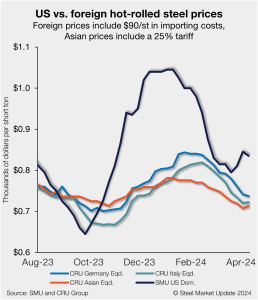
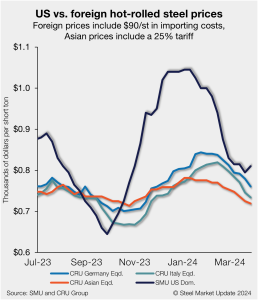
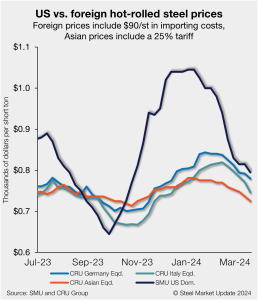
US hot-rolled coil (HRC) remains more expensive than offshore hot band, even as domestic prices remain under pressure. The premium domestic product had over imports for roughly five months now remains near parity as tags abroad and stateside inch down.
Sheet and plate prices were mostly flat this week – largely in response to the mill price blitz from last week – pausing the downtrend they’d been on for the better part of 2024.
A weak start for sheet demand this year has continued to weigh on global prices. European demand outside of the renewable energy sector was weak enough that market participants said mills are likely to cut output further after several furnace restarts earlier in the year. In China, demand has also failed to pick up after recent holidays, and even government announcements of more stimulus measures during the country’s “Two Sessions” meetings failed to boost market confidence.
The US plate market has been largely quiet over the past week since Nucor’s $90-per-ton price cut at the close of February.
A Detroit-area mill entered the scrap market on Thursday offering down $70 per gross ton (gt) on #1 busheling. And Nucor announced a minimum base price of $825 per short ton (st) for hot-rolled (HR) coil. What's the best way to interpret would could be read as contradictory trends?
US hot-rolled coil (HRC) is now just about 5% more expensive than offshore hot band. The premium domestic product had over imports for roughly five months is all but gone, and nearing parity.
What are folks in the steel industry talking about at present? Respondents to SMU’s mini-survey this week shared some of their thoughts with us about what's going on in the market. Rather than summarizing their responses, here’s some of what they had to say in their own words.
Flat-rolled steel prices have been running downhill in a hurry since the beginning of the year. In some ways, it's no surprise because other indicators have also been pointing lower for some time. Lead times have been contracting since the beginning of the year and are now below the five-week mark for hot-rolled (HR) coil for the first time since September. Mills are more willing to negotiate lower prices, and early reports seem to indicate that scrap might settle lower again in March.
Sheet and plate prices this week continued the downward trend they’ve been on for most of 2024. Some market sources predicted that a wave of spring maintenance outages would help to stabilize lead times and prices in the weeks ahead – especially should service center inventories, high at the beginning of the year, come down meaningfully.
Steel prices continued to ease lower throughout February, following a loss of upwards momentum in the middle of January.
A clear consensus has emerged among respondents to SMU’s latest steel market survey that hot-rolled (HR) coil prices will bottom this month or in April. Seventy-five percent of respondents to our latest survey think that prices will find a floor before May as the chart below shows:
The latest SMU market survey results are now available on our website to all premium members. After logging in at steelmarketupdate.com, visit the pricing and analysis tab and look under the “survey results” section for “latest survey results.” Historical survey results are also available under that selection. If you need help accessing the survey results, […]
The premium US hot-rolled coil (HRC) held over offshore product for roughly five months has nearly vanished. Domestic hot band prices continue to run downhill at a high rate, erasing a $300/st gap they had over imported HRC just two months ago.
Steel mill lead times shrunk by an average of 0.3 weeks, according to our latest market survey, now nearing levels last seen in September of last year.
US hot-rolled (HR) coil prices have fallen further this week, working their way to $800 per short ton (st) on average – a mark not seen since late October.
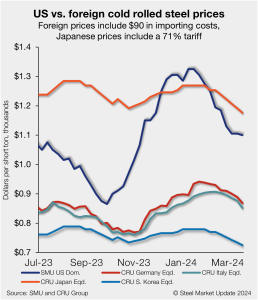
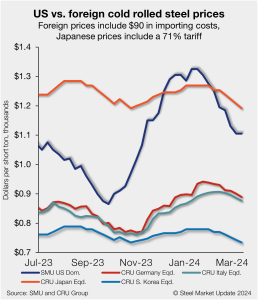
Foreign cold-rolled coil (CR) remains much less expensive than domestic product even as prices in the US have declined at a rapid pace over the past month, according to SMU’s latest check of the market.
Falling US sheet prices have reduced the attractiveness of hot-rolled (HR) coil imports as domestic mills price competitively to secure limited business. However, tightness in the CR coil market has extended delivery to June or July in some cases, and buyers may consider to import given competitive prices and arrival times.
Domestic prices have been sliding since the beginning of the year, and I don’t see any obvious reasons why the slide might stop this week. But let’s put the timing of a bottom aside for a minute. The question among some of you seems to be whether we’ll see another price spike, or at least a “dead-cat bounce,” before the typical summer doldrums kick in.
At SMU, our goal is not to tell you what to think but to keep the conversation going. We asked you in our survey this week what you were seeing when it comes to steel prices, demand, imports, and wildcards. In your own words, with minimal editing, here’s what some of you in the SMU community shared with us this week.
I’ve had discussions with some of you lately about where and when sheet prices might bottom. Some of you say that hot-rolled (HR) coil prices won’t fall below $800 per short ton (st). Others tell me that bigger buyers aren’t interested unless they can get something that starts with a six. Obviously a lot depends on whether we're talking 50 tons or 50,000 tons. I've even gotten some guff about how the drop in US prices is happening only because we’re talking about it happening.
Over my years of observing the steel market, there's been a recurring belief that current market disruptions in either the physical spot market or steel futures are temporary anomalies, destined to fade, and that normalcy will soon return. However, the events of the first few weeks of 2024 served as a stark reminder that this expectation seldom materializes, and that the US steel market is still the most volatile steel market in the world.
Canada will soon require steel imports to report “country of melt and pour” information.
The premium US hot-rolled coil (HRC) held over offshore product is disappearing in a hurry. Domestic hot band prices continue to fall at a fast clip, erasing a nearly $300/st gap they had over imported HRC just two months ago. All told, US HRC prices are now 8.8% more expensive than imports. The premium is […]
Steel Market Update’s Steel Demand Index has moved lower, having remained in contraction territory for the better part of the past two months, according to our latest survey data.
We’ve all heard a lot about mill “discipline” following a wave of consolidation over the last few years. That discipline is often evident when prices are rising, less so when they are falling. I remember hearing earlier this year that mills weren’t going to let hot-rolled (HR) coil prices fall below $1,000 per short ton (st). Then not below $900/st. Now, some of you tell me that HR prices in the mid/high-$800s are the “1-800 price” – widely available to regular spot buyers. So what comes next, and will mills “hold the line” in the $800s?
US hot-rolled (HR) coil prices have fallen below $900 per short ton (st) on average for the first time since early November. SMU’s HR price stands at $875/st on average, down $65/st from a week ago and down $170/st from the beginning of the year.
What's the steel market talking about at present?
The latest SMU market survey results are now available on our website to all premium members. After logging in at steelmarketupdate.com, visit the pricing and analysis tab and look under the “survey results” section for “latest survey results.” Historical survey results are also available under that selection. If you need help accessing the survey results, […]